
Close Menu
    Facebook X (Twitter) Instagram
    SciTechDaily
    • Biology
    • Chemistry
    • Earth
    • Health
    • Physics
    • Science
    • Space
    • Technology
    Facebook X (Twitter) Pinterest YouTube RSS
    SciTechDaily
    Home»Space»Hitch a Virtual Ride on a NASA Sounding Rocket – View Earth From 98 Miles Up
    Space

    Hitch a Virtual Ride on a NASA Sounding Rocket – View Earth From 98 Miles Up

    By Keith Koehler, NASA Wallops Flight FacilityDecember 20, 2021No Comments2 Mins Read
    Facebook Twitter Pinterest Telegram LinkedIn WhatsApp Email Reddit
    Share
    Facebook Twitter LinkedIn Pinterest Telegram Email Reddit
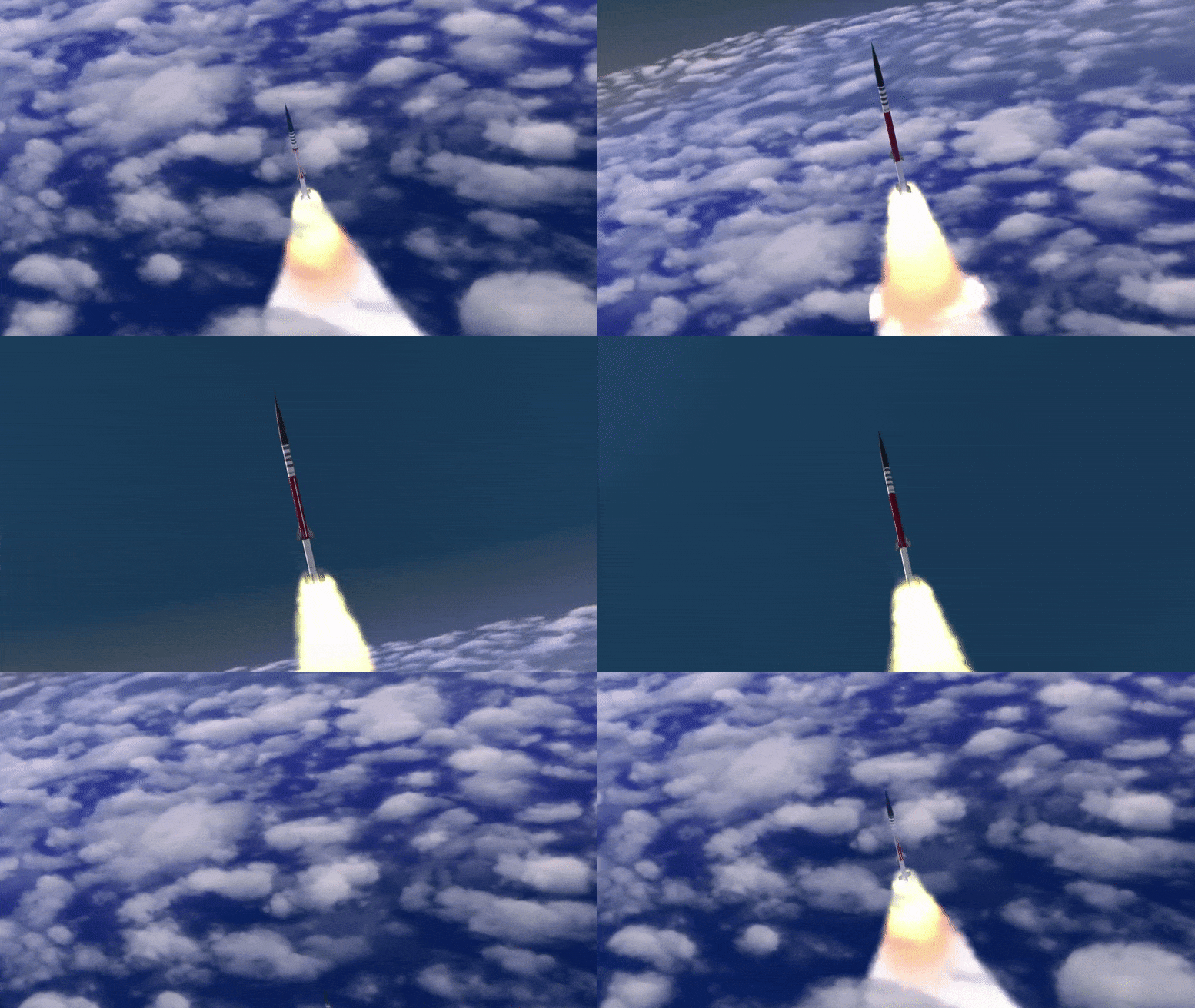
    NASA Terrier Improved Malemute Rocket Animation
    NASA Terrier-Improved Malemute Rocket. Credit: NASA/Goddard Space Flight Center/CI Lab

    A project developed by community college students is providing the opportunity for the public to see Earth from the perspective of a small rocket in flight.

    What does Earth look like from 98 miles (158 kilometers) up? A project developed by Colorado community college students is providing the opportunity for the public to see Earth from the perspective of a small rocket in flight.

    The 360-degree camera experiment flew on a Terrier-Improved Malemute suborbital sounding rocket in August 2021 from NASA’s Wallops Flight Facility. The camera experiment was flown as part of the RockSat-X mission, a NASA education program in partnership with the Colorado Space Grant Consortium. Participating schools in the project included Arapahoe Community College in Littleton, Colorado, and Red Rocks Community College in Lakewood, Colorado.

    “The goal of the project was to produce a video of a sounding rocket flight away from the body of the vehicle,” said Giovanni Rosanova, chief of the NASA sounding programs office at Wallops. “In addition to the educational and public outreach values of the project, the technology may also be used on NASA sounding rocket flights to observe science or technology instrument deployments during flight.”

    “Over 50 community college students participated in the project,” said Chris Koehler, director of the Colorado Space Grant Consortium. “Developed over a two-year period, the project provided the students with many challenges, including how to get the camera away from the rocket and then protecting it from re-entry then impact in the ocean.”

    “The students met the challenges, during a pandemic, and the camera system provided a spectacular and immersive view from space,” Koehler said.

    Sounding rockets fly a parabolic or arc trajectory.  Flying from 75 to 800 miles (120 to 1,300 kilometers) altitude, these rockets are used to conduct science, pursue technology development, and provide educational opportunities for students. They do not place experiments or satellites into orbit.

    Never miss a breakthrough: Join the SciTechDaily newsletter.
    Follow us on Google and Google News.

    NASA Rocket Wallops Flight Facility
    Share. Facebook Twitter Pinterest LinkedIn Email Reddit

    Related Articles

    Antares’ Night Sky Spectacle: Watch the Next NASA Cargo Resupply Launch From Wallops

    NASA Readies for Future Artemis Moon Missions With SLS Rocket Engine Test Series

    RockOn! NASA Launches Student Experiments to Space on Terrier-Improved Orion Rocket

    RockOn! Student Experiments to Blast Off From NASA Wallops

    Minotaur I Rocket Launches From NASA’s Wallops Flight Facility

    See the Northrop Grumman Minotaur 1 Rocket Launch – Visiblity Map

    FORTIS Rocket Ready for Launch, Set to Study Extra-Galactic Dust

    Unmanned Orbital Sciences Corp Spacecraft Explodes During Launch

    NASA Confiscates Stolen Rocket Engine

    Leave A Reply Cancel Reply

    • Facebook
    • Twitter
    • Pinterest
    • YouTube

    Don't Miss a Discovery

    Subscribe for the Latest in Science & Tech!

    Trending News

    Invisible Black Holes Could Be Triggering Supernovae

    Scientists Discover the First Contagious Cancer in a Freshwater Animal

    THC-CBD Treatment Dramatically Reduces Agitation in Dementia Trial

    Scientists Say Love Follows Mathematical Patterns

    “Zombie Cells” Reveal a Hidden Weakness That Could Help Fight Aging

    Alien Signals May Be Hiding in a Radio Band SETI Has Barely Explored

    Earth’s Hidden Thermostat Has Regulated Climate for 60 Million Years

    This 518-Million-Year-Old Creature Reveals How Spiders Got Their Bite

    Follow SciTechDaily
    • Facebook
    • Twitter
    • YouTube
    • Pinterest
    • Newsletter
    • RSS
    SciTech News
    • Biology News
    • Chemistry News
    • Earth News
    • Health News
    • Physics News
    • Science News
    • Space News
    • Technology News
    Recent Posts
    • Tiny Divers Challenge a Major Theory About Ocean Insects
    • More Than 1,500 Ships Could Carry a Marine Crisis Around the World
    • New Compound Could Help Aging Muscles Repair Themselves
    • Exercise Helps Hip Arthritis but the Relief May Be Hard to Notice
    • Rare Bourbon Virus Confirmed in New York for the First Time
    Copyright © 1998 - 2026 SciTechDaily. All Rights Reserved.
    • Science News
    • About
    • Contact
    • Editorial Board
    • Privacy Policy
    • Terms of Use

    Type above and press Enter to search. Press Esc to cancel.