
A new COVID-19 model shows that social restrictions are key — vaccines alone aren’t enough.
The World Health Organization reports that as of January 19, 2021, there are approximately 94 million cases of COVID-19 globally, with over 2 million deaths. In the face of these numbers — driven in part by an aggressive resurgence of the virus in the U.S. — health authorities face a tenuous balancing act: how to enact policies to keep citizens safe while doing the least possible damage to quality of life and local economies, especially in smaller cities and towns, where short supply of intensive care units and tight budgets make the thin line between precautionary measures and normalcy even thinner.
A new theory and simulation platform that can create predictive models based on aggregated data from observations taken across multiple strata of society could prove invaluable.
Developed by a research team led by Maurizio Porfiri, Institute Professor at the NYU Tandon School of Engineering, the novel open-source platform comprises an agent-based model (ABM) of COVID-19 for the entire town of New Rochelle, located in Westchester County in New York State.
In the paper “High-Resolution Agent-Based Modeling of COVID-19 Spreading in a Small Town,” published in Advanced Theory and Simulations, the team trains its system, developed at the resolution of a single individual, on the city of New Rochelle — one of the first outbreaks registered in the United States.
Modeling Epidemics at the Individual Level
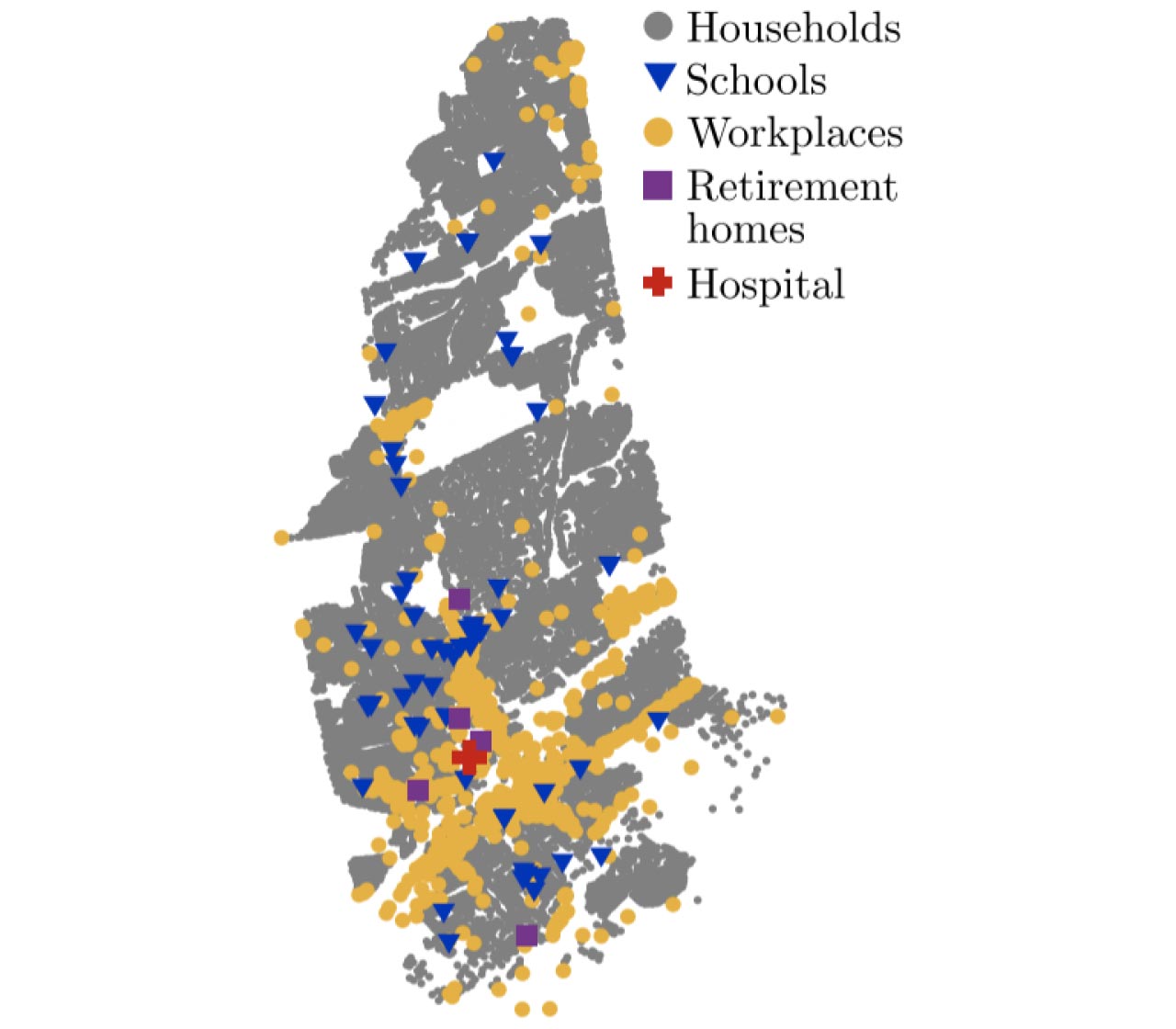
The ABM replicates, geographically and demographically, the town structure obtained from U.S. Census statistics and superimposes a high-resolution — both temporal and spatial — representation of the epidemic at the individual level, considering physical locations as well as unique features of communities, like human behavioral trends or local mobility patterns.
Among the study’s findings are those suggesting that prioritizing vaccination of high-risk individuals has only a marginal effect on the number of COVID-19 deaths. To obtain significant improvements, a very large fraction of the town population should, in fact, be vaccinated.
Importantly, the benefits of the restrictive measures in place during the first wave greatly surpass those from any of these selective vaccination scenarios. Even with a vaccine available, social distancing, masks, and mobility restrictions will still be key tools to fight COVID-19.
Porfiri pointed out that focusing on a city of New Rochelle’s size was crucial to the research because most cities in the U.S. have comparable population sizes and concentrations.
“We chose New Rochelle not only because of its place in the COVID timeline, but because agent-based modeling for mid-size towns is relatively unexplored despite the U.S. being largely composed of such towns and small cities,” he said.
A Comprehensive, Realistic Approach to COVID Modeling
Supported by expert knowledge and informed by officially reported COVID-19 data, the model incorporates detailed elements of pandemic spread within a statistically realistic population. Along with testing, treatment, and vaccination options, the model also accounts for the burden of other illnesses with symptoms similar to those of COVID-19.
Unique to the model is the possibility to explore different testing approaches — in hospitals or drive-through facilities— and vaccination strategies that could prioritize vulnerable groups.
“We think decision making by public authorities could benefit from this model, not only because it is ‘open source,’ but because it offers a ‘fine-grain’ resolution at the level of the individual and a wide range of features,” noted Porfiri.
Reference: “High‐Resolution Agent‐Based Modeling of COVID‐19 Spreading in a Small Town” by Agnieszka Truszkowska, Brandon Behring, Jalil Hasanyan, Lorenzo Zino, Sachit Butail, Emanuele Caroppo, Zhong‐Ping Jiang, Alessandro Rizzo and Maurizio Porfiri, 18 January 2021, Advanced Theory and Simulations.
DOI: 10.1002/adts.202000277
The research team included Zhong-Ping Jiang, professor of electrical and computer engineering; post-docs Agnieszka Truszkowska, who led the implementation of the computational framework for the project, and Brandon Behring; and graduate student Jalil Hasanyan; as well as Lorenzo Zino from the University of Groningen, Sachit Butail from Southern Illinois University, Emanuele Caroppo from the Università Cattolica del Sacro Cuore, and Alessandro Rizzo from Turin Polytechnic, and visiting professor of mechanical and aerospace engineering at NYU Tandon.
The work was partially supported by the National Science Foundation (CMMI1561134 and CMMI-2027990), Compagnia di San Paolo, MAECI (“Mac2Mic”), the European Research Council, and the Netherlands Organisation for Scientific Research.
Never miss a breakthrough: Join the SciTechDaily newsletter.
Follow us on Google and Google News.
3 Comments
The early models predicting the growth rate of COVID-19 were notoriously inaccurate. How has this model been vetted? The conclusions depend critically on the accuracy of the model!
It’s only a theory. Would you volunteer to be one of those in the would be eliminated marginal group?
“prioritizing vaccination of high-risk individuals has only a marginal effect on the number of COVID-19 deaths.”
What a load of hot horse diarrhea.