

Sealing manure ponds at a Central Valley farm led to a significant reduction in emissions.
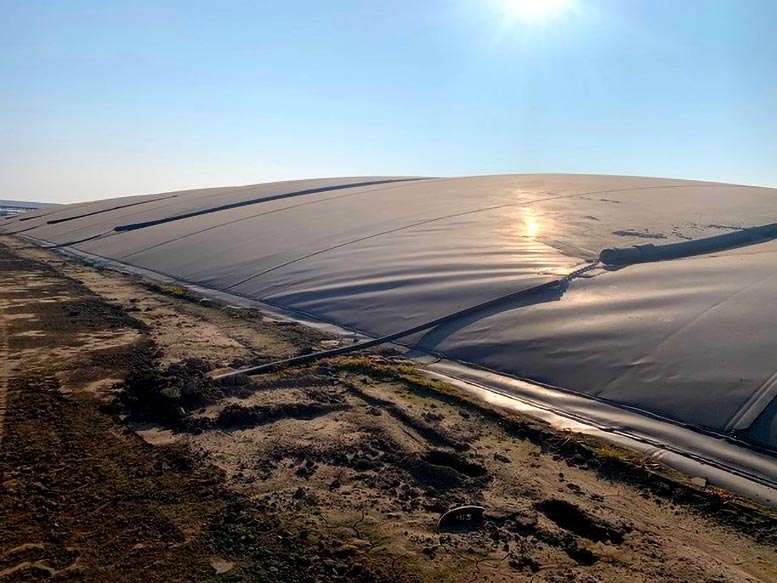
A large, balloon-like tarp covers a manure lagoon on a Central Valley dairy farm, marking a quiet but important change. Instead of escaping into the atmosphere, methane—a powerful climate-warming gas—is now being captured and cleaned.
Researchers at the University of California, Riverside have released a new study demonstrating how effective dairy digesters can be. These sealed manure ponds are designed to collect and repurpose the methane they generate. According to the study, the systems can cut methane emissions by about 80 percent, closely aligning with the estimates used in California’s climate planning.
Study verifies real-world emissions data
The findings, published in Global Change Biology Bioenergy, come at a time when California is increasing its investment in methane control technologies to meet its goal of reducing emissions to 40 percent below 2013 levels by the end of the decade. More than 130 of these systems are already in use on dairies across the state, but this study is the first to verify their real-world performance with such thorough analysis.
“The digesters can leak, and they sometimes do,” said Francesca Hopkins, a climate scientist at UCR who led the research. “But when the system is built well and managed carefully, the emissions really drop. That’s what we saw here.”
The team focused on a family-run dairy farm in Tulare County, a hot and dry area in the San Joaquin Valley that produces more milk than any other county in the country. For one year before and one year after the digester system was installed in 2021, the researchers collected hundreds of data points using a van outfitted with precision gas sensors to take mobile atmospheric measurements around the farm.
Why manure management matters
Methane is more than 80 times as powerful as carbon dioxide at warming the atmosphere over a 20-year period. In California, a large share of methane emissions comes from dairy cows. The gas is released not only through their burps after eating, but also from how their manure is stored. When manure sits in open, water-filled pits, it breaks down without oxygen and releases methane into the air.
Covering those pits with gas-tight membranes allows the gas to be trapped, cleaned, and piped into fuel systems that often replace diesel in long-haul trucks. At the Tulare County site, researchers initially found some leaks in the system. Working with the digester operator, California Bioenergy, the team flagged the problems. Adjustments were made. The methane reductions followed.
“This was a textbook case of adaptive management,” Hopkins said. “The partnership between scientists, the company, and the farmer really made a huge difference.”
While the study affirms the potential of dairy digesters, it also acknowledges their limitations. They do not address other emissions common to dairy operations, such as ammonia or airborne particles that affect local air quality. Building the digesters is also no small task. It requires permits, capital investment, and long-term maintenance.
Looking ahead with caution and optimism
“They’re not for every farm,” Hopkins said. “But for dairies that can make it work, this is one of the most cost-effective ways we have to cut these greenhouse gas emissions.”
California is also expanding its monitoring capacity with satellite technology that can detect large methane leaks from space. State regulators can follow up with site operators when emissions spikes are detected.
Hopkins views the effort as a model for how climate policy, science, and industry can align when conditions are right. “There’s so much division in the climate space,” she said. “But this is a real example of cooperation that leads to measurable results.”
Reference: “Anaerobic Digester Installation Significantly Reduces Liquid Manure Management CH4 Emissions at a California Dairy Farm” by Michael V. Rodriguez, Nidia Rojas Robles, Valerie Carranza, Ranga Thiruvenkatachari, Mariana Reyes, Chelsea V. Preble, Joyce Pexton, Deanne Meyer, Ray G. Anderson, Akula Venkatram and Francesca M. Hopkins, 4 June 2025, GCB Bioenergy.
DOI: 10.1111/gcbb.70047
Never miss a breakthrough: Join the SciTechDaily newsletter.
Follow us on Google and Google News.
3 Comments
Anaerobic digesters are not new technology and are used around the world to generate biomethane which is the same as the natural gas methane (CH4), but the gasses produced in anaerobic digesters often need substantial cleaning especially if the waste contains protein, which is often found in domestic and food factory waste, that produces hydrogen sulphide gas (H2S) that is highly toxic. Methane is not 80 times more powerful a greenhouse gas than carbon dioxide (CO2) as stated in this article, but about 28 times more powerful than CO2 according to the US EPA: https://www.epa.gov/gmi/importance-methane. Methane produced from the decomposition of organic waste is not an overall contributor to global atmospheric CO2 because it was captured from the air by plants in growing, unlike fossil methane from oil and gas wells that was captured by primitive plants billions of years ago that turned our atmosphere into one that animals can breathe.
You are correct about the global warming potential. The Global Warming Potential (GWP) multiplier depends on the length of time used for integrating the radiative forcing. From the IPCC Fifth Assessment Report, “The GWP for a time horizon of 100 years was later adopted as a metric to implement the multi-gas approach embedded in the United Nations Framework Convention on Climate Change (UNFCCC) and made operational in the 1997 Kyoto protocol.” Thus, the agreed to GWP should be 32X, NOT the commonly cited 85X! One would think that after 28-years they might get it right.
More importantly, as usual, those writing on the subject neglect to mention that the claimed multiplier is for equal weights of carbon dioxide and the gas that is being compared to it. However, the gases are usually measured and reported in equal volumes, such as the mole fraction expressed in parts per million. When compared in the same units that are measured in the atmosphere, that 32X weight equivalence becomes less than 12X volume equivalence.
https://wattsupwiththat.com/2023/03/06/the-misguided-crusade-to-reduce-anthropogenic-methane-emissions/
If dairies can find a way to increase their profits by turning a waste product into a saleable product, fine. All companies should endeavor to do that. However, tax payers should not be subsidizing some companies to the detriment of competitors, or providing advantages to some industries while forcing others to struggle in highly competitive times.
However, more to the point is that it is highly unlikely that there will be a measurable decrease in warming as a result of these tax subsidies. If I were still paying taxes in California I would be upset with tax money being spent on this line of research when analysis that even legislators should be able to comprehend can demonstrate that there is little reason to believe the expenditures will accomplish the goal of reducing even the rate of warming, let along warming.