
Close Menu
    Facebook X (Twitter) Instagram
    SciTechDaily
    • Biology
    • Chemistry
    • Earth
    • Health
    • Physics
    • Science
    • Space
    • Technology
    Facebook X (Twitter) Pinterest YouTube RSS
    SciTechDaily
    Home»Space»How a Single Star Outshines a Massive Galaxy in the Cosmic Dance of Light
    Space

    How a Single Star Outshines a Massive Galaxy in the Cosmic Dance of Light

    By ESA/HubbleApril 15, 2024No Comments3 Mins Read
    Facebook Twitter Pinterest Telegram LinkedIn WhatsApp Email Reddit
    Share
    Facebook Twitter LinkedIn Pinterest Telegram Email Reddit
    Spiral Galaxy NGC 3783
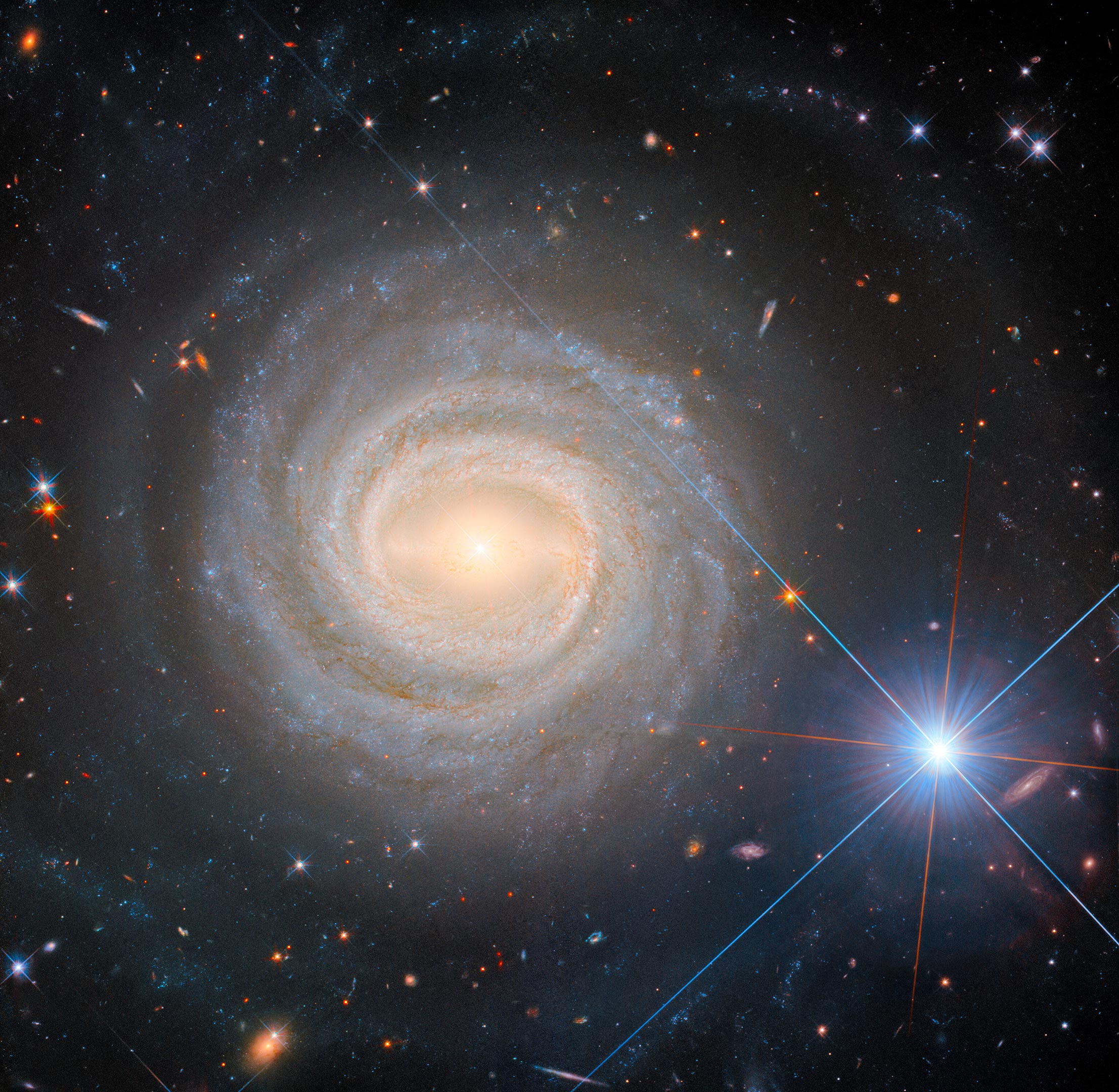
    NGC 3783, a bright barred spiral galaxy, anchors its namesake galaxy group located about 130 million light-years away. This Hubble Space Telescope image contrasts NGC 3783 with the much closer star HD 101274, which lies only 1,530 light-years from Earth, creating an optical illusion of proximity. Credit: ESA/Hubble & NASA, M. C. Bentz, D. J. V. Rosario

    In this Hubble Space Telescope image, NGC 3783, a barred spiral galaxy, is featured alongside the star HD 101274, which, despite seeming nearby, is significantly closer to Earth.

    This image features NGC 3783, a bright barred spiral galaxy about 130 million light-years from Earth, that also lends its name to the eponymous NGC 3783 galaxy group. Like galaxy clusters, galaxy groups are aggregates of gravitationally bound galaxies. Galaxy groups, however, are less massive and contain fewer members than galaxy clusters do: where galaxy clusters can contain hundreds or even thousands of constituent galaxies, galaxy groups do not typically include more than 50.

    The Milky Way is actually part of a galaxy group, known as the Local Group, which contains two other large galaxies (Andromeda and the Triangulum galaxy), as well as several dozen satellite and dwarf galaxies. The NGC 3783 galaxy group, meanwhile, contains 47 galaxies. It also seems to be at a fairly early stage of its evolution, making it an interesting object of study.

    Visual Illusion in Space

    While the focus of this image is the spiral galaxy NGC 3783, the eye is equally drawn to the very bright object in the lower right part of this image. This is the star HD 101274. The perspective in this image makes the star and the galaxy look like close companions, but this is an illusion. HD 101274 lies only about 1530 light-years from Earth, meaning it is about 85 thousand times closer than NGC 3783. This explains how a single star can appear to outshine an entire galaxy!

    Detailed Observation by Hubble

    NGC 3783 is a type-1 Seyfert galaxy, which is a galaxy with a bright central region — so it’s particularly bright itself, as far as galaxies go. In this image it is recorded by Hubble in incredible detail, from its glowing central bar to its narrow, winding arms and the dust threaded through them, thanks to five separate images taken in different wavelengths of light. In fact, the galactic center is bright enough to Hubble that it exhibits diffraction spikes, normally only seen on stars such as HD 101274.

    Never miss a breakthrough: Join the SciTechDaily newsletter.
    Follow us on Google and Google News.

    Astronomy European Space Agency Hubble Space Telescope Popular
    Share. Facebook Twitter Pinterest LinkedIn Email Reddit

    Related Articles

    Hubble’s Newest Discovery Isn’t a Star, It’s a Window Into the Dark Universe

    Hubble Views Spiral Galaxy NGC 5793

    Hubble Captures the Best Ever Image of the Antennae Galaxies

    Hubble Captures Face-On Image of Messier 61

    Hubble Views an Ongoing Cosmic Collision

    Hubble Views Newborn Stars in Galaxy IC 5052

    New XDF Image, The Deepest-Ever View of the Universe

    Hubble Zooms in on the Center of M4

    Hubble Image of Peculiar Galaxy Pair Arp 116

    Leave A Reply Cancel Reply

    • Facebook
    • Twitter
    • Pinterest
    • YouTube

    Don't Miss a Discovery

    Subscribe for the Latest in Science & Tech!

    Trending News

    Artificial Sweeteners May Harm Future Generations, Study Suggests

    Splashdown! NASA Artemis II Returns From Record-Breaking Moon Mission

    What If Consciousness Exists Beyond Your Brain

    Scientists Finally Crack the 100-Million-Year Evolutionary Mystery of Squid and Cuttlefish

    Beyond “Safe Levels”: Study Challenges What We Know About Pesticides and Cancer

    Researchers Have Found a Dietary Compound That Increases Longevity

    Scientists Baffled by Bizarre “Living Fossil” From 275 Million Years Ago

    Your IQ at 23 Could Predict Your Wealth at 27, Study Finds

    Follow SciTechDaily
    • Facebook
    • Twitter
    • YouTube
    • Pinterest
    • Newsletter
    • RSS
    SciTech News
    • Biology News
    • Chemistry News
    • Earth News
    • Health News
    • Physics News
    • Science News
    • Space News
    • Technology News
    Recent Posts
    • What if Dark Matter Has Two Forms? Bold New Hypothesis Could Explain a Cosmic Mystery
    • Researchers Expose Hidden Chemistry of “Ore-Forming” Elements in Biology
    • Geologists Reveal the Americas Collided Earlier Than We Thought
    • 20x Difference: Study Reveals True Source of Airborne Microplastics
    • Scientists Uncover Hidden Force Powering Yellowstone’s Supervolcano
    Copyright © 1998 - 2026 SciTechDaily. All Rights Reserved.
    • Science News
    • About
    • Contact
    • Editorial Board
    • Privacy Policy
    • Terms of Use

    Type above and press Enter to search. Press Esc to cancel.