
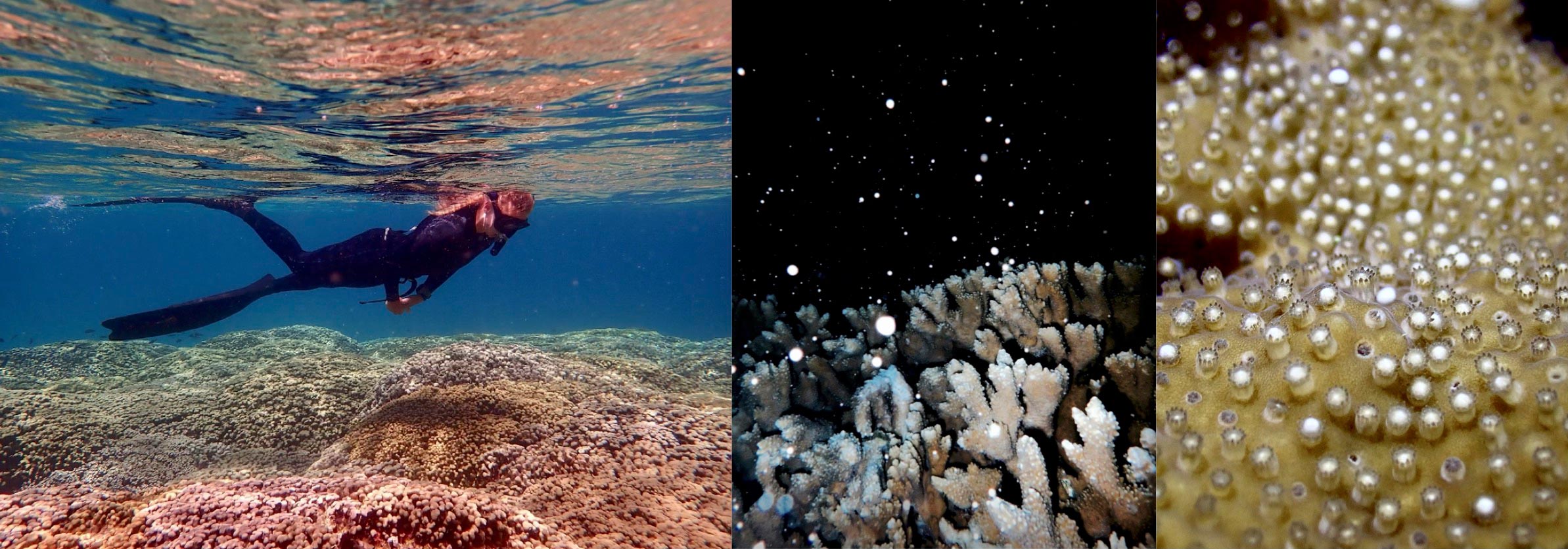
(Middle) Colonies of the study species, Montipora capitata, releasing gametes during a broadcast spawning event in Kāne‘ohe Bay.Credit: Mariana Rocha de Souza.
(Right) Close-up view of individual coral polyps releasing egg-sperm bundles during spawning. Credit: Mariana Rocha de Souza
Research reveals that coral larvae combat high temperatures by lowering their metabolism and boosting nitrogen uptake, averting bleaching.
This adaptive strategy enhances their survival by conserving energy and optimizing nutritional exchanges with symbiotic algae during critical growth phases.
Coral Larvae Adaptation to Heat
A new study led by Ariana S. Huffmyer from the University of Washington, published today (November 12th) in PLOS Biology, reveals that coral larvae adapt to high temperatures by reducing their metabolism and boosting nitrogen uptake, helping them resist bleaching.
Coral bleaching, driven by elevated ocean temperatures, occurs when corals and their symbiotic algae become disrupted. This issue has drawn increasing attention as global temperatures continue to rise. Yet, few studies have explored how high temperatures affect corals in their early life stages.
In this study, Huffmyer and her team exposed coral larvae to increased temperatures at the Hawai‘i Institute of Marine Biology. During their first week of development, the larvae and their algae were subjected to water temperatures 2.5 degrees Celsius above normal, simulating the impact of climate change. Remarkably, the larvae showed no signs of bleaching in the warmer water, maintaining healthy algal photosynthesis and a steady supply of carbon-based nutrients from the algae. Notably, the larvae reduced their metabolism by 19% and increased nitrogen uptake and storage—adaptations that likely enhance their survival in stressful conditions.
Strategies for Coral Survival
Reduced metabolism allows the coral to conserve energy and resources, also seen in adult corals during bleaching. The change in nitrogen cycling seems to be an adaptation by the coral to limit the amount of nitrogen available to the algae, thus preventing algal overgrowth and the destabilization of the coral-algae relationship.
It remains unclear how effective these strategies are at higher temperatures and for longer durations. Further research into the details and limitations of coral reaction to high temperatures will provide crucial knowledge for predicting coral response and protecting coral reefs as global temperatures continue to rise.
The authors add, “This research reveals that coral larvae must invest in their nutritional partnership with algae to withstand stress, offering key insights into strategies to avoid bleaching in earliest life stages of corals.”
Reference: “Coral larvae increase nitrogen assimilation to stabilize algal symbiosis and combat bleaching under increased temperature” by Ariana S. Huffmyer, Jill Ashey, Emma Strand, Eric N. Chiles, Xiaoyang Su and Hollie M. Putnam, 12 November 2024, PLOS Biology.
DOI: 10.1371/journal.pbio.3002875
Funding: This research was supported by the National Science Foundation Ocean Sciences Postdoctoral Fellowship (2205966 to ASH), National Science Foundation Rules of Life-Epigenetics (EF-1921465 to HMP), and a gift of the Washington Research Foundation to the University of Washington eScience Institute (eScience Data Science Postdoctoral Fellowship award to ASH). The funders had no role in study design, data collection and analysis, decision to publish, or preparation of the manuscript.
Never miss a breakthrough: Join the SciTechDaily newsletter.
Follow us on Google and Google News.
1 Comment
If ocean acidification is global, how come only the Great Coral Reef goes through the process of bleaching?