
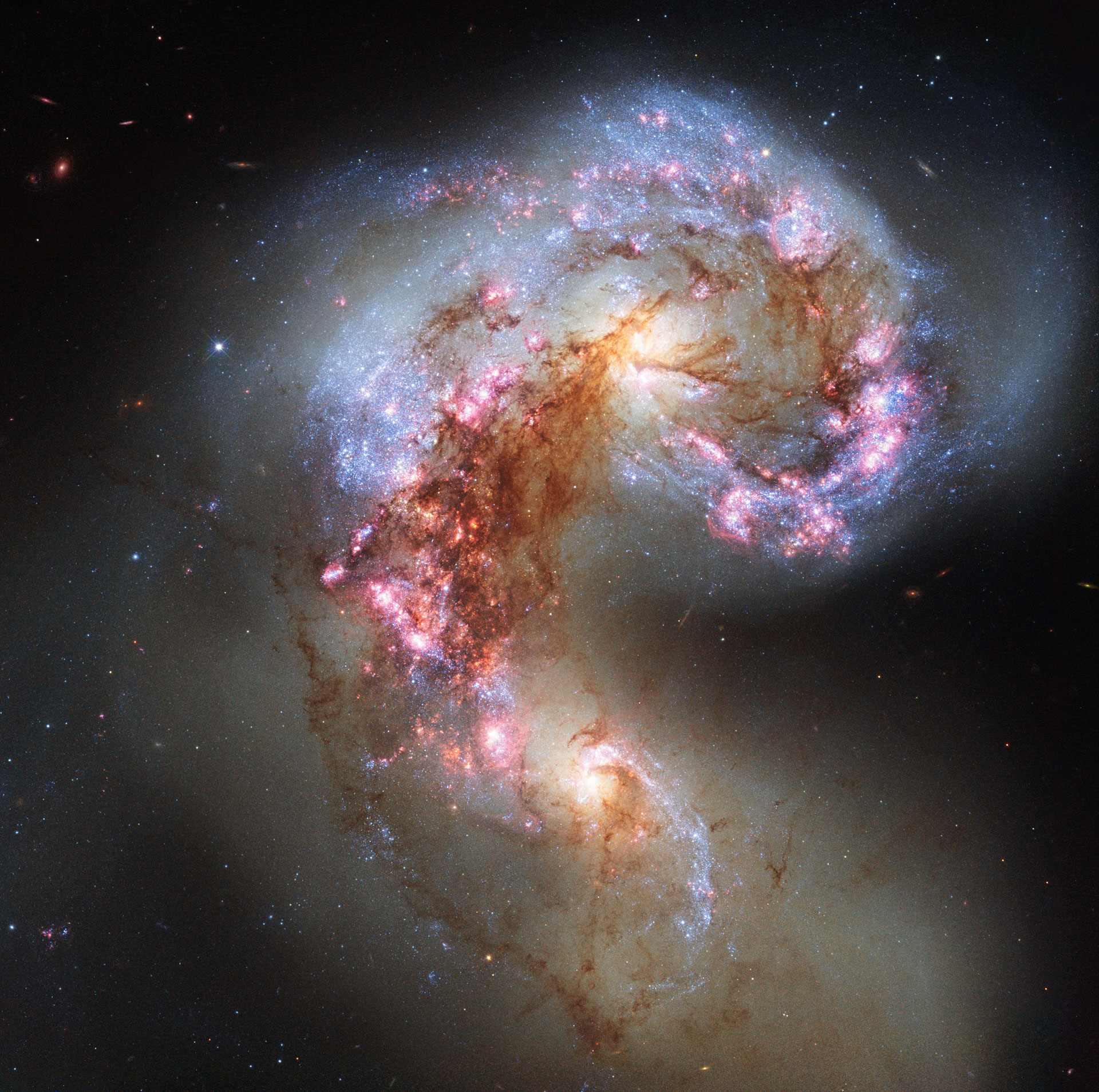
Researchers have identified the birth sites of massive elliptical galaxies, providing new insights into their formation which has puzzled scientists for decades.
The study suggests that these galaxies were formed from large flows of cold gas and galactic collisions in the early universe, leading to rapid star formation.
Insights Into Ancient Galactic Formation
Astronomers are closing in on solving a long-standing intergalactic mystery about the formation of the universe’s largest galaxies—an enigma that has puzzled experts for decades.
Researchers have identified the birth sites of massive elliptical galaxies, offering fresh insights into how these cosmic giants were formed.
Unlike our Milky Way’s flat, disk-like shape, these ancient galaxies resemble bulging footballs. Despite decades of study, their origins have remained elusive.
Now, an international team led by the University of Southampton may have uncovered the answer.
Breakthrough Research and Methods
Dr. Annagrazia Puglisi, a co-author of the study, suggests that these colossal systems were likely formed through massive flows of cold gas and collisions between galaxies in the early universe.
She added: “Two disk galaxies smashing together caused gas – the fuel from which stars are formed – to sink towards their center, generating trillions of new stars.
“These cosmic collisions happened some eight to 12 billion years ago, when the universe was in a much more active phase of its evolution.
“Our findings take us closer to solving a long-standing mystery in astronomy that will redefine our understanding of how galaxies were created in the early universe.”
Advancements in Galactic Observations
The study, published in Nature, was a collaboration between Southampton, the Purple Mountain Observatory in China, and the Chinese Academy of Sciences, among others.
Experts analyzed more than 100 star-forming galaxies in the distant universe using the world’s largest radio telescope, known as ALMA, located in Chile’s Atacama desert.
The scientists made the discovery using a new technique that looked at the distribution of light emitted by distant and highly luminous galaxies, said study lead Dr. Qing-Hua Tan from the Purple Mountain Observatory.
She added: “This is the first real evidence that spheroids form directly through intense episodes of star formation located in the cores of distant galaxies.
“Astrophysicists have sought to understand this process for decades.
“These galaxies form quickly – gas is sucked inwards to feed black holes and triggers bursts of stars, which are created at rates ten to 100 times faster than our Milky Way.”
Researchers used the open-source A3COSMOS and A3GOODSS archival projects which enabled them to gather high-quality observations of many distant galaxies.
Future Directions in Galactic Study
The scientists say they will combine their findings with data taken from telescopes aboard the JWST and Euclid satellites, as well as the Chinese Space Station, to map the stellar components of galaxies.
Dr. Puglisi from Southampton added: “This will give us a more complete picture of early galaxy formation and deepen our understanding of how the universe has evolved since the beginning of time.”
Reference: “In situ spheroid formation in distant submillimetre-bright galaxies” by Qing-Hua Tan, Emanuele Daddi, Benjamin Magnelli, Camila A. Correa, Frédéric Bournaud, Sylvia Adscheid, Shao-Bo Zhang, David Elbaz, Carlos Gómez-Guijarro, Boris S. Kalita, Daizhong Liu, Zhaoxuan Liu, Jérôme Pety, Annagrazia Puglisi, Eva Schinnerer, John D. Silverman and Francesco Valentino, 4 December 2024, Nature.
DOI: 10.1038/s41586-024-08201-6
Never miss a breakthrough: Join the SciTechDaily newsletter.
Follow us on Google and Google News.
4 Comments
“Two disk galaxies smashing together caused gas – the fuel from which stars are formed – to sink towards their center, generating trillions of new stars….”
Seems unusually fair, not suggesting the disk galaxies had to be spirals.
So in the expanding universe, galaxies can collide? Fancy that!
In a local, gravitationally bound group it is inevitable that all non-ejected galaxies will eventually merge. Our own Local Group is a prime example:
“The Andromeda–Milky Way collision is a galactic collision predicted to occur in about 4.5 billion years between the two largest galaxies in the Local Group—the Milky Way (which contains the Solar System and Earth) and the Andromeda Galaxy.”
“Such collisions are relatively common, considering galaxies’ long lifespans. Andromeda, for example, is believed to have collided with at least one other galaxy in the past,[11] and several dwarf galaxies such as Sgr dSph are currently colliding with the Milky Way and being merged into it.
The studies also suggest that M33, the Triangulum Galaxy—the third-largest and third-brightest galaxy of the Local Group—will participate in the collision event, too. Its most likely fate is to end up orbiting the merger remnant of the Milky Way and Andromeda galaxies and finally to merge with it in an even more distant future. However, a collision with the Milky Way, before it collides with the Andromeda Galaxy, or an ejection from the Local Group cannot be ruled out.”
– Wikipedia
Rob, I’d ignore count chocula in cat drag there. How should the BAO form?