
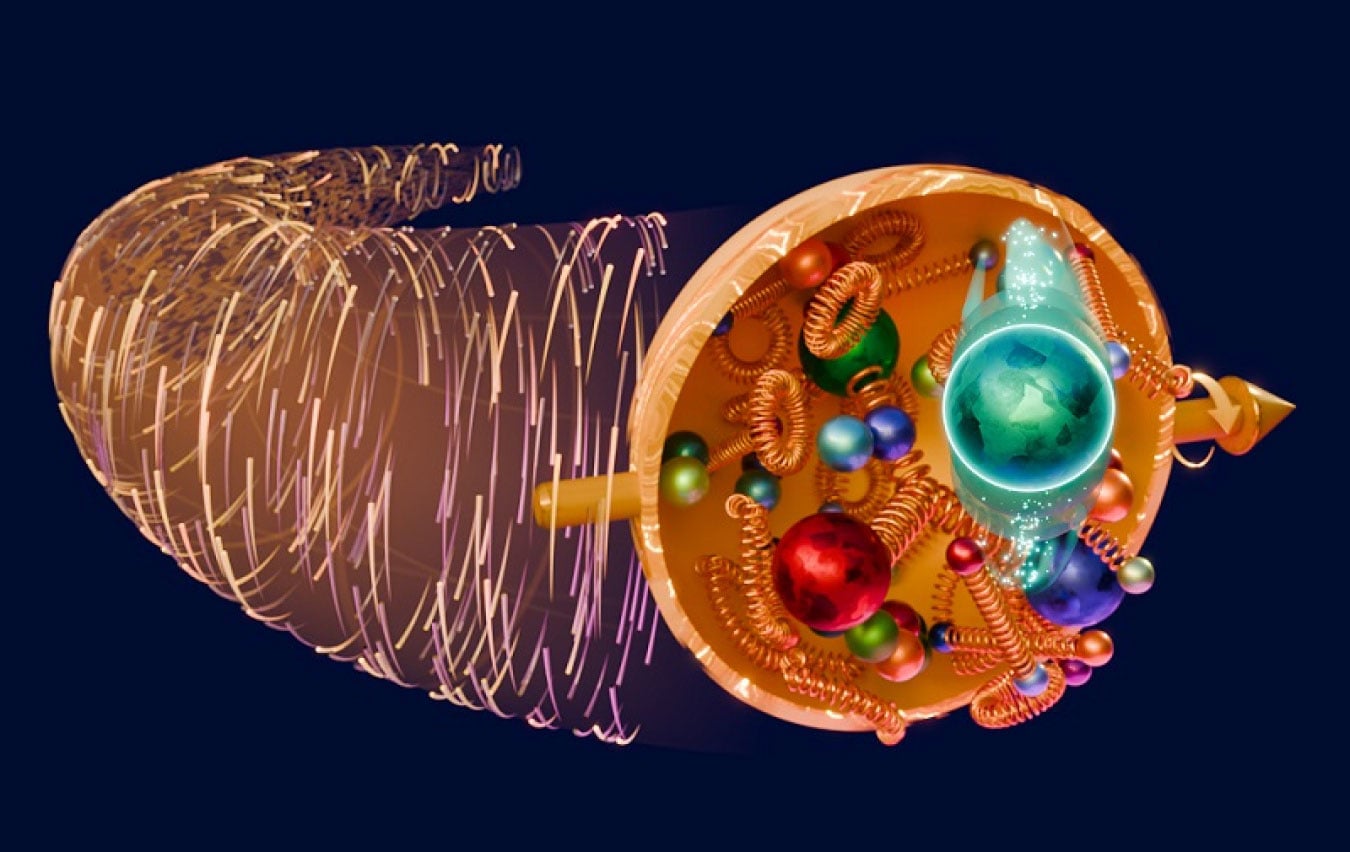
A new theory-based approach provides access to the minute transverse motion of quarks within protons.
Nuclear physicists have developed a new theoretical framework that allows them to calculate a crucial quantity for understanding the three-dimensional movement of quarks inside a proton. Using this innovative method, researchers have created a far more precise picture of the quarks’ transverse motion, the movement that occurs around a proton’s spin axis and at right angles to its forward direction.
The latest calculations align closely with model-based reconstructions derived from particle collision data. They are especially effective for describing quarks with low transverse momentum, a region where older techniques lacked precision. Scientists plan to use this refined approach to better predict the full 3D behavior of quarks and the gluons that bind them in upcoming collider experiments.
Understanding the source of proton spin is one of the key scientific objectives of the upcoming Electron-Ion Collider (EIC). At this facility, collisions between spin-aligned protons and high-energy electrons will make it possible to measure the transverse motion of quarks and gluons within protons with remarkable accuracy.
This improved 3D imaging will help clarify how the motion of quarks and gluons contributes to the overall spin of a proton. The new theoretical model provides the first reliable calculations showing how the distribution of quarks’ transverse momentum changes as collision energy varies.
By offering more accurate predictions for the small-scale transverse motions of quarks, the approach removes the need to rely on complex models of strong-force interactions that govern the behavior of quarks and gluons.
Breakthrough Calculations Using Lattice QCD
Nuclear theorists at Brookhaven National Laboratory and Argonne National Laboratory have successfully employed a new theoretical approach to calculate the Collins-Soper kernel, a quantity that describes how the distribution of quarks’ transverse momentum inside a proton changes with the collision energy. The team used lattice quantum chromodynamics (QCD), supercomputer-based simulations that track quark-gluon interactions on a 4D space-time lattice.
The new theoretical approach enabled the team to significantly simplify their lattice QCD calculations and obtain precise results for even the small transverse motion of quarks, where the quark-gluon interactions become strong and complex. Such precise descriptions of the small transverse motion of quarks could not be achieved in previous lattice QCD calculations that used more conventional approaches.
The new results for low-transverse-momentum quarks are consistent with previous results but are much more precise and have significantly smaller uncertainties. They also match up with models developed to explain existing experimental data. These achievements demonstrate that the new approach can be used to predict and interpret future experimental results at different collision energies at the EIC, which is being built at Brookhaven National Laboratory, and the European Large Hadron Collider. Physicists will use these predictions and experiments to learn about quarks’ small transverse motion within protons and how that motion contributes to proton spin.
References:
“Parton distributions from boosted fields in the Coulomb gauge” by Xiang Gao, Wei-Yang Liu and Yong Zhao, 10 May 2024, Physical Review D.
DOI: 10.1103/PhysRevD.109.094506
“Nonperturbative Collins-Soper kernel from chiral quarks with physical masses” by Dennis Bollweg, Xiang Gao, Swagato Mukherjee and Yong Zhao, 2 April 2024, Physics Letters B.
DOI: 10.1016/j.physletb.2024.138617
This work was supported by the Department of Energy (DOE) Office of Science, Office of Nuclear Physics, within the frameworks of the Scientific Discovery through Advanced Computing (SciDAC) award “Fundamental Nuclear Physics at the Exascale and Beyond,” by the “Quark-Gluon Tomography” Topical Collaboration, by a DOE Office of Science Early Career Award, and by the National Science Foundation. This research used awards of computer time provided by the INCITE program at Argonne Leadership Computing Facility, the ALCC program at the Oak Ridge Leadership Computing Facility, and the National Energy Research Scientific Computing Center.
Never miss a breakthrough: Join the SciTechDaily newsletter.
Follow us on Google and Google News.
14 Comments
Using this innovative method, researchers have created a far more precise picture of the quarks’ transverse motion, the movement that occurs around a proton’s spin axis and at right angles to its forward direction.
VERY GOOD!
Please ask researchers to think deeply:
1. Why do protons spin?
2, What would happen if the protons don’t spin?
3. Is the proton spin related to topological spin?
When we pursue the ultimate truth of all things, the space in which our bodies and all things exist may itself be the final and deepest puzzle we need to explore. This is not only the pursuit of physics, but also the most magnificent exploration of the origin of the universe by human reason.
Based on the Topological Vortex Theory (TVT), space is an uniformly incompressible physical entity. Space-time vortices are the products of topological phase transitions of the tipping points in space, are the point defects in spacetime. Point defects do not only impact the thermodynamic properties, but are also central to kinetic processes. They create all things and shape the world through spin and self-organization.
In today’s physics, some so-called peer-reviewed journals—including Physical Review Letters, Nature, Science, and others—stubbornly insist on and promote the following:
1. Even though θ and τ particles exhibit differences in experiments, physics can claim they are the same particle. This is science.
2. Even though topological vortices and antivortices have identical structures and opposite rotational directions, physics can define their structures and directions as entirely different. This is science.
3. Even though two sets of cobalt-60 rotate in opposite directions and experiments reveal asymmetry, physics can still define them as mirror images of each other. This is science.
4. Even though vortex structures are ubiquitous—from cosmic accretion disks to particle spins—physics must insist that vortex structures do not exist and require verification. Only the particles that like God, Demonic, or Angelic are the most fundamental structures of the universe. This is science.
5. Even though everything occupies space and maintains its existence in time, physics must still debate and insist on whether space exists and whether time is a figment of the human mind. This is science.
6. Even though space, with its non-stick, incompressible, and isotropic characteristics, provides a solid foundation for the development of physics, physics must still insist that the ideal fluid properties of space do not exist. This is science.
and go on.
Is this the counterintuitive science they widely promote? Compromising with pseudo academic publications and peer review by pseudo scholars is an insult to science and public intelligence. Some so-called scholars no longer understand what shame is. The study of Topological Vortex Theory (TVT) reminds us that the most profound problems in physics often lie at the intersection of different theories. By exploring these border regions, we can not only resolve contradictions in existing theories but also discover new physical phenomena and application possibilities.
Under the topological vortex architecture, it is highly challenging for even two hydrogen atoms or two quarks to be perfectly symmetrical, let alone counter-rotating two sets of cobalt-60. Contemporary physics and so-called peer-reviewed publications (including Physical Review Letters, Science, Nature, etc.) stubbornly believe that two sets of counter rotating cobalt-60 are two mirror images of each other, constructing a more shocking pseudoscientific theoretical framework in the history of science than the “geocentric model”. This pseudo scientific framework and system have seriously hindered scientific progress and social development.
For nearly a century, physics has been manipulated by this pseudo scientific theoretical system and the interest groups behind it, wasting a lot of manpower, funds, and time. A large amount of pseudo scientific research has been conducted, and countless pseudo scientific papers have been published, causing serious negative impacts on scientific and social progress, as well as humanistic development.
Complexity does not necessarily mean that there is no logical and architectural framework to follow. Mathematics is the language and tool that reveals the motion of spacetime, rather than the motion itself. Although the physical form of spacetime vortices is extremely simple, their interaction patterns are highly complex, and we must develop more and richer mathematical languages to describe and understand them.
The development of the Topological Vortex Theory (TVT) reflects a progression from concrete physical phenomena to abstract mathematical modeling and, ultimately, to interdisciplinary unification.
——Excerpted from https://t.pineal.cn/blogs/4569/An-Overview-of-the-Development-of-Topological-Vortex-Theory-TVT.
B Memo 2511131304_Source 1. Storytelling []
Source 1
https://scitechdaily.com/how-do-quarks-really-move-new-theory-unlocks-decades-old-physics-mystery/
1.
How do quarks really move? A new theory solves a decades-old physics mystery.
_A new theory-based approach provides access to the subtle transverse motion of quarks within protons.
Nuclear physicists have developed a new theoretical framework that allows them to calculate quantities crucial for understanding the three-dimensional motion of quarks within protons.
_This innovative method allowed researchers to much more precisely determine the transverse motion of quarks, which move perpendicular to the direction of travel around the proton’s spin axis.
【If we view msbase.msoss.qpeoms as a rhombus (*), we can see that quarks move transversely in xy directions perpendicular to the spin axis zz’ within a proton pixel.
>>> In my theory, pixels are effectively classified as qqcells and mbshells.
If these have a pixel system, would they be rhombus-shaped (*)? If so, this would provide a new perspective on explaining the quantum state of qpeoms within the nucleus.
】
1-1.
_The latest computational results are in excellent agreement with model-based reconstructions derived from particle collision data. They are particularly effective in describing quarks with low transverse momentum, an area where existing techniques have lacked accuracy.
_Scientists plan to utilize this improved approach to more accurately predict the full three-dimensional behavior of quarks and their binding gluons in future collision experiments.
1-2. Understanding the origin of proton spin is one of the key scientific goals of the soon-to-be-built Electron-Ion Collider (EIC). This facility will allow for the measurement of the transverse motion of quarks and gluons within protons with remarkable precision through the collisions of spin-aligned protons with high-energy electrons.
High-energy electrons are likely *[free electrons and ionized electrons], elementary particles traveling at the speed of light created by laser-injected photons and particle accelerators, or spontaneously occurring particles such as cosmic rays.
*[Free electrons] are electrons that are relatively free to move without being bound by the nucleus, as in a metallic bond. Ions are atoms that have lost or gained electrons, becoming positively or negatively charged. Free electrons are a key element in the electrical conductivity of metallic materials, where electrons can move easily. Ions are charged particles that have undergone ionization. ]
>>>>>If these free ions (oser.oss_nsum.+-.ion) are experimentally collided with protons (uud/3=1) using the principle of local scarcity,
>>>>>From the axial spins of quarks (111…) and gluons (2>>>>> The transverse pendulum motion of the poms (1111…) is highly likely to occur (the inverted triangular pendulum motion mode). Uh-huh.
】
1-3.
There is a complex and important correlation between transverse momentum and proton spin, a topic actively discussed in high-energy particle physics, particularly in the study of the transverse momentum-dependent distribution function (TMD).
2. The Relationship Between Proton Spin and Transverse Momentum
_Spin is a Unique Property: The spin (spin, ½ value) of a proton is a unique quantum mechanical property (intrinsic angular momentum) that is independent of the particle’s motional state.
_It should not be considered classical rotation; it exists even when the particle is not moving.
_Transverse Momentum Dependence: In particle collision experiments, the spin direction of a proton (especially the transverse spin perpendicular to the beam direction) affects the transverse momentum distribution of the resulting particles.
3-1.
_Emergence of Correlations: These correlations arise from the interaction between the intrinsic transverse momentum of quarks and the spin of nucleons (protons or neutrons).
_Typical examples include the Sivers function, the Collins function, and the Boer-Mulders function, which are used to describe transverse spin asymmetries.
These functions provide detailed information about the momentum and spin distributions of quarks and gluons within a proton.
2-3. Research Significance
Studying the correlation between transverse motion and proton spin is essential for understanding the origin of proton spin.
Proton spin cannot be explained simply by the spin of the inner quarks (proton spin crisis); the orbital angular momentum contributions of quarks and gluons must also be considered. The transverse momentum-dependent distribution function serves as a crucial tool for elucidating this complex internal structure.
This improved 3D imaging will help elucidate how the motions of quarks and gluons contribute to the overall spin of the proton.
The new theoretical model provides the first reliable calculations showing how the transverse momentum distribution of quarks changes with varying collision energy.
This approach eliminates the need to rely on complex models of the strong interactions that govern the behavior of quarks and gluons by providing more accurate predictions of the small-scale transverse motion of quarks.
3.
Breakthrough Calculations Using Lattice QCD
Nuclear theorists at Brookhaven National Laboratory and Argonne National Laboratory have successfully calculated the Collins-Sofer kernel using a new theoretical approach.
The Collins-Sofer kernel describes how the transverse momentum distribution of quarks within a proton varies with collision energy. The team used lattice quantum chromodynamics (QCD), a supercomputer-based simulation that tracks quark-gluon interactions on a four-dimensional spacetime lattice.
The new theoretical approach allowed the team to significantly simplify lattice quantum dynamics (QCD) calculations and obtain accurate results even for the small transverse motions of quarks, where quark-gluon interactions become strong and complex.
_Such a precise description of the tiny transverse motions of quarks was not possible in lattice quantum mechanical calculations using conventional approaches.
Quark motion becomes easier to understand when viewed from an external perspective and interpreted through Higgs dynamics.
I explored this idea in my article Higgs and Time
LinkedIn:
http://www.linkedin.com/pulse/higgs-y-el-tiempo-leandro-vico-costa
Unfortunately “quarks” are energy splats always equal to the amount of energy applied, via accelerators.
Since a nucleus was blasted apart, the various stats splats are apparitions.
To decide they are inflated particles and assume they should reside cozily together within the 1 fm framework is (what’s the word? foolish?) Foolish will do.
So come up with a different theory that reflects experimental results, otherwise you are just one of those people who are destructive but have nothing positive to offer.
The proton is a circular waveform made of three wave quadrants plus one half power wave quadrant (same h amplitude but double the stretch). Sorry. The illustration shows what is in the theorists’ heads, not in the proton. https://x.com/lebelmarcel?lang=en
VERY GOOD!
Physics today has long been tainted by so-called peer review. The so-called peer-reviewed publications and core journals blatantly define differences as the same and asymmetry as symmetry, and never know what shame, dirtiness, and ugliness mean.
To compromise with pseudoscience and fraudulent academic publications is to commit a crime against scientific progress and human advancement.
Oups! Correction: The proton is a circular waveform made of three wave quadrants plus one half power wave quadrant (same > h/2 < amplitude but double the stretch). Sorry. The illustration shows what is in the theorists’ heads, not in the proton. https://x.com/lebelmarcel?lang=en
VERY GOOD!
Physics today has long been tainted by so-called peer review. The so-called peer-reviewed publications and core journals blatantly define differences as the same and asymmetry as symmetry, and never know what shame, dirtiness, and ugliness mean.
Compromise with pseudoscience and pseudo academic publications is to commit a crime against scientific progress and human advancement.
Compromise with pseudoscience and pseudo academic publications is to commit a crime against scientific progress and human advancement.
Incommensurability is a core concept introduced by American philosophers of science Thomas Kuhn and Paul Feyerabend to describe the incomparability between successive paradigms during scientific revolutions. This theory emphasizes the fundamental differences between paradigms in their linguistic systems, taxonomic categories, and value judgments, which prevent them from being directly compared or translated through a common standard. In his work The Structure of Scientific Revolutions, Kuhn used this concept alongside “paradigm” to construct a discontinuous model of scientific development.