
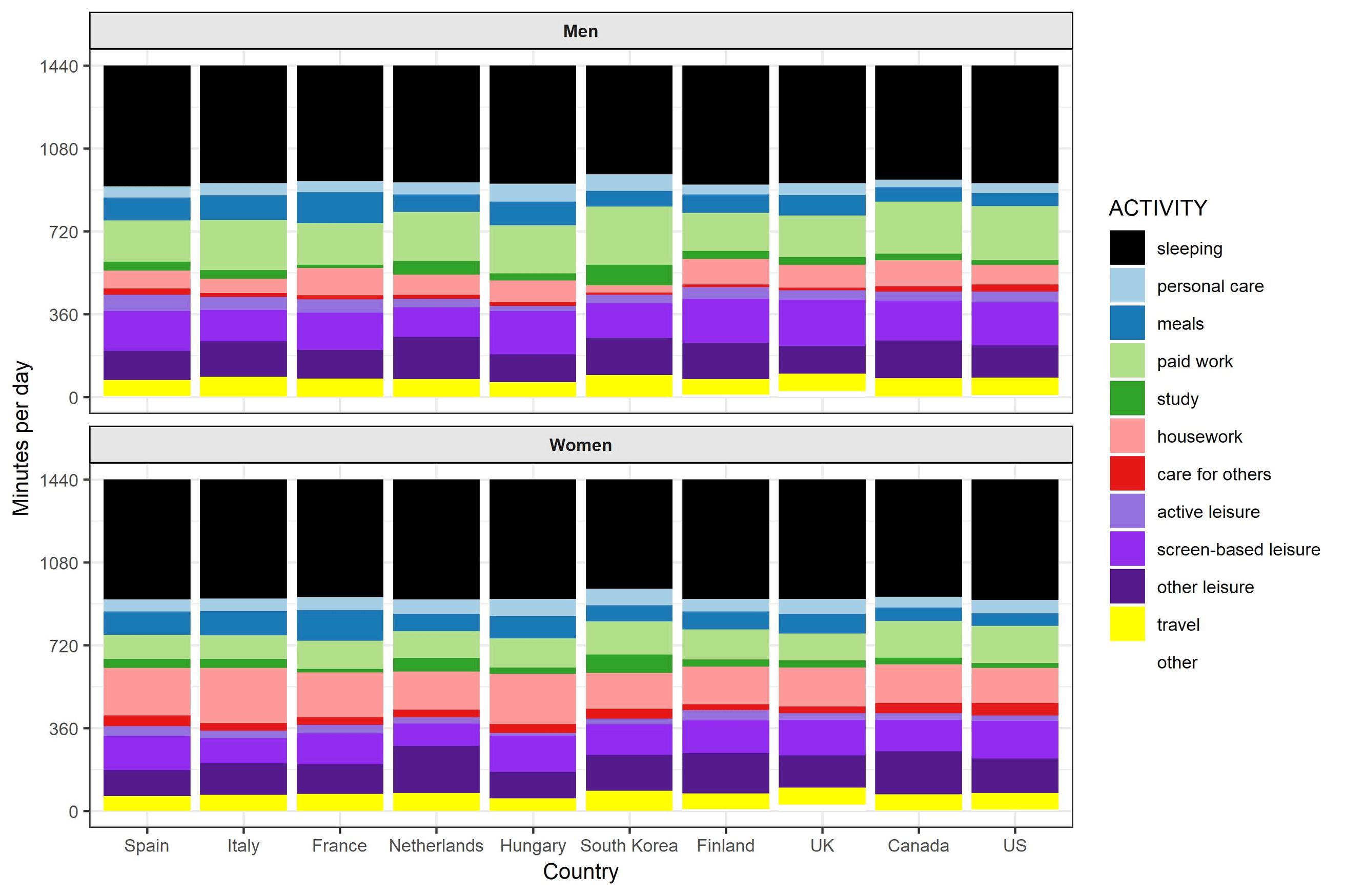
Gender gaps in daily time usage at different ages vary between countries.
Cultural context appears to influence how men versus women spend time on employment, housework, care-giving and other activities throughout life.
A new, 10-country analysis identifies between-nation differences in the amount of time men and women spend on various daily activities at different stages of life. Joan García Román of Centre d’Estudis Demogràfics in Bellaterra, Spain, and Pablo Gracia of Trinity College in Dublin, Ireland, present these findings in the open-access journal PLOS ONE on March 9, 2022.
Despite progress, gender inequalities remain in time use, with women more active in domestic chores and men more active in paid work. Prior research has illuminated, in particular, how parenthood magnifies these disparities. However, it has been unclear how different cultural contexts might affect gender disparities in time use from childhood through late adulthood.
To provide new insights, García Román and Gracia analyzed data from the Multinational Time Use study, in which participants tracked their daily time usage in diaries. The time-diary data included entries recorded from 2005 to 2015 by more than 200,000 participants from 10 countries in Asia, Europe, and North America.
Statistical analysis found that, for all 10 countries, the biggest disparities in time use between men and women were in the areas of housework, care work, and employment activities. Disparities were greatest in South Korea, Hungary, Italy, and Spain, while moderate in other Western European countries and lowest in Finland and Anglo-Saxon countries, such as the U.K., the U.S., and Canada.
For all ten countries, gender gaps in time spent on housework and care work widened from adolescence to adulthood, with the largest gaps persisting from age 30 to 44, but narrowing after 65. This pattern was strongest for Italy and South Korea, and less pronounced in Canada and Finland. Disparities in time spent on employment activities were greatest from the ages to 30 through 64; this pattern was most pronounced in the Netherlands and less prominent in the U.S.
These findings suggest that national context affects the precise ways in which gender gaps in time use may arise and wane over the entire life course. These findings, and future research in this area, could help inform country-specific efforts to close gender gaps in important activities for individuals’ health and well-being outcomes.
The authors add: “Our study shows that age and gender intersect strongly in affecting time-use patterns, but also that the national context plays an important role in shaping gender-age interactions in time use allocation.”
Reference: “Gender differences in time use across age groups: A study of ten industrialized countries, 2005–2015” by Joan García Román and Pablo Gracia, 9 March 2022, PLoS ONE.
DOI: 10.1371/journal.pone.0264411
Never miss a breakthrough: Join the SciTechDaily newsletter.
Follow us on Google and Google News.
4 Comments
Do you want congratulations for directly implying that the most important distinction we can draw between people is based on what’s between their legs?
You only contribute to the problem in your failure to examine your destructive assumptions and precepts. I thought your title included “science,” but that’s beginning to look like a misrepresentation on your part.
This is utter bull. You cherry picked countries in which the household chores and the taking care of children are equal. How about Japan or latam? Or maybe India? What the hell was that garbage?
Culture affects the roles of men and women: not a shocker. The fact that these roles exist similarly accross cultures is also not a shocker. And lastly, the pretentious neoliberal assumption that men and women are the same and should exist with the exact same roles culture be damned is sadly not a shocker. Poor article with little substance and an excess of nonsense.
Why is the assumption always that these “gaps” MUST be closed?
Why can’t adults decide how they want to spend their bloody time and divide their responsibilities however they dang well please?
The fact most economies have devolved to the point of REQUIRING two incomes to survive isn’t progress. It’s the opposite of that, you morons.