
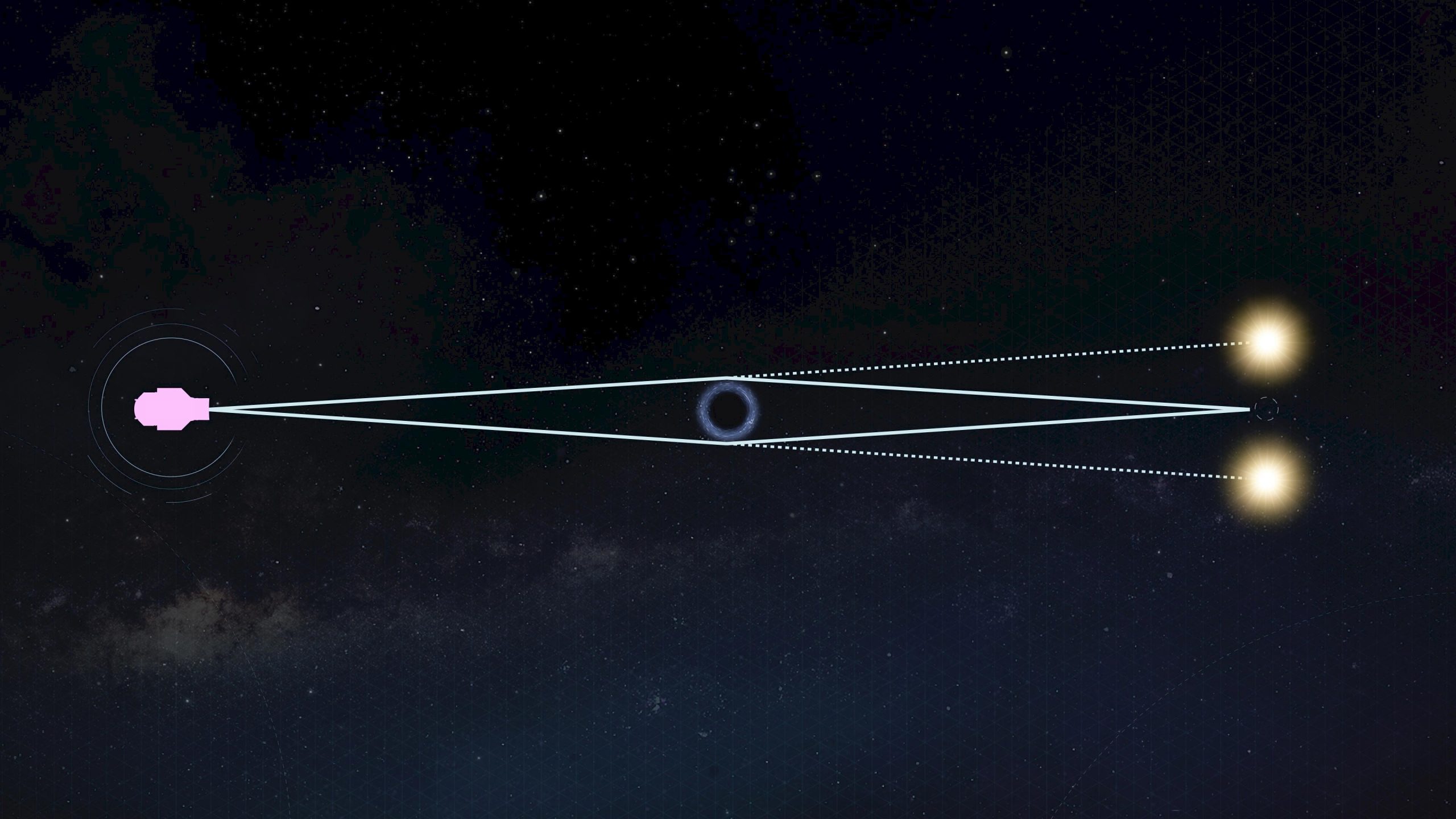
NASA’s Roman Telescope will use gravitational lensing to uncover hidden black holes and exoplanets, revealing the dark skeleton of our galaxy.
NASA’s Nancy Grace Roman Space Telescope will provide an unprecedented window into the infrared universe when it launches in the mid-2020s. One of the mission’s planned surveys will use a quirk of gravity to reveal thousands of new planets beyond our solar system. The same survey will also provide the best opportunity yet to definitively detect solitary small black holes for the first time. Formed when a star with more than 20 solar masses exhausts the nuclear fuel in its core and collapses under its own weight, these objects are known as stellar-mass black holes.
Black holes have such powerful gravity that not even light can escape their clutches. Since they’re invisible, we can only find black holes indirectly, by seeing how they affect their surroundings. The supermassive black holes found at the centers of galaxies, which contain millions of times the mass of the Sun, disrupt the orbits of nearby stars and occasionally tear them apart with visible consequences.
But astronomers think the vast majority of stellar-mass black holes, which are much lighter, have nothing around them that can tip us off to their presence. Roman will find planets throughout our galaxy by observing how their gravity distorts distant starlight, and because stellar-mass black holes produce the same effects, the mission should be able to find them too.
This animation illustrates the concept of gravitational microlensing with a black hole. When the black hole appears to pass nearly in front of a background star, the light rays of the star become bent as they travel through the warped space-time around the black hole. It becomes a virtual magnifying glass, amplifying the brightness of the distant background star. Unlike when a less massive star or planet is the lensing object, black holes warp space-time so much that they noticeably alter the distant star’s apparent location in the sky. Credit: NASA’s Goddard Space Flight Center/Conceptual Image Lab
“Astronomers have identified about 20 stellar-mass black holes so far in the Milky Way, but all of them have a companion that we can see,” said Kailash Sahu, an astronomer at the Space Telescope Science Institute in Baltimore. “Many scientists, myself included, have spent years trying to find black holes on their own using other telescopes. It’s exciting that with Roman, it will finally be possible.”
Making a Black Hole
Stars seem like eternal beacons, but each is born with a limited supply of fuel. Stars spend the majority of their lives turning hydrogen in their centers into helium, which creates an enormous amount of energy. This process, called nuclear fusion, is like a controlled explosion – a finely balanced game of tug-of-war between outward pressure and gravity.
But as a star’s fuel runs low and fusion slows, gravity takes over and the star’s core contracts. This inward pressure heats up the core and sparks a new round of fusion, which produces so much energy that the star’s outer layers expand. The star swells in size, its surface cools, and it becomes a red giant or supergiant.
The Roman Space Telescope will make its microlensing observations in the direction of the center of the Milky Way galaxy. The higher density of stars will yield more microlensing events, including those that reveal exoplanets. Credit: NASA’s Goddard Space Flight Center/CI Lab
The type of stellar corpse that’s ultimately left behind depends on the star’s mass. When a Sun-like star runs out of fuel, it eventually ejects its outer layers, and only a small, hot core called a white dwarf remains. The white dwarf will fade out over time, like the dying embers of a once-roaring fire. Our Sun has about five billion years of fuel remaining.
More massive stars run hotter, so they use up their fuel faster. Above about eight times the mass of the Sun, most stars are doomed to die in cataclysmic explosions called supernovae before becoming black holes. At the highest masses, stars may skip the explosion and collapse directly into black holes.
The cores of these massive stars collapse until their protons and electrons crush together to form neutrons. If the leftover core weighs less than about three solar masses, the collapse stops there, leaving behind a neutron star. For larger leftover cores, even the neutrons cannot support the pressure and the collapse continues to form a black hole.
Millions of massive stars have undergone this process and now lurk throughout the galaxy as black holes. Astronomers think there should be about 100 million stellar-mass black holes in our galaxy, but we’ve only been able to find them when they noticeably affect their surroundings. Astronomers can infer the presence of a black hole when hot, glowing accretion disks form around them, or when they spot stars orbiting a massive but invisible object.
“Roman will revolutionize our search for black holes because it will help us find them even when there’s nothing nearby,” Sahu said. “The galaxy should be littered with these objects.”
Seeing the Invisible
Roman will primarily use a technique called gravitational microlensing to discover planets beyond our solar system. When a massive object, such as a star, crosses in front of a more distant star from our vantage point, light from the farther star will bend as it travels through the curved space-time around the nearer one.
The result is that the closer star acts as a natural lens, magnifying light from the background star. Planets orbiting the lens star can produce a similar effect on a smaller scale.
In addition to causing a background star to brighten, a more massive lensing object can warp space-time so much that it noticeably alters the distant star’s apparent location in the sky. This change in position, called astrometric microlensing, is extremely small – only about one milliarcsecond. That’s like distinguishing movement as small as about the width of a quarter on top of the Empire State Building in New York all the way from Los Angeles. Using Roman’s exquisite spatial resolution to detect such a tiny apparent movement – the telltale sign of a massive black hole – astronomers will be able to constrain the black hole’s mass, distance, and motion through the galaxy.
Microlensing signals are so rare that astronomers need to monitor hundreds of millions of stars for long periods to catch them. Observatories must be able to track the position and brightness of the background star extremely precisely – something that can only be done from above Earth’s atmosphere. Roman’s location in space and enormous field of view will provide us with the best opportunity yet to probe our galaxy’s black hole population.
“The stellar-mass black holes we’ve discovered in binary systems have strange properties compared to what we expect,” Sahu said. “They’re all about 10 times more massive than the Sun, but we think they should span a much wider range of between three and 80 solar masses. By conducting a census of these objects, Roman will help us understand more about stars’ death throes.”
The Nancy Grace Roman Space Telescope is managed at NASA’s Goddard Space Flight Center in Greenbelt, Maryland, with participation by NASA’s Jet Propulsion Laboratory and Caltech/IPAC in Southern California, the Space Telescope Science Institute in Baltimore, and a science team comprising scientists from various research institutions. The primary industrial partners are Ball Aerospace and Technologies Corporation in Boulder, Colorado, L3Harris Technologies in Melbourne, Florida, and Teledyne Scientific & Imaging in Thousand Oaks, California.
Never miss a breakthrough: Join the SciTechDaily newsletter.
Follow us on Google and Google News.