
Close Menu
    Facebook X (Twitter) Instagram
    SciTechDaily
    • Biology
    • Chemistry
    • Earth
    • Health
    • Physics
    • Science
    • Space
    • Technology
    Facebook X (Twitter) Pinterest YouTube RSS
    SciTechDaily
    Home»Space»How Scientists Are Turning Moon Dust Into Drinking Water
    Space

    How Scientists Are Turning Moon Dust Into Drinking Water

    By Chinese Academy of SciencesAugust 24, 2024No Comments3 Mins Read
    Facebook Twitter Pinterest Telegram LinkedIn WhatsApp Email Reddit
    Share
    Facebook Twitter LinkedIn Pinterest Telegram Email Reddit
    In Situ Water Production on the Moon
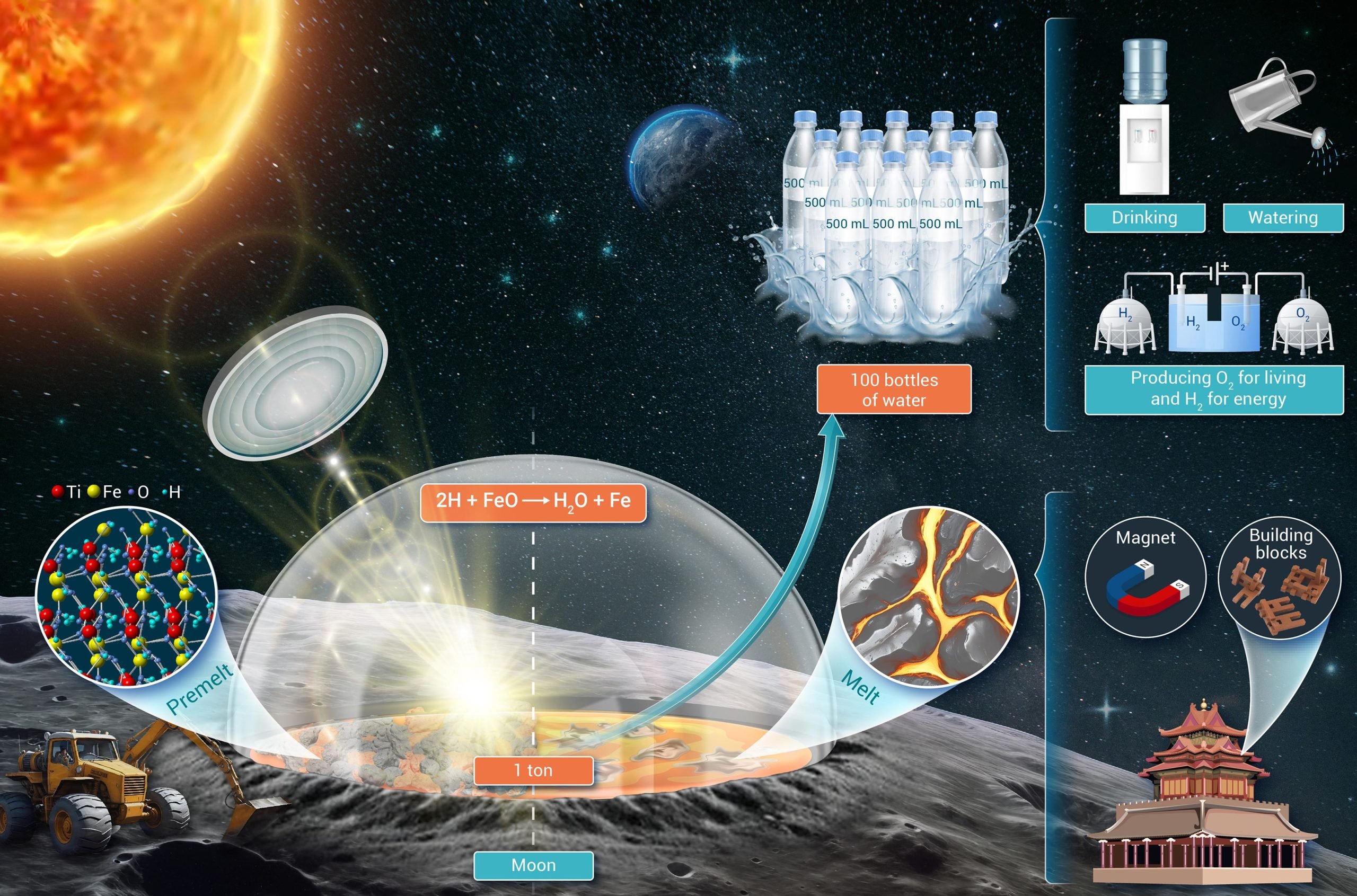
    The strategy for in situ water production on the Moon through the reaction between lunar regolith and endogenous hydrogen. Credit: NIMTE

    Researchers have developed a method to produce significant amounts of water on the Moon by reacting lunar regolith with hydrogen.

    This innovative process could potentially yield over 50 kg of water from a ton of lunar soil, paving the way for sustainable human life and research stations on the Moon.

    Lunar Water Extraction

    Water plays a crucial role in human survival on the lunar surface, thus attracting extensive research attention. Prof. Junqiang Wang’s team at the Ningbo Institute of Materials Technology and Engineering (NIMTE) of the Chinese Academy of Sciences (CAS) has recently developed a new method of massive water production through reaction between lunar regolith and endogenous hydrogen.

    Research results of previous lunar explorations, like the Apollo and Chang’E-5 missions, have revealed the widespread presence of water on the Moon. However, the water content in lunar minerals is extremely low, ranging from 0.0001% to 0.02%. It remains challenging to extract and utilize water in situ on the Moon.

    Breakthrough in Lunar Hydrogen Utilization

    “We used lunar regolith samples brought back by the Chang’E-5 mission in our study, trying to find a way to produce water on the Moon,” said Wang.

    The study revealed that when the lunar regolith is heated above 1,200 K with concave mirrors, one gram of molten lunar regolith can generate 51–76 mg of water. In other words, one ton of lunar regolith could produce more than 50 kg of water, which is equal to about a hundred 500-ml bottles of drinking water. This would be enough drinking water for 50 people for one day.

    Exploring Mineral Resources for Sustained Life on the Moon

    In addition, lunar ilmenite (FeTiO3) was found to contain the highest amount of solar wind-implanted hydrogen among the five primary minerals in the lunar regolith, owing to its unique lattice structure with sub-nanometer tunnels.

    In-situ heating experiments indicated that hydrogen in lunar minerals is a substantial resource for producing water on the Moon. Such water could be used both for drinking and irrigating plants. In addition it could be electrochemically decomposed into hydrogen and oxygen, with hydrogen being used for energy and oxygen being essential for breathing.

    These discoveries provide pioneering insights into water exploration on the Moon and shed light on the future construction of lunar research stations.

    The results of the study were published in the scientific journal The Innovation.

    Reference: “Massive Water Production from Lunar Ilmenite through Reaction with Endogenous Hydrogen” by Xiao Chen, Shiyu Yang, Guoxin Chen, Weixu, Lijian Song, Ao Li, Hangbo Ce Yin, Weixing Xia, Meng Gao, Ming Li, Haichen Wu, Junfeng Cui, Lei Zhang, Lijing Miao, Xiaoxue Shui, Weiping Xie, Peiling Ke, Yongjiang Huang, Jianfei Sun, Bingnan Yao, Min Ji, Mingliang Xiang, Yan Zhang, Shaofan Zhao, Wei Yao, Zhigang Zou, Mengfei Yang, Weihua Wang, Juntao Huo, Jun-Qiang Wang and Haiyang Bai, 22 August 2024, The Innovation.
    DOI: 10.1016/j.xinn.2024.100690

    Never miss a breakthrough: Join the SciTechDaily newsletter.
    Follow us on Google and Google News.

    Chinese Academy of Sciences Moon Water
    Share. Facebook Twitter Pinterest LinkedIn Email Reddit

    Related Articles

    Dry Moon Rising: Chang’e-6 Uncovers a Hidden Water Divide in Lunar Mantle

    Chinese Scientists Discover Water Reservoir on the Moon

    “Ocean of Storms” – China’s Lunar Lander Finds Source of Water on Moon

    China’s Chang’E-5 Lander Makes First Onsite Detection of Water on the Moon

    Hidden Pockets of Water Could Be Common on the Surface of the Moon

    NASA’s Airborne Observatory Discovers Water on Sunlit Surface of Moon

    Composition Revealed of Weird Glistening “Gel-Like” Substance Discovered on Far Side of the Moon

    Lunar Rover Reveals What Lurks 40 Meters Below Surface on Far Side of the Moon

    New Study Reveals Amount of Water Present in the Moon May Have Been Overestimated

    Leave A Reply Cancel Reply

    • Facebook
    • Twitter
    • Pinterest
    • YouTube

    Don't Miss a Discovery

    Subscribe for the Latest in Science & Tech!

    Trending News

    Largest-Ever Study Finds Medicinal Cannabis Ineffective for Anxiety, Depression, PTSD

    250-Million-Year-Old Egg Solves One of Evolution’s Biggest Mysteries

    Living With Roommates Might Be Changing Your Gut Microbiome Without You Knowing

    Century-Old Cleaning Chemical Linked to 500% Increased Risk of Parkinson’s Disease

    What if Your Memories Never Happened? Physicists Take a New Look at the Boltzmann Brain Paradox

    One of the Universe’s Largest Stars May Be Getting Ready To Explode

    Scientists Discover Enzyme That Could Supercharge Ozempic-Like Weight Loss Drugs

    Popular Sweetener Linked to DNA Damage – “It’s Something You Should Not Be Eating”

    Follow SciTechDaily
    • Facebook
    • Twitter
    • YouTube
    • Pinterest
    • Newsletter
    • RSS
    SciTech News
    • Biology News
    • Chemistry News
    • Earth News
    • Health News
    • Physics News
    • Science News
    • Space News
    • Technology News
    Recent Posts
    • A Cosmic Crash Turned This Nearby Galaxy Into Chaos
    • This Alien Solar System Doesn’t Follow the Rules – and Scientists Are Intrigued
    • What Did Prehistoric Europeans Eat? Scientists Uncover Surprising Answers
    • Scientists Say This Overlooked Organ Could Hold the Key to Longer Life
    • Want Less Stress? Landmark Study Points to a Simple Habit
    Copyright © 1998 - 2026 SciTechDaily. All Rights Reserved.
    • Science News
    • About
    • Contact
    • Editorial Board
    • Privacy Policy
    • Terms of Use

    Type above and press Enter to search. Press Esc to cancel.