
Close Menu
    Facebook X (Twitter) Instagram
    SciTechDaily
    • Biology
    • Chemistry
    • Earth
    • Health
    • Physics
    • Science
    • Space
    • Technology
    Facebook X (Twitter) Pinterest YouTube RSS
    SciTechDaily
    Home»Space»Dry Moon Rising: Chang’e-6 Uncovers a Hidden Water Divide in Lunar Mantle
    Space

    Dry Moon Rising: Chang’e-6 Uncovers a Hidden Water Divide in Lunar Mantle

    By Chinese Academy of SciencesApril 9, 2025No Comments4 Mins Read
    Facebook Twitter Pinterest Telegram LinkedIn WhatsApp Email Reddit
    Share
    Facebook Twitter LinkedIn Pinterest Telegram Email Reddit
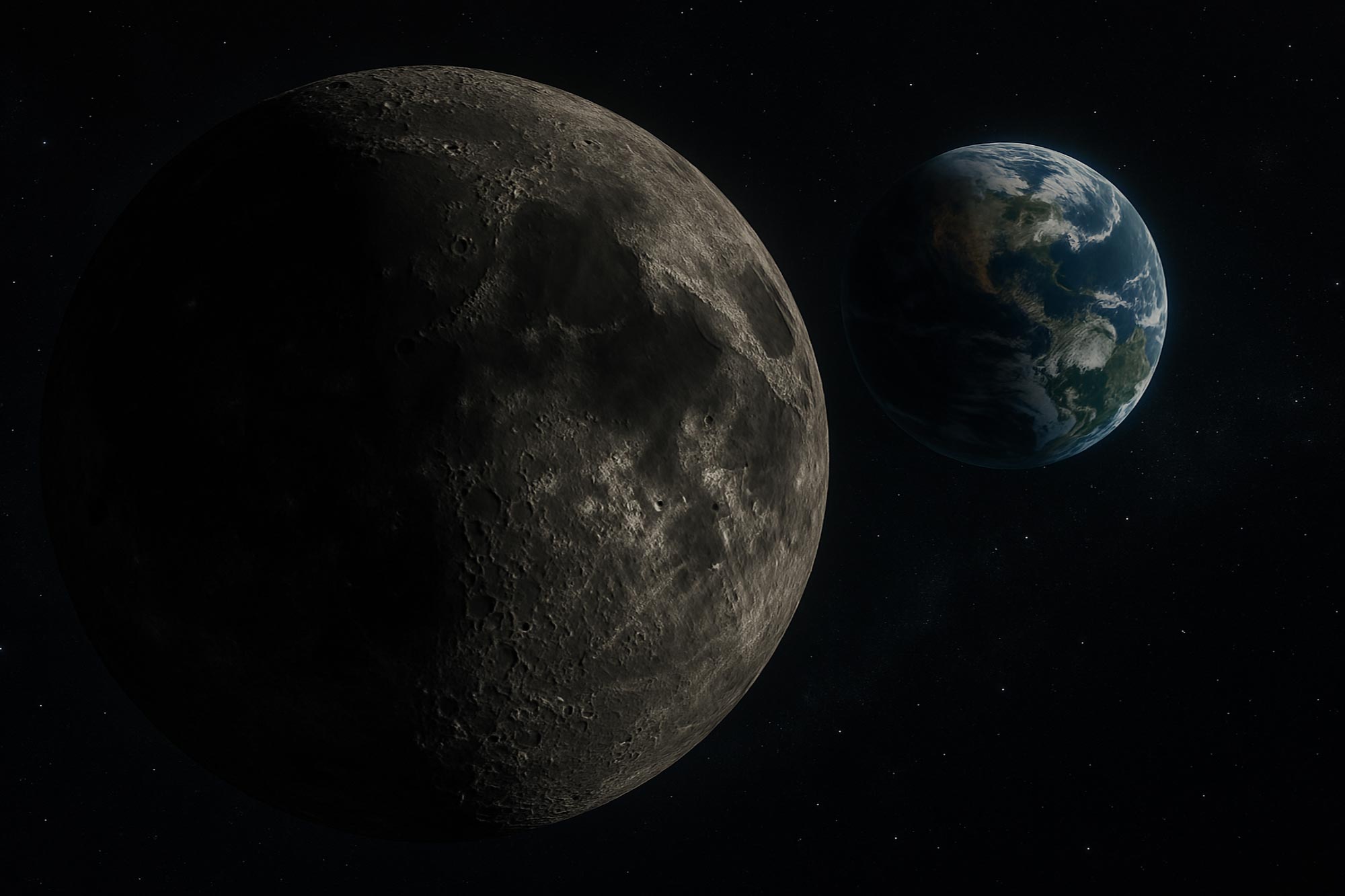
    Earth Moon Space Art Concept Illustration
    The Moon’s farside mantle is much drier than the nearside, according to new data from China’s Chang’e-6 mission, revealing a hidden hemispheric divide in lunar water. Credit: SciTechDaily.com

    Chinese scientists analyzing samples from the Moon’s farside have uncovered that its mantle holds significantly less water than the nearside—a finding that hints at a deep, internal divide within our celestial neighbor.

    This discovery, based on basalt samples returned by China’s Chang’e-6 mission, offers new insight into the Moon’s mysterious formation and evolution. It could even reshape theories about the Moon’s violent origins and how water shaped its interior over billions of years.

    Drier Mantle on the Lunar Farside

    Chinese scientists have found that the Moon’s mantle contains significantly less water on the farside than on the nearside, based on a new analysis of volcanic rocks collected by the Chang’e-6 lunar mission.

    The research, led by Prof. Hu Sen from the Institute of Geology and Geophysics at the Chinese Academy of Sciences, was published today (April 9) in Nature. The team examined basalts from the lunar farside and found that their mantle source contains only 1 to 1.5 micrograms of water per gram, far lower than levels typically found on the nearside. This discovery could provide important clues about how the Moon formed and how its interior evolved over time.

    Chang’e 6 Lander and Ascender
    Chang’e 6 lander and ascender. Credit: China National Space Administrationdrct

    Water Variation Across the Moon

    Previous studies of nearside lunar samples have shown that water in the Moon’s interior is unevenly distributed, with concentrations ranging from about 1 to 200 μg/g.

    Notably, the crust exposed at the surface of the Procellarum KREEP Terrane on the lunar nearside has a higher thorium (Th) concentration than the other two primary lunar geochemical provinces: the Feldspathic Highlands and the South Pole–Aitken (SPA) Basin on the lunar farside.
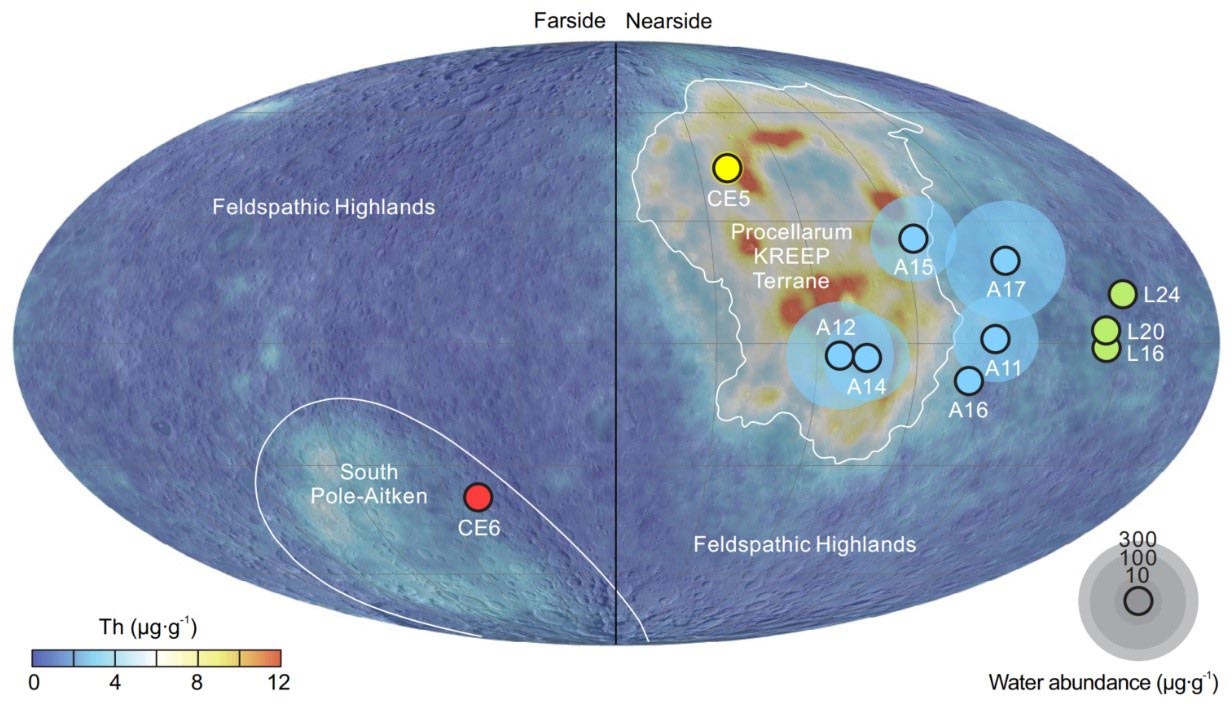
    Lunar Sample Return Water Content Estimates
    Lunar sample return sample missions with associated water content estimates. Credit: Prof. HU Sen’s group

    Incompatible Elements and Lunar Dryness

    Both Th and water are considered incompatible elements during magmatic processes, meaning they preferentially remain in the melt rather than becoming incorporated into crystallizing minerals. This geochemical behavior suggests that the mantle beneath the SPA Basin, on the lunar farside, may contain a lower abundance of water.

    To confirm this hypothesis, the research team focused on analyzing water content and hydrogen isotopes in melt inclusions and apatite within CE6 mare basalts—the first samples returned from the farside SPA Basin.

    Measuring Moon’s Hidden Water

    The team’s results indicate that the parent magma of these basalts contains 15-168 μg/g of water. Additionally, the team estimated that the mantle source of the CE6 basalts has a water content of 1-1.5 μg/g, significantly lower than that of the nearside mantle.

    A New Look at Lunar Origins

    This disparity points to a potential hemispheric dichotomy in the Moon’s internal water distribution, mirroring many of the asymmetrical features observed on the lunar surface.

    This new estimate of the lunar farside mantle’s water content marks a significant step forward in refining our understanding of the bulk silicate Moon’s water inventory. It provides important constraints on the giant-impact hypothesis of the Moon’s origin and underscores the role of water in the Moon’s long-term evolution.

    Reference: “Water abundance in the lunar farside mantle” by Huicun He, Linxi Li, Sen Hu, Yubing Gao, Liang Gao, Zhan Zhou, Mengfan Qiu, Disheng Zhou, Huanxin Liu, Ruiying Li, Jialong Hao, Hejiu Hui and Yangting Lin, 9 April 2025, Nature.
    DOI: 10.1038/s41586-025-08870-x

    This study was conducted in collaboration with Nanjing University and supported by the National Natural Science Foundation of China, the Strategic Priority Research Program of the Chinese Academy of Sciences, and other funding agencies.

    Never miss a breakthrough: Join the SciTechDaily newsletter.
    Follow us on Google and Google News.

    Chinese Academy of Sciences Moon Water
    Share. Facebook Twitter Pinterest LinkedIn Email Reddit

    Related Articles

    How Scientists Are Turning Moon Dust Into Drinking Water

    Chinese Scientists Discover Water Reservoir on the Moon

    “Ocean of Storms” – China’s Lunar Lander Finds Source of Water on Moon

    China’s Chang’E-5 Lander Makes First Onsite Detection of Water on the Moon

    Hidden Pockets of Water Could Be Common on the Surface of the Moon

    NASA’s Airborne Observatory Discovers Water on Sunlit Surface of Moon

    Composition Revealed of Weird Glistening “Gel-Like” Substance Discovered on Far Side of the Moon

    Lunar Rover Reveals What Lurks 40 Meters Below Surface on Far Side of the Moon

    New Study Reveals Amount of Water Present in the Moon May Have Been Overestimated

    Leave A Reply Cancel Reply

    • Facebook
    • Twitter
    • Pinterest
    • YouTube

    Don't Miss a Discovery

    Subscribe for the Latest in Science & Tech!

    Trending News

    Largest-Ever Study Finds Medicinal Cannabis Ineffective for Anxiety, Depression, PTSD

    250-Million-Year-Old Egg Solves One of Evolution’s Biggest Mysteries

    Living With Roommates Might Be Changing Your Gut Microbiome Without You Knowing

    Century-Old Cleaning Chemical Linked to 500% Increased Risk of Parkinson’s Disease

    What if Your Memories Never Happened? Physicists Take a New Look at the Boltzmann Brain Paradox

    One of the Universe’s Largest Stars May Be Getting Ready To Explode

    Scientists Discover Enzyme That Could Supercharge Ozempic-Like Weight Loss Drugs

    Popular Sweetener Linked to DNA Damage – “It’s Something You Should Not Be Eating”

    Follow SciTechDaily
    • Facebook
    • Twitter
    • YouTube
    • Pinterest
    • Newsletter
    • RSS
    SciTech News
    • Biology News
    • Chemistry News
    • Earth News
    • Health News
    • Physics News
    • Science News
    • Space News
    • Technology News
    Recent Posts
    • Challenging the Narrative: New Study Shows U.S. Life Expectancy Is Rising Across All States
    • Mystery Illness Kills 5 in Burundi As Doctors Scramble for Answers
    • Bone-Strengthening Discovery Could Reverse Osteoporosis
    • The Most Elusive Number in Physics Just Got Even More Mysterious
    • Scientists Uncover Hidden Trigger Behind Stem Cell Aging
    Copyright © 1998 - 2026 SciTechDaily. All Rights Reserved.
    • Science News
    • About
    • Contact
    • Editorial Board
    • Privacy Policy
    • Terms of Use

    Type above and press Enter to search. Press Esc to cancel.