
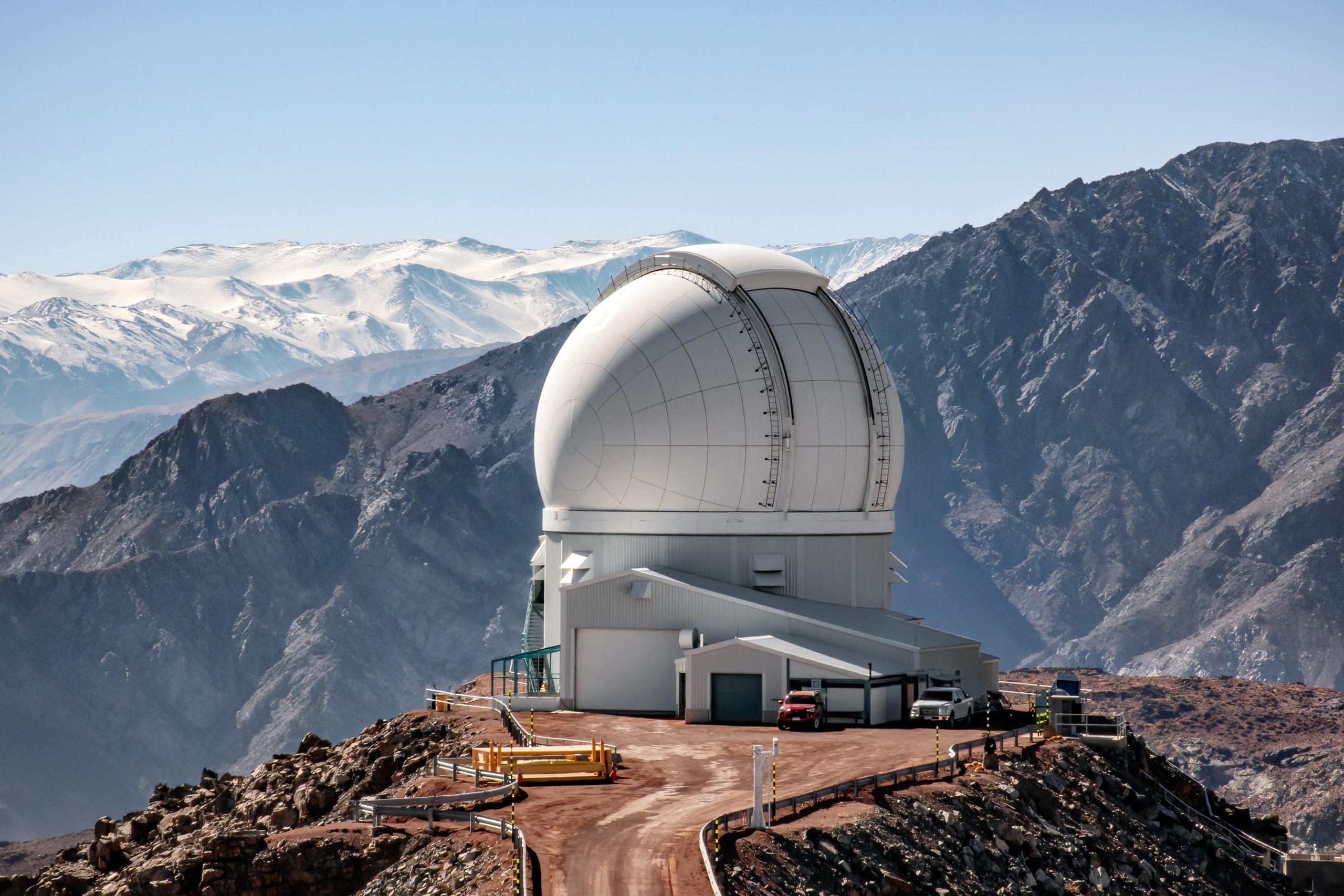
Researchers have recently utilized skipper charge-coupled devices (CCDs) on the 4.1-meter Southern Astrophysical Research Telescope to capture the first astronomical spectrum using this technology.
Recent advancements in skipper CCD technology have enabled precise, low-noise astronomical observations, paving the way for future scientific breakthroughs in cosmology and beyond.
Using an instrument on the 4.1-meter Southern Astrophysical Research (SOAR) Telescope, researchers obtained the first astronomical spectrum using skipper charge-coupled devices (CCDs).
The results were presented on June 16 at the Society of Photo-Optical Instrumentation Engineers Astronomical Telescopes + Instrumentation meeting in Japan by Edgar Marrufo Villalpando, a physics PhD candidate at the University of Chicago and a Fermilab DOE Graduate Instrumentation Research Award Fellow.
Technological Milestone in Astronomy
“This is a major milestone for skipper-CCD technology,” said Alex Drlica-Wagner, a cosmologist at the U.S. Department of Energy’s Fermi National Accelerator Laboratory who led the project. “It helps to retire the perceived risks for using this technology in the future, which is vitally important for future DOE cosmology projects.”
This is an important achievement for a project conceived and initiated through the Laboratory Directed Research and Development program at Fermilab in collaboration with NSF’s NOIRLab detector group. LDRD is a national program sponsored by the DOE that allows national laboratories to internally fund research and development projects that explore new ideas or concepts.
Historical Context and Technological Evolution
CCDs were invented in the United States in 1969, and forty years later scientists were awarded the Nobel Prize in Physics for their achievement. The devices are two-dimensional arrays of light-sensitive pixels that convert incoming photons into electrons. Conventional CCDs are the image sensors first used in digital cameras, and they remain the standard for many scientific imaging applications, such as astronomy, though their precision is limited by electronic noise.
Cosmologists seek to understand the mysterious natures of dark matter and dark energy by studying the distributions of stars and galaxies. To do this, they need advanced technology that can see fainter, more distant astronomical objects with as little noise as possible.
Breakthrough in Noise Reduction with Skipper CCDs
Existing CCD technology can make these measurements but take a long time or are less efficient. So, astrophysicists must either increase the signal — i.e., by investing more time on the world’s largest telescopes — or decrease the electronic noise.
Skipper CCDs were introduced in 1990 to reduce electronic noise to levels that allow the measurement of individual photons. They do this by taking multiple measurements of interesting pixels and skipping the rest. This strategy enables skipper CCDs to increase the precision of measurements in interesting regions of the image while reducing total readout time.
First Astronomical Application of Skipper CCDs
In 2017, scientists pioneered the use of skipper CCDs for dark matter experiments such as SENSEI and OSCURA, but the recent presentation showed the first time the technology was used to observe the night sky and collect astronomical data.
On March 31 and April 9, the researchers used skipper CCDs in the SOAR Integral Field Spectrograph to collect astronomical spectra from a galaxy cluster, two distant quasars, a galaxy with bright emission lines, and a star that is potentially associated with a dark-matter-dominated ultra-faint galaxy. In a first for astrophysical CCD observations, they achieved sub-electron readout noise and counted individual photons at optical wavelengths.
“What’s incredible is that these photons traveled to our detectors from objects billions of light-years away, and we could measure each one individually,” said Marrufo Villalpando.
Impact and Future Applications of Skipper CCDs
Researchers are analyzing data from these first observations, and the next scheduled run for the skipper-CCD instrument on the SOAR Telescope is in July 2024.
“Many decades have passed since the skipper was born, so I was surprised to see the technology come to life again many decades later,” said Jim Janesick, inventor of the skipper CCD and a distinguished engineer at SRI International, a research institute based in California. “The noise results are amazing! I fell off my seat when I saw the very clean data.”
“Many decades have passed since the skipper was born, so I was surprised to see the technology come to life again,” said Jim Janesick, inventor of the skipper CCD and a distinguished engineer at SRI International, a research institute based in California. “The noise results are amazing! I fell off my seat when I saw the very clean sub-electron noise data.”
Advancements and Future Prospects for Skipper CCD Technology
With the first successful demonstration of skipper-CCD technology for astrophysics, scientists are already working to improve it. The next generation of skipper CCDs, developed by Fermilab and Lawrence Berkeley National Laboratory, is 16 times faster than current devices. These new devices will greatly reduce readout time, and researchers have already begun testing them in the laboratory.
The next generation of skipper CCDs has been identified for use in future DOE cosmology efforts, such as the spectroscopic experiments DESI-II and Spec-S5, recommended by the recent U.S. particle physics planning process. In addition, NASA is considering skipper CCDs for the forthcoming Habitable Worlds Observatory that will attempt to detect earth-like planets around sun-like stars.
“I’m looking forward to seeing where these detectors might end up,” said Marrufo Villalpando, who joined the program in 2019. “People are using them for amazing things all over; their utility ranges from particle physics to cosmology. It’s a very versatile and useful technology.”
The project was a close collaboration between physicists, astronomers and engineers at Fermilab, University of Chicago, the National Science Foundation’s NOIRLab, DOE’s Lawrence Berkeley National Laboratory, and the National Astrophysical Laboratory of Brazil.
Never miss a breakthrough: Join the SciTechDaily newsletter.
Follow us on Google and Google News.
1 Comment
Watched and – same new’s with some written coment’s and extended para’s ..any how i-try later on such ..some trouble with metore and around earth surface. close or saved with peripheral–angles and dashing speed..any with crushes of stone and fricle’s dark in colour and deformed shape as observed in screen — wobbling ahead with ruptured image in web new’s..since several hour’s..take care good luck god save’s men and ther earth ‘s natures. bye–caoutious.