
Researchers are developing simple and inexpensive tools — like a DIY ventilator — to treat patients more effectively and prevent disease transmission in hospitals.
The rapid spread of COVID-19 overwhelmed hospitals that were unable to contend with the increasing number of patients, many requiring ventilators and other critical care. Such conditions can put medical workers at risk. Now researchers are studying methods to increase hospital safety and efficacy during the pandemic.
A shortage of life-saving ventilators, which typically cost around $30,000 each, hit hospitals particularly hard.
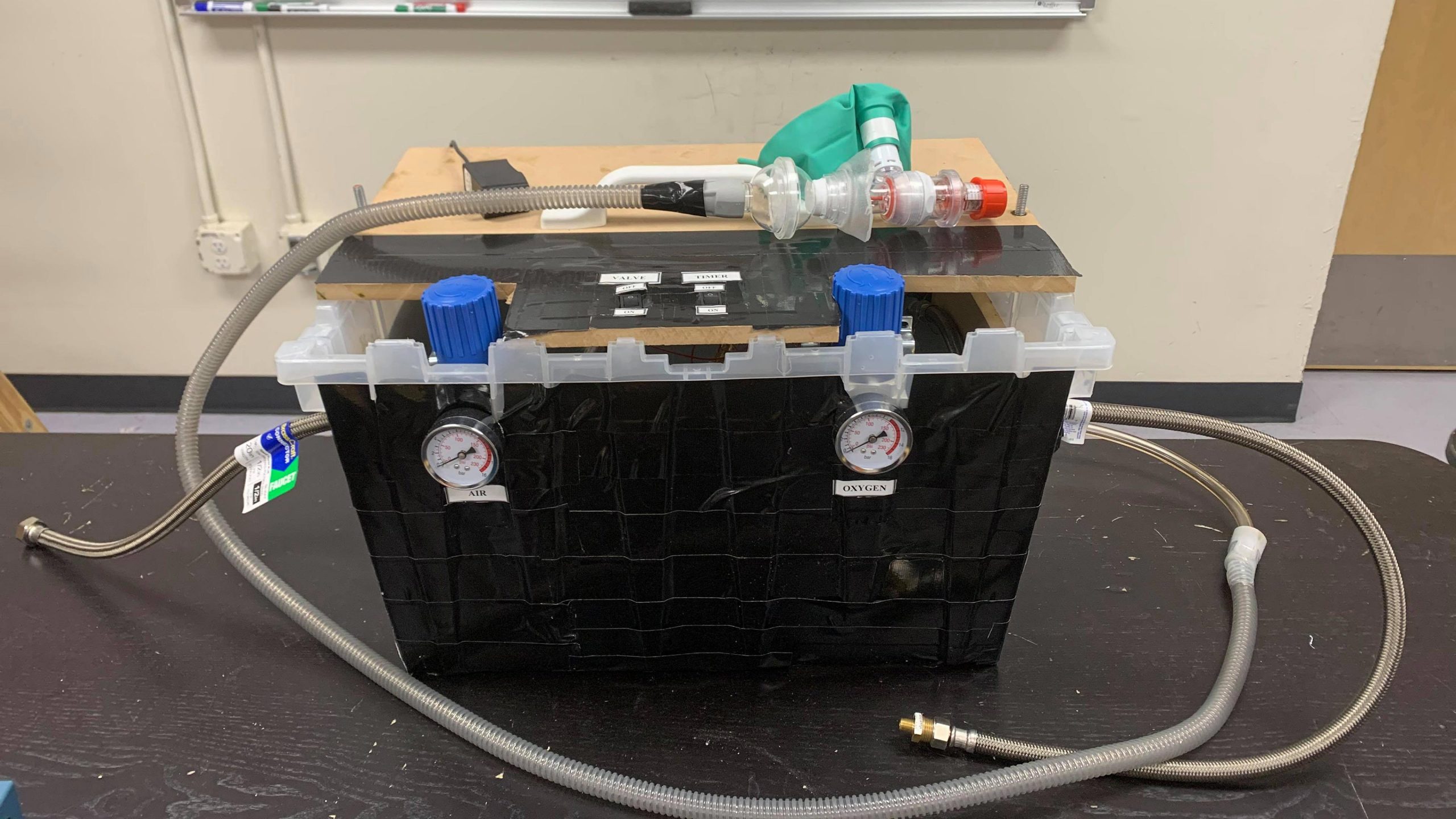
“By building a simple and cheap ventilator, we can help alleviate this burden for the medical staff,” said Mohamed Amine Abassi, a PhD student in fluid mechanics.
Based on a prototype designed by his advisor, engineering professor Xiaofeng Liu, Abassi spearheaded an effort with colleagues from San Diego State University and the University of California San Diego to build such a device from readily available parts — plastic tubing, pressure valves, humidifier — and an air supply. Then they tested it.
Preliminary results shared at the 73rd Annual Meeting of the American Physical Society’s Division of Fluid Dynamics suggest the ventilator meets essential requirements set by the Food and Drug Administration. It is fully controllable on three parameters — air pressure, inspiration time, and Positive End Expiratory Pressure (PEEP) — with plans for more controls in the works.
Abassi and Liu foresee the ventilators assisting not just overwhelmed hospitals in the United States but also in developing countries and rural areas with limited medical infrastructure. “If they can build it at home, they can use it,” said Abassi. “And you can build many of these ventilators in a very short time.”
Patients on ventilators who have some pulmonary conditions relevant to COVID-19 with underlying chronic lung diseases will often receive drugs like albuterol through an endotracheal tube. This treatment relaxes the bronchial muscles and improves airflow to the constricted lung airways.
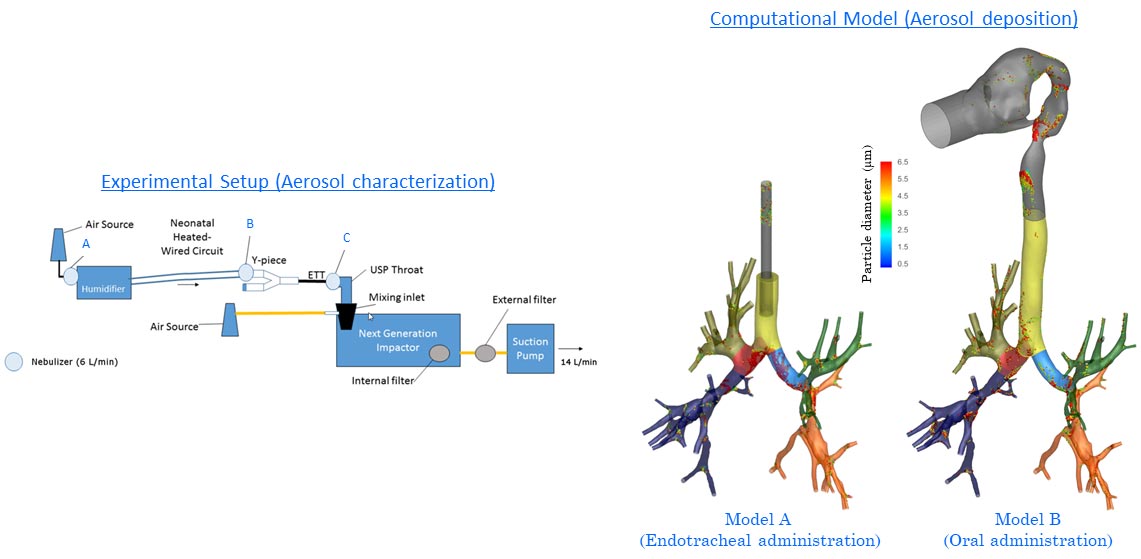
A group from Lehigh University and the University of Arkansas for Medical Sciences sought the most effective methods for administering albuterol via ventilator.
Ariel Berlinski and his group conducted aerosol characterization experiments at the University of Arkansas. Rahul Rajendran at Lehigh used the results to investigate drug delivery through computations.
“The research objective was to evaluate the efficiency of drug delivery when the nebulizer type and its placement were varied in the ventilator circuit,” said Arindam Banerjee, a member of the group and a Lehigh professor of mechanical engineering and mechanics.
The researchers found that a vibrating mesh (rather than a jet) nebulizer placed on the dry side of the humidifier delivers the highest dose to the lung. Administering albuterol through intubation works most effectively for smaller particles, while oral administration is more efficient for larger particles.
“Our results are vital for mechanical ventilator based treatment,” said Banerjee.
Even in optimal circumstances, healthcare workers still risk contracting COVID-19. A new respiratory apparatus could reduce exhaled aerosols, which are known to transmit the virus that causes the disease.
Researchers from Liberty University and Vapotherm wondered how common respiratory treatments would affect aerosol emissions. So they decided to test a proposed design for a PVC face mask connected to suction, adding a high-velocity nasal insufflation cannula — the kind of tubed device that delivers oxygen to the nose.
Then, with input from medical experts, they modeled a hospital room with two patients and four caregivers using highly sophisticated computational techniques. According to their model, when patients wear the new apparatus, fewer particles reach the healthcare workers.
“It represents an inexpensive way to reduce the spread of airborne contagion using supplies commonly found in hospital rooms already,” said engineering PhD candidate Reid Prichard. “This will remain an important tool even after the pandemic is over.”
Another group from the University of South Florida, led by mechanical engineering PhD student Anthony Perez, is investigating what happens to any aerosol contaminants that patients do emit into a hospital isolation room — and how quickly the contaminants leave the room.
“As many hospitals are reaching capacity, ensuring a hospital room is safe to enter after an aerosol-generating procedure — or after the removal of a previous patient so hygiene workers can prepare the room — requires significant down time,” said Perez.
According to the researchers, the Centers for Disease Control and Prevention ventilation recommendations assume pathogen-containing aerosols are perfectly mixed within a room. Using numerical simulations, the group finds that imperfect mixing conditions significantly affect how quickly ventilation removes pathogens from a room.
“It is both surprising and somewhat concerning that the standard for air sanitization is based on what many would consider a back-of-an-envelope calculation,” said Perez.
The simulations suggest aerosol contaminants can linger in “dead zones” for around 10 minutes in a typical hospital isolation room. Meanwhile, “short circuits” expel some packets of contaminants quickly before they can disperse.
“Our research illustrates the need for a more accurate, yet inexpensive, framework for the prediction of aerosol concentrations in an arbitrary hospital room, especially in assessing the level of exposure of healthcare workers,” said Perez.
References:
Design, Build and Test of an In-House Made Ventilator System
Novel Use of a Common Respiratory Treatment: Diminishing COVID-19 Transmission
Never miss a breakthrough: Join the SciTechDaily newsletter.
Follow us on Google and Google News.
1 Comment
Interesting.
Practical and Localizaton of Knowledge transfer in Pandemic times —must be made available irrespective of Differences ( Political,Economic or anything else), as the pandemic is agnostice in nature and is complicated by mutations which can spread even faster and be more lethal. Humanity’s Response must ALSO be agnostic AND Global in Nature. If not , it is tantamount to a Global Genocide let lose on Humanity. As even one person who is infected can start the same cycle of infection , treatment , cure and search for the same of unknown mutated strain of the virus and flood the hospitals with patients. Sure , more buisness for Hospitals , accompanied by More Risk for the selfless Health care Workers. Please do remember as well, that as the treatments , cures, prevention technologies simply do not exist or are available off the shelf and reaction times and panic created is normal , it can ensure success of the Viral, Bacterial and Pathogen infections in the battle for survival of Humanity.
All this is post -infection. Classified as Lagging Indicators. Lead Indicators to prevent likelihood of indication and protecting those members of Humanity including Health care workers is even more critical People come to health care centres and hospitals seeking assistance after the infection. Takingg Health care to the individual communities, providing early warning systems for handling the spread and minimising the same , and Monitoring the same in terms of Viral Load and providing neutralizing agents is a essential integrated technology , yet to be invented or made available globally.