
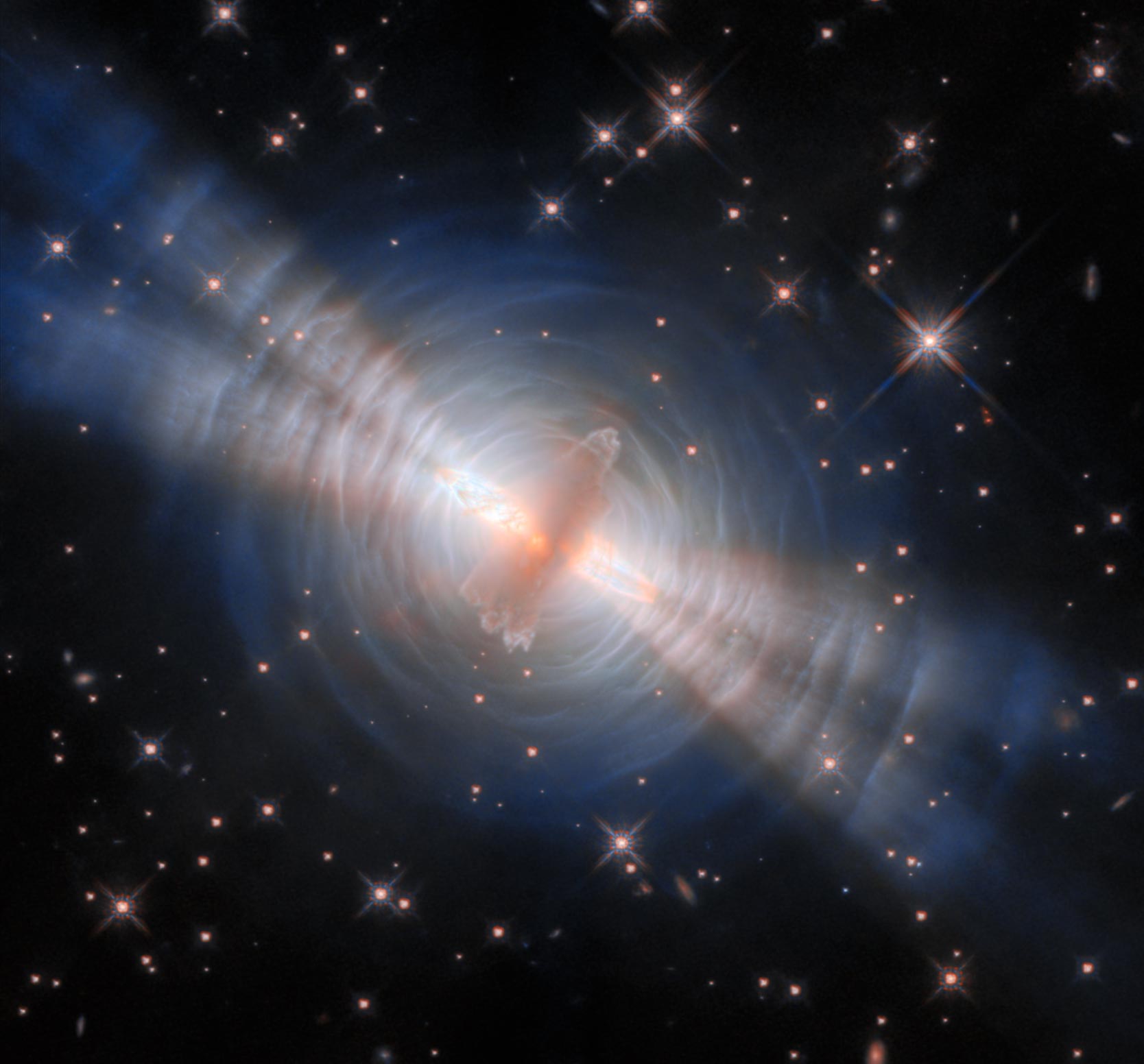
Hubble captures a dying star cracking open the dazzling, dust-filled Egg Nebula in a rare cosmic transformation.
NASA’s Hubble Space Telescope has captured a striking new image of the Egg Nebula, revealing a complex pattern of brightness and shadow shaped by newly expelled stardust. About 1,000 light-years away in the constellation Cygnus, this unusual object surrounds a central star hidden behind a thick cloud of dust — resembling a glowing “yolk” enclosed within a dark “egg white.” Hubble’s exceptional clarity exposes delicate structures that offer clues about how this mysterious formation is evolving.
The Egg Nebula holds a unique place in astronomy. It is the first, youngest, and closest pre-planetary nebula ever discovered. (A pre-planetary nebula is a precursor stage of a planetary nebula, which is a structure of gas and dust formed from the ejected layers of a dying, Sun-like star. The term is a misnomer, as planetary nebulae are not related to planets.)
A Rare Stage in Stellar Evolution
Because the Egg Nebula is in such an early phase, it provides scientists with a rare chance to study the final stages of a Sun-like star’s life. At this point, the nebula does not yet glow from energized gas. Instead, it shines by reflecting light from its central star. That light escapes through a polar opening, or “eye,” in the surrounding dust. The glow originates from a dense, dusty disk that the star expelled only a few hundred years ago.
Two bright beams extend outward from the dying star, lighting up fast moving polar lobes that push through older, slower shells arranged in concentric arcs. The symmetry and motion of these structures suggest that gravity from one or more unseen companion stars may be shaping the outflow. Those companions remain concealed deep within the thick disk of dust.
From Sun Like Star to Planetary Nebula
Stars similar to our Sun eventually exhaust their hydrogen and helium fuel and begin shedding their outer layers. As the hot core is exposed, it emits intense radiation that ionizes nearby gas, producing the glowing shells seen in planetary nebulae such as the Helix, Stingray, and Butterfly nebulae. The Egg Nebula, however, has not yet reached that stage. It is still in a short transitional period known as the pre-planetary stage — a phase that lasts only a few thousand years. Observing it now allows astronomers to examine the mass ejection process while the evidence remains fresh.
The orderly patterns captured by Hubble make it clear that this structure was not created by a violent explosion like a supernova. Instead, the arcs, lobes, and central dust cloud likely formed through a coordinated series of sputtering outbursts within the carbon-enriched core of the aging star. Stars at this point in their lives create and release vast amounts of dust. That material can later become part of new star systems, including our own solar system, which formed into Earth and other rocky planets 4.5 billion years ago.
Hubble’s Ongoing Observations
Hubble has observed the Egg Nebula several times over the decades. An early visible light image from WFPC2 (Wide Field and Planetary Camera 2) was followed in 1997 by a near infrared view from NICMOS (Near Infrared Camera and Multi-Object Spectrometer), offering a closer look at the nebula’s glow. In 2003, the ACS (Advanced Camera for Surveys) revealed the full sweep of dusty ripples surrounding the object. Observations from WFC3 (Wide Field Camera 3) in 2012 zoomed in on the dense central dust cloud and dramatic gas outflows. The latest image combines data from the 2012 program with additional observations, providing the most detailed portrait yet of this intricate cosmic egg.
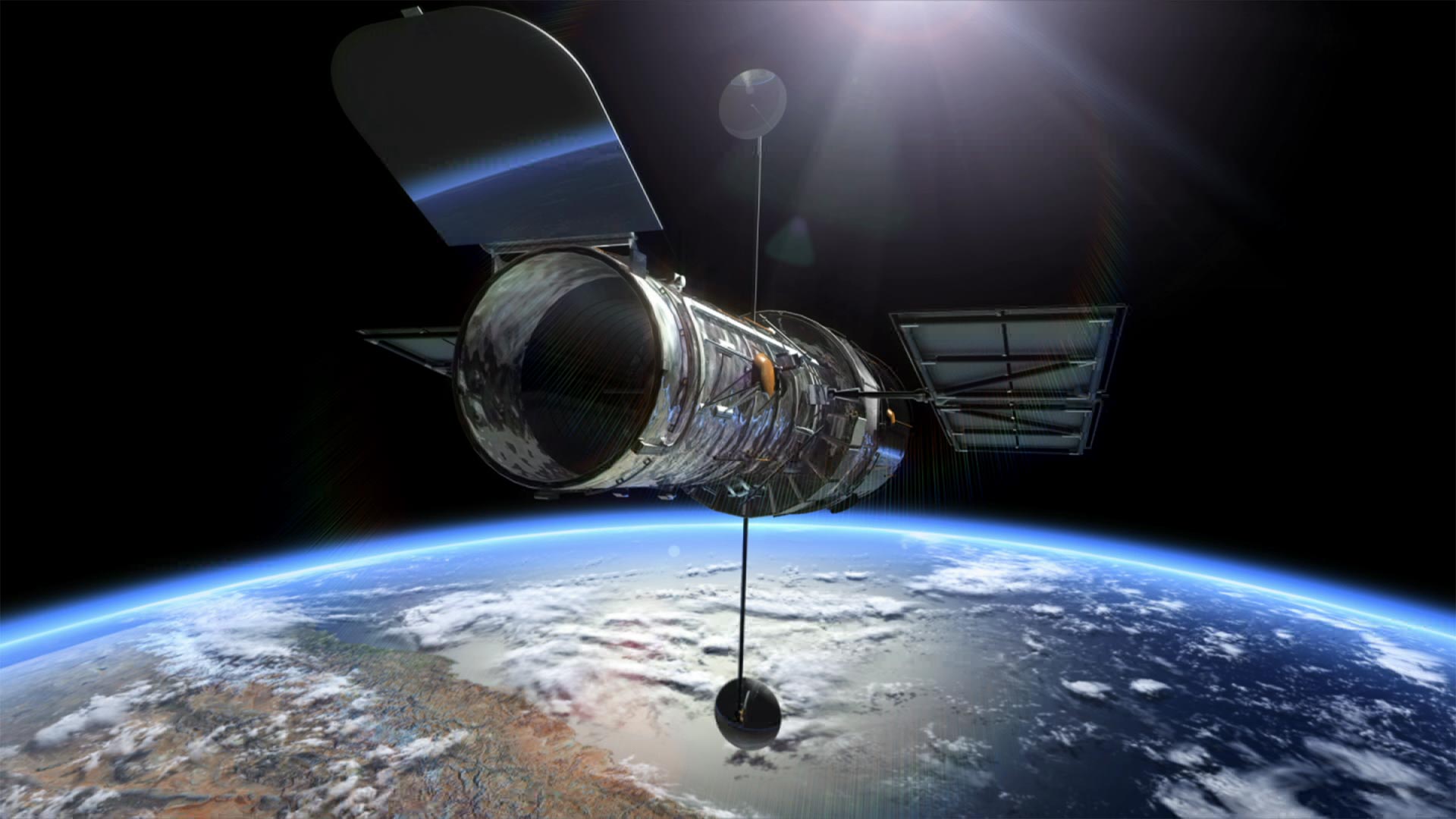
For more than 30 years, the Hubble Space Telescope has continued to deliver discoveries that deepen our understanding of the universe. The mission is a collaboration between NASA and ESA (European Space Agency). NASA’s Goddard Space Flight Center in Greenbelt, Marylan,d oversees telescope and mission operations, with additional support from Lockheed Martin Space in Denver. The Space Telescope Science Institute in Baltimore, operated by the Association of Universities for Research in Astronomy, manages Hubble’s science operations for NASA.
Never miss a breakthrough: Join the SciTechDaily newsletter.
Follow us on Google and Google News.