
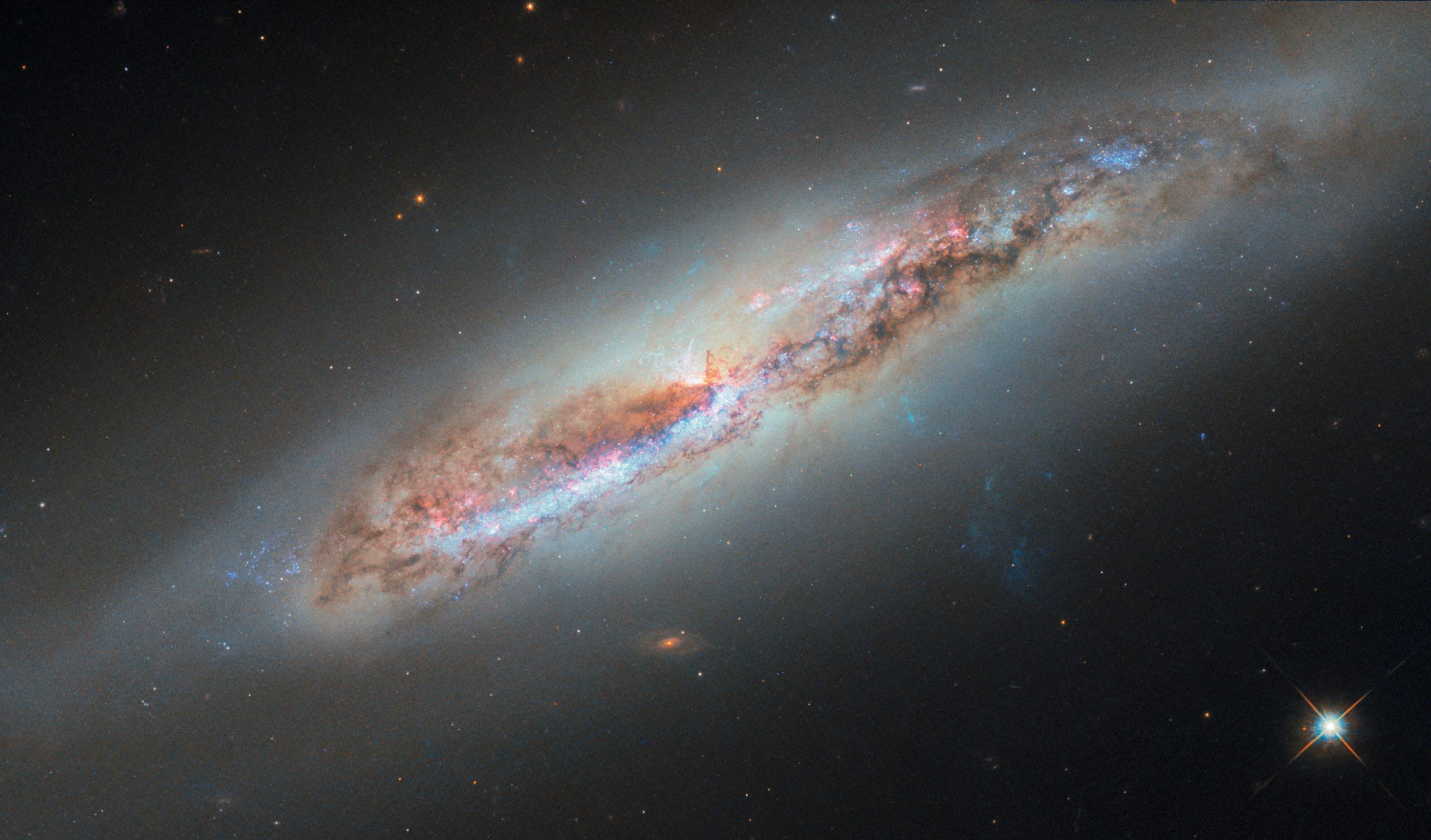
Hubble catches a spiral galaxy mid-flight, shedding glowing gas as it battles the harsh environment of a nearby galaxy cluster.
This striking ESA Hubble Picture of the Week highlights a spiral galaxy seen almost perfectly from the side. Known as NGC 4388, the galaxy lies about 60 million light-years from Earth in the constellation Virgo (The Maiden). It is part of the Virgo galaxy cluster, a massive collection of more than a thousand galaxies, and the closest large galaxy cluster to our own Milky Way.
A Hidden Feature Comes Into View
NGC 4388 is angled so sharply toward Earth that astronomers see it nearly edge-on. This unusual orientation reveals a detail that did not appear in an earlier Hubble image released in 2016. A stream of gas can now be seen flowing outward from the galaxy’s center, spreading away from the disc toward the lower-right corner of the image. This newly revealed plume raises an obvious question: what caused the gas to escape, and what makes it glow?
The Invisible Gas Between Galaxies
The explanation likely involves the environment inside the Virgo cluster itself. While the space separating galaxies may look empty, it actually contains thin, extremely hot gas known as the intracluster medium. As NGC 4388 moves through the cluster, it travels directly through this hot material. The resulting pressure strips gas from the galaxy’s disc, pulling it backward and leaving a trailing cloud as the galaxy continues its motion.
Black Hole Energy and Shock Waves
What powers the glow of this stripped gas is less certain. Scientists think part of the energy may come from the galaxy’s core, where a supermassive black hole spins surrounding material into an intensely hot disc. Radiation from this region could energize the gas closest to the galaxy. Farther away, shock waves produced by the violent interaction with the intracluster medium may cause more distant strands of gas to shine.
New Data Reveal the Full Structure
The image combines newly added observations across several wavelengths of light, allowing the glowing gas cloud to stand out clearly. These data come from multiple observing programs designed to study galaxies that host active black holes at their centers. Together, they offer a clearer look at how powerful environments inside galaxy clusters can reshape entire galaxies over time.
Never miss a breakthrough: Join the SciTechDaily newsletter.
Follow us on Google and Google News.
2 Comments
I would like to see, as an expected standard for all presentations, an accompanying read-out of the whole frequency spectra, not just visual band.
The ‘runaway black hole’ vD23 discovered by Pieter van Dokkum in 2023 displays similar traits to NGC 4388… might this galaxy be an older, similar object that has coalesced into a fully fledged galaxy over time?