
Close Menu
    Facebook X (Twitter) Instagram
    SciTechDaily
    • Biology
    • Chemistry
    • Earth
    • Health
    • Physics
    • Science
    • Space
    • Technology
    Facebook X (Twitter) Pinterest YouTube RSS
    SciTechDaily
    Home»Space»Hubble Captures Incredible Snapshot of a Massive Galaxy Cluster
    Space

    Hubble Captures Incredible Snapshot of a Massive Galaxy Cluster

    By ESA/HubbleJune 19, 2022No Comments2 Mins Read
    Facebook Twitter Pinterest Telegram LinkedIn WhatsApp Email Reddit
    Share
    Facebook Twitter LinkedIn Pinterest Telegram Email Reddit
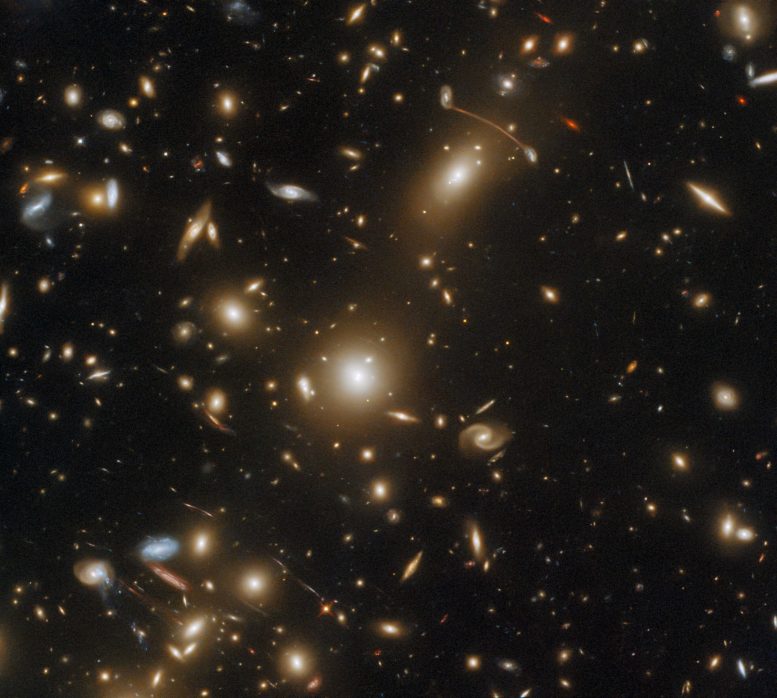
    Galaxy Cluster Abell 1351
    Hubble Space Telescope image of massive galaxy cluster Abell 1351. Credit: ESA/Hubble & NASA, H. Ebeling, Acknowledgment: L. Shatz

    The massive galaxy cluster Abell 1351 is captured in this image by the NASA/ESA Hubble Space Telescope’s Wide Field Camera 3 and Advanced Camera for Surveys. This galaxy cluster lies in the constellation Ursa Major in the northern hemisphere.

    This image is filled with streaks of light, which are actually images of distant galaxies. The streaks are the result of gravitational lensing, an astrophysical phenomenon that occurs when a massive celestial body such as a galaxy cluster distorts spacetime sufficiently strongly to affect the path of light passing through it — almost as if the light were passing through a gigantic lens. Gravitational lensing comes in two varieties — strong and weak — and both can give astronomers an insight into the distribution of mass within a lensing galaxy cluster such as Abell 1351.

    This observation is part of an astronomical album comprising snapshots of some of the most massive galaxy clusters. This menagerie of massive clusters demonstrates interesting astrophysical phenomena such as strong gravitational lensing, as well as showcasing spectacular examples of violent galaxy evolution.

    To obtain this astronomical album, astronomers proposed a Snapshot Program to be slotted into Hubble’s packed observing schedule. These Snapshot Programs are lists of separate, relatively short exposures which can fit into gaps between longer Hubble observations. Having a large pool of Snapshot candidates to dip into allows Hubble to use every second of observing time possible and to maximize the scientific output of the observatory.

    Never miss a breakthrough: Join the SciTechDaily newsletter.
    Follow us on Google and Google News.

    Astronomy Astrophysics European Space Agency Hubble Space Telescope
    Share. Facebook Twitter Pinterest LinkedIn Email Reddit

    Related Articles

    Hubble Captures a Dangerous Dance Over 100 Million Light-Years From Earth

    Hubble Captures the Final Acts of a Monster Star

    Hubble Find Surprises Astronomers: White Dwarfs Can Still Undergo Stable Thermonuclear Activity

    First Evidence of Water Vapor at Jupiter’s Moon Ganymede – May Hold More Water Than All of Earth’s Oceans

    Our Giant Universe: Hubble Spots Massive Galaxy Cluster With a Wealth of Exciting Possibilities

    Tantrums of a Baby Star: Herbig-Haro Objects

    Unexpected Discovery: Hubble Space Telescope Uncovers Concentration of Small Black Holes

    “Unprecedented” – Unusual Planetary Nebula Fades Mere Decades After It Arrived

    Hubble Captures Unprecedented Fading of Stingray Nebula – “This Is Very, Very Dramatic, and Very Weird”

    Leave A Reply Cancel Reply

    • Facebook
    • Twitter
    • Pinterest
    • YouTube

    Don't Miss a Discovery

    Subscribe for the Latest in Science & Tech!

    Trending News

    AI Could Detect Early Signs of Alzheimer’s in Under a Minute – Far Before Traditional Tests

    What if Dark Matter Has Two Forms? Bold New Hypothesis Could Explain a Cosmic Mystery

    This Metal Melts in Your Hand – and Scientists Just Discovered Something Strange

    Beef vs. Chicken: Surprising Results From New Prediabetes Study

    Alzheimer’s Breakthrough: Scientists Discover Key Protein May Prevent Toxic Protein Clumps in the Brain

    Quantum Reality Gets Stranger: Physicists Put a Lump of Metal in Two Places at Once

    Scientists May Have Found the Key to Jupiter and Saturn’s Moon Mystery

    Scientists Uncover Brain Changes That Link Pain to Depression

    Follow SciTechDaily
    • Facebook
    • Twitter
    • YouTube
    • Pinterest
    • Newsletter
    • RSS
    SciTech News
    • Biology News
    • Chemistry News
    • Earth News
    • Health News
    • Physics News
    • Science News
    • Space News
    • Technology News
    Recent Posts
    • What if Your Memories Never Happened? Physicists Take a New Look at the Boltzmann Brain Paradox
    • Students Found an Ancient Star That Shouldn’t Be in the Milky Way
    • Astronomers Solve 50-Year Mystery and Reveal Hidden Culprit Behind Strange X-Ray Emissions
    • One of the Universe’s Largest Stars May Be Getting Ready To Explode
    • Scientists Discover Enzyme That Could Supercharge Ozempic-Like Weight Loss Drugs
    Copyright © 1998 - 2026 SciTechDaily. All Rights Reserved.
    • Science News
    • About
    • Contact
    • Editorial Board
    • Privacy Policy
    • Terms of Use

    Type above and press Enter to search. Press Esc to cancel.