
Close Menu
    Facebook X (Twitter) Instagram
    SciTechDaily
    • Biology
    • Chemistry
    • Earth
    • Health
    • Physics
    • Science
    • Space
    • Technology
    Facebook X (Twitter) Pinterest YouTube RSS
    SciTechDaily
    Home»Space»Hubble Image of the Week – Blue Bubble in Carina
    Space

    Hubble Image of the Week – Blue Bubble in Carina

    By SciTechDailyFebruary 22, 20162 Comments2 Mins Read
    Facebook Twitter Pinterest Telegram LinkedIn WhatsApp Email Reddit
    Share
    Facebook Twitter LinkedIn Pinterest Telegram Email Reddit
    Hubble Image of the Week Bubble in Carina
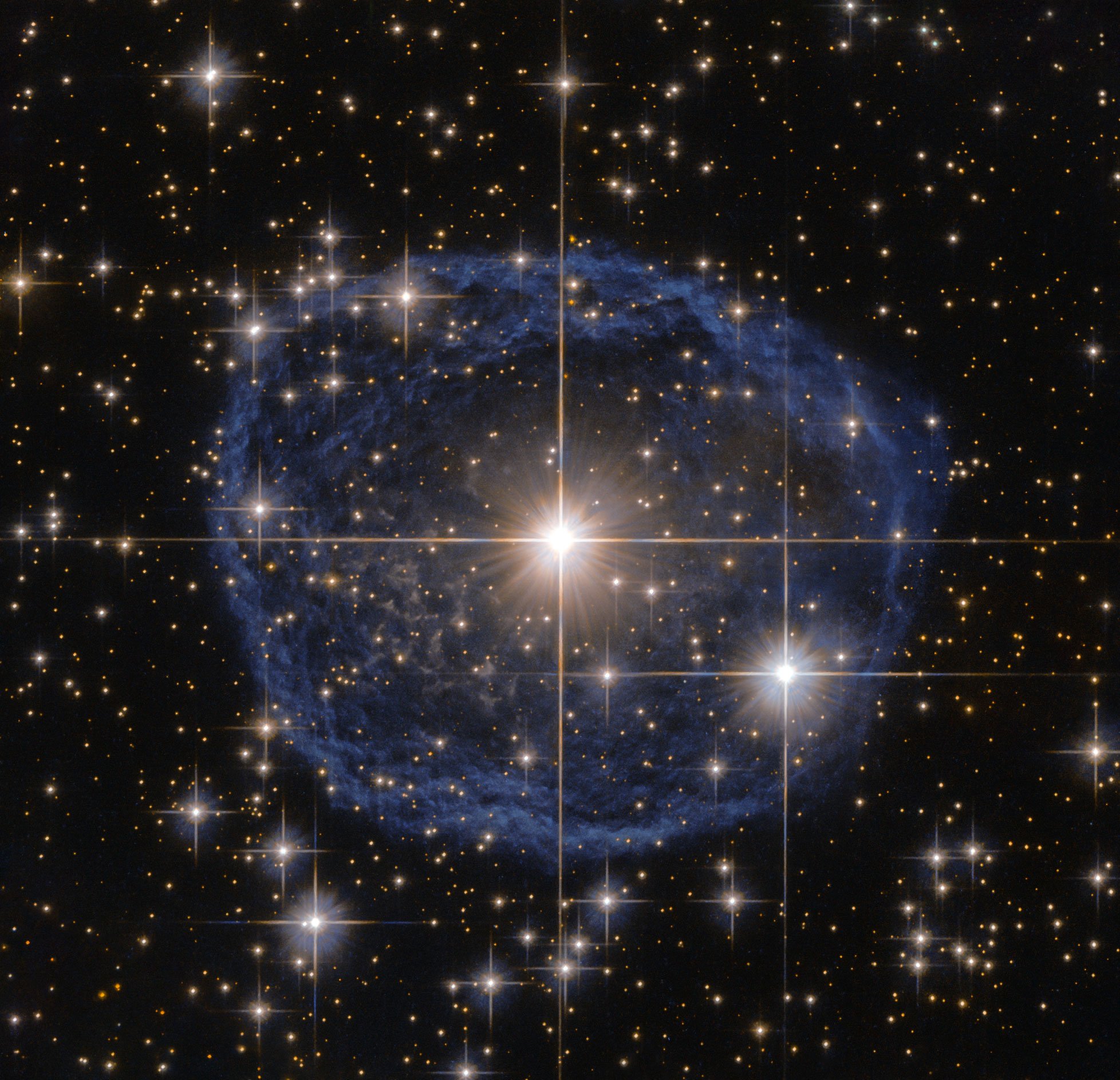
    Wolf–Rayet star known as WR 31a is located about 30,000 light-years away in the constellation of Carina (The Keel). Credit: ESA/Hubble & NASA Acknowledgment: Judy Schmidt

    This newly released Hubble image shows Wolf–Rayet star WR 31a.

    Sparkling at the center of this beautiful NASA/ESA Hubble Space Telescope image is a Wolf–Rayet star known as WR 31a, located about 30,000 light-years away in the constellation of Carina (The Keel).

    The distinctive blue bubble appearing to encircle WR 31a, and its uncatalogued stellar sidekick, is a Wolf–Rayet nebula — an interstellar cloud of dust, hydrogen, helium, and other gases. Created when speedy stellar winds interact with the outer layers of hydrogen ejected by Wolf–Rayet stars, these nebulae are frequently ring-shaped or spherical. The bubble — estimated to have formed around 20,000 years ago — is expanding at a rate of around 220,000 kilometers (137,000 miles) per hour!

    Unfortunately, the lifecycle of a Wolf–Rayet star is only a few hundred thousand years — the blink of an eye in cosmic terms. Despite beginning life with a mass at least 20 times that of the Sun, Wolf–Rayet stars typically lose half their mass in less than 100,000 years. And WR 31a is no exception to this case. It will, therefore, eventually end its life as a spectacular supernova, and the stellar material expelled from its explosion will later nourish a new generation of stars and planets.


    Never miss a breakthrough: Join the SciTechDaily newsletter.
    Follow us on Google and Google News.

    Astronomy Hubble Space Telescope Star Wolf-Rayet Star
    Share. Facebook Twitter Pinterest LinkedIn Email Reddit

    Related Articles

    Hubble Image of the Week – EZ Canis Majoris, Sh2-308

    Hubble Image of the Week: A Cosmic Couple

    Hubble Image of Wolf-Rayet Galaxy SBS 1415+437

    Hubble Views Globular Cluster Palomar 12

    Quasars Acting as Gravitational Lenses Viewed by Hubble

    Atmosphere of Super-Earth GJ1214b Possibly Includes Abundant Water Vapor

    Hubble Discovers NGC 1073, A Barred Spiral Galaxy Similar to Milky Way

    SN Primo Is Farthest Type Ia Supernova Discovered

    Hubble Observes Rare Blue Stars in Andromeda’s Core

    2 Comments

    1. jody on February 23, 2016 2:49 am

      DO U PEOPEL EVEN NO WHAT UR TALKING ABOUT

      Reply
      • zak on February 23, 2016 12:39 pm

        Are you some kind of crazy person?

        Reply
    Leave A Reply Cancel Reply

    • Facebook
    • Twitter
    • Pinterest
    • YouTube

    Don't Miss a Discovery

    Subscribe for the Latest in Science & Tech!

    Trending News

    Monster Storms on Jupiter Unleash Lightning Beyond Anything on Earth

    Scientists Create “Liquid Gears” That Spin Without Touching

    The Simple Habit That Could Help Prevent Cancer

    Millions Take These IBS Drugs, But a New Study Finds Serious Risks

    Scientists Unlock Hidden Secrets of 2,300-Year-Old Mummies Using Cutting-Edge CT Scanner

    Bread Might Be Making You Gain Weight Even Without Eating More Calories

    Scientists Discover Massive Magma Reservoir Beneath Tuscany

    Europe’s Most Active Volcano Just Got Stranger – Here’s Why Scientists Are Rethinking It

    Follow SciTechDaily
    • Facebook
    • Twitter
    • YouTube
    • Pinterest
    • Newsletter
    • RSS
    SciTech News
    • Biology News
    • Chemistry News
    • Earth News
    • Health News
    • Physics News
    • Science News
    • Space News
    • Technology News
    Recent Posts
    • Scientists Were Wrong About This Strange “Rule-Breaking” Particle
    • Webb Space Telescope Uncovers Unexpected Ice Clouds on a Jupiter-Like World
    • 289-Million-Year-Old Reptile Mummy Reveals Origin of Human Breathing System
    • New Brain Discovery Challenges Long-Held Theory of Teenage Brain Development
    • Sharks Are Overheating as Warming Oceans Push Them to the Edge
    Copyright © 1998 - 2026 SciTechDaily. All Rights Reserved.
    • Science News
    • About
    • Contact
    • Editorial Board
    • Privacy Policy
    • Terms of Use

    Type above and press Enter to search. Press Esc to cancel.