
Close Menu
    Facebook X (Twitter) Instagram
    SciTechDaily
    • Biology
    • Chemistry
    • Earth
    • Health
    • Physics
    • Science
    • Space
    • Technology
    Facebook X (Twitter) Pinterest YouTube RSS
    SciTechDaily
    Home»Space»Hubble Image of the Week – Messier Monday
    Space

    Hubble Image of the Week – Messier Monday

    By ESA/Hubble Telescope & NASAJanuary 14, 20191 Comment2 Mins Read
    Facebook Twitter Pinterest Telegram LinkedIn WhatsApp Email Reddit
    Share
    Facebook Twitter LinkedIn Pinterest Telegram Email Reddit

    Spherical Nature of Messier 89

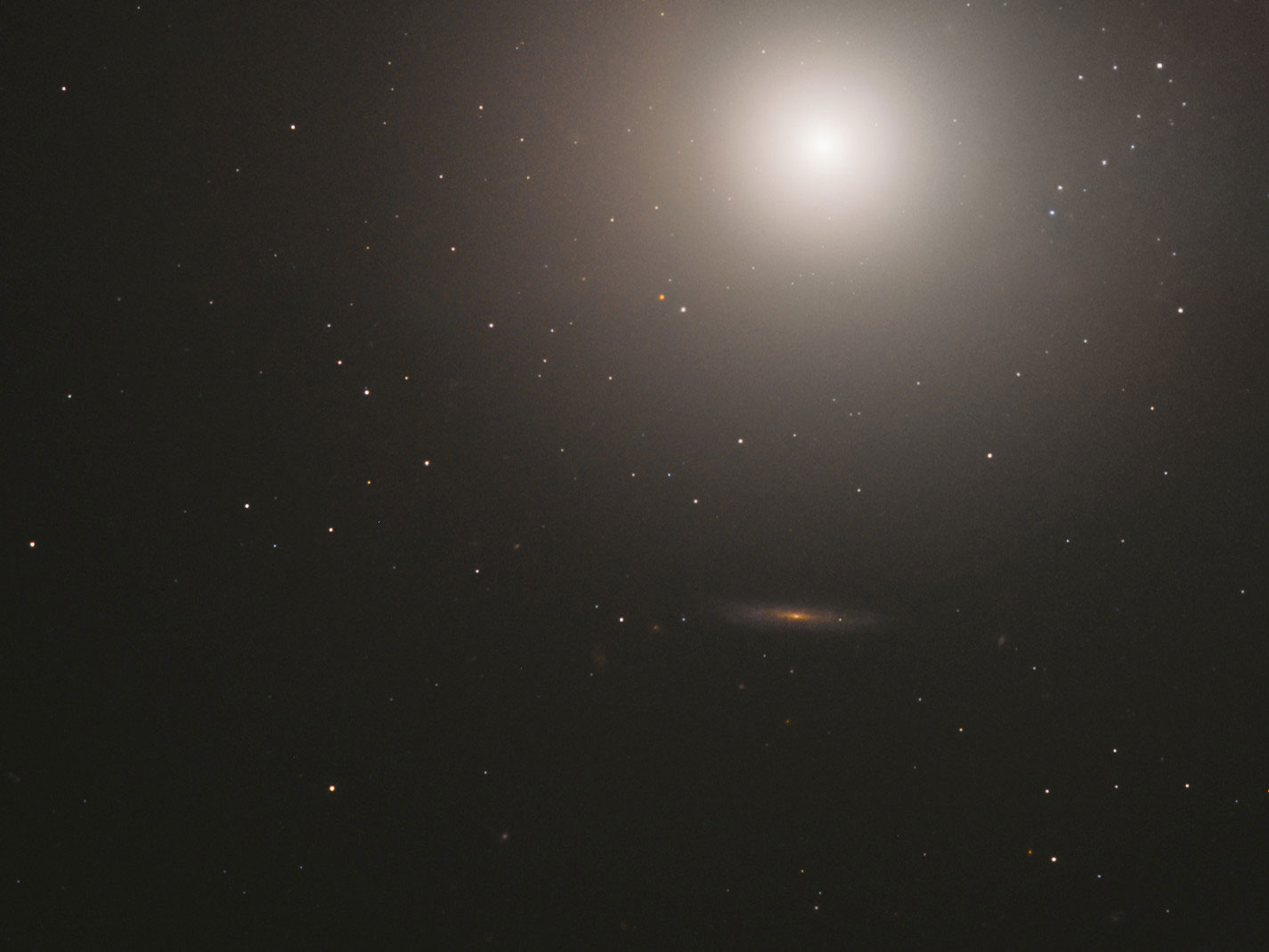
    This huge ball of stars — around 100 billion in total — is an elliptical galaxy located some 55 million light-years away from us. Known as Messier 89, this galaxy appears to be perfectly spherical; this is unusual for elliptical galaxies, which tend to be elongated ellipsoids. The apparently spherical nature of Messier 89 could, however, be a trick of perspective, and be caused by its orientation relative to the Earth. Credit: ESA/Hubble & NASA, S. Faber et al.

    Messier 89 is slightly smaller than the Milky Way but has a few interesting features that stretch far out into the surrounding space. One structure of gas and dust extends up to 150 000 light-years out from the galaxy’s center, which is known to house a supermassive black hole. Jets of heated particles reach out to 100 000 light-years from the galaxy, suggesting that Messier 89 may have once been far more active — perhaps an active quasar or radio galaxy — than it is now. It is also surrounded by an extensive system of shells and plumes, which may have been caused by past mergers with smaller galaxies — and implies that Messier 89 as we know it may have formed in the relatively recent past.

    Messier 89 was discovered by astronomer Charles Messier in 1781, when Messier had been cataloging astronomical objects for 23 years — ever since he mistook a faint object in the sky for Halley’s Comet. Upon closer inspection, he realized the object was actually the Crab Nebula. To prevent other astronomers from making the same error, he decided to catalog all the bright, deep-sky objects that could potentially be mistaken for comets. His methodical observations of the night sky led to the first comprehensive catalog of astronomical objects: the Messier catalog! Messier 89 holds the record for being the last ever giant elliptical to be found by Messier, and the most perfectly spherical galaxy in the entire catalog of 110 objects.

    Never miss a breakthrough: Join the SciTechDaily newsletter.
    Follow us on Google and Google News.

    Astronomy Hubble Space Telescope
    Share. Facebook Twitter Pinterest LinkedIn Email Reddit

    Related Articles

    A Morphing Spiral Galaxy Amongst Friends

    Hubble Views Magnificent Lopsided Galaxy NGC 2276

    Hubble Captures Fantastic Detail of Eponymous Spiral Galaxy NGC 691

    Spectacular Image Captured by Hubble Shows a Strangely Contorted Spiral Galaxy

    A Distant Spiral in Virgo: Extraordinary Detail Seen in a Galaxy 150 Million Light-Years Away From Earth

    Magnetic Monsters: Hubble Tracks Down Location of Mysterious Radio Signals From Intergalactic Space

    A Menagerie of Galaxies: Hubble Captures a Cluster With Galaxies of All Shapes and Sizes

    How Habitable Are Planets That Orbit Red Dwarfs – The Most Common Type of Stars in the Galaxy?

    Cosmic Silver Lining: Hubble Spots V565 Surrounded by Four Prominent Diffraction Spikes

    1 Comment

    1. Gumby on January 20, 2019 7:08 pm

      Isnt 89 part of the Markarian chain in Virgo ?

      Reply
    Leave A Reply Cancel Reply

    • Facebook
    • Twitter
    • Pinterest
    • YouTube

    Don't Miss a Discovery

    Subscribe for the Latest in Science & Tech!

    Trending News

    Massive Study Warns Marijuana Use in Teens Is Linked to Serious Mental Illness

    Scientists Discover a Completely Unexpected Way T Cells Kill Cancer

    Scientists Just Found the Solar System’s Original “Planet Factory”

    Study Warns Widely Used Food Preservatives Linked to High Blood Pressure and Heart Disease

    New Treatment Could Reverse Osteoarthritis Within Weeks

    Physicists Have Measured “Negative Time” in Bizarre Quantum Experiment

    The Deadly Tapeworm Spreading Across America Has Reached the Pacific Northwest

    Could Low Vitamin D Be Making Your Pain Worse?

    Follow SciTechDaily
    • Facebook
    • Twitter
    • YouTube
    • Pinterest
    • Newsletter
    • RSS
    SciTech News
    • Biology News
    • Chemistry News
    • Earth News
    • Health News
    • Physics News
    • Science News
    • Space News
    • Technology News
    Recent Posts
    • Stanford’s Revolutionary New Microscope Reveals Living Cells in Stunning Detail
    • Scientists Discover a Sea Slug Smaller Than a Sesame Seed in Taiwan
    • Wasp Colonies Explode Into Violence After Losing Their Queen
    • Antarctica Suddenly Became Far More Sensitive to Climate Change 1 Million Years Ago
    • A Hidden Arctic Ocean Crisis Is Unfolding Beneath the Melting Ice
    Copyright © 1998 - 2026 SciTechDaily. All Rights Reserved.
    • Science News
    • About
    • Contact
    • Editorial Board
    • Privacy Policy
    • Terms of Use

    Type above and press Enter to search. Press Esc to cancel.