
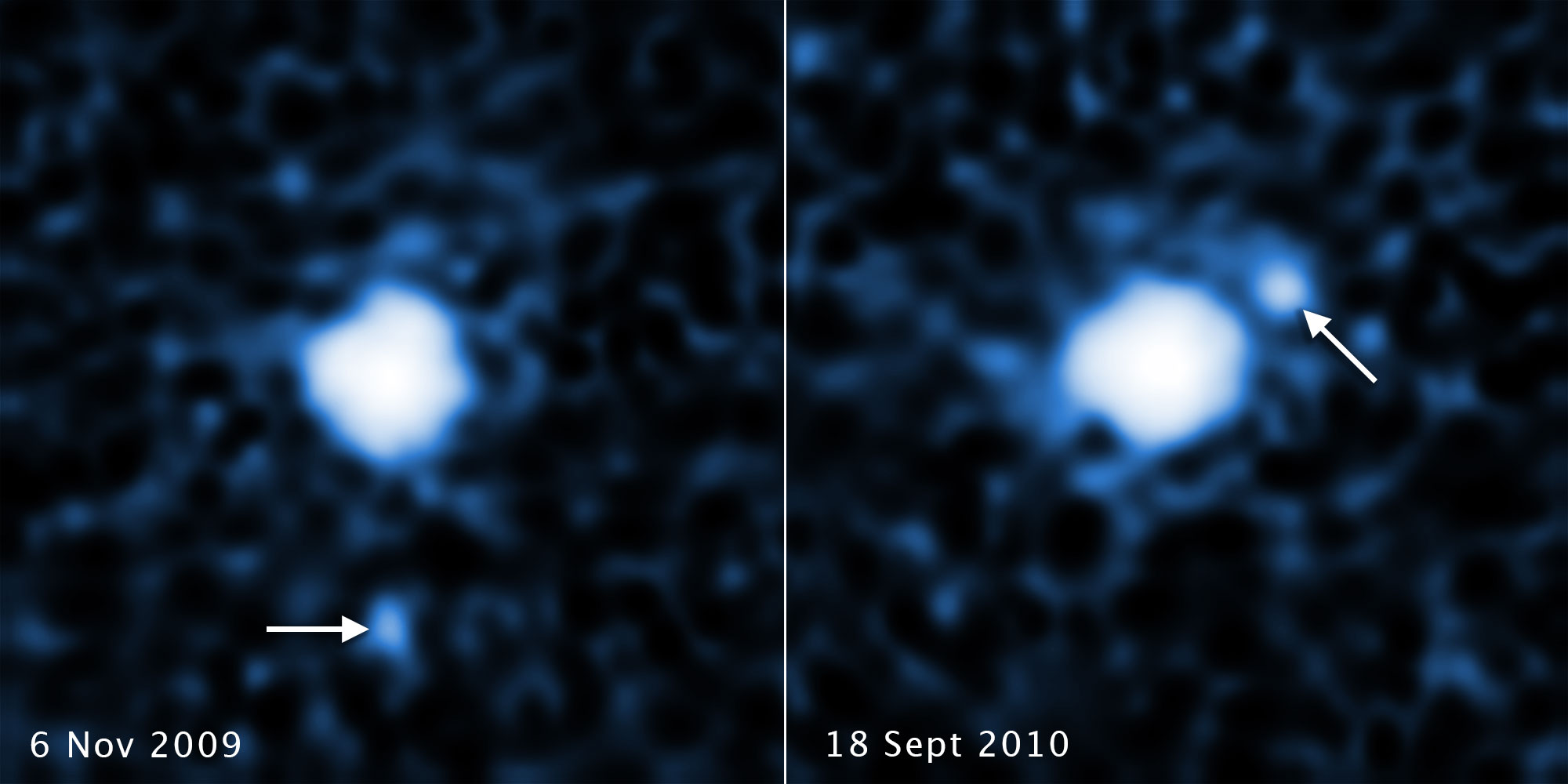
Using the Hubble Space Telescope, astronomers have uncovered a moon orbiting the third largest dwarf planet in the Kuiper Belt. Cataloged as 2007 OR10, the pair resides in a realm of icy debris left over from our solar system’s formation.
Beyond the orbit of Neptune lies a frigid, dark, vast frontier of countless icy bodies left over from the solar system’s construction 4.6 billion years ago. This region, called the Kuiper Belt, was hypothesized by astronomer Gerard Kuiper in 1951. But it took another four decades for astronomers to confirm its existence. The largest bodies are called dwarf planets, with Pluto being the biggest member. Pluto is so big, in fact, that it was discovered 60 years before other Kuiper worlds were detected. Moons around dwarf planets are elusive, though. Pluto’s moon Charon wasn’t found until the mid-1970s.
Now, astronomers have uncovered a moon around another dwarf planet by using the combined power of three space observatories, including archival images from the Hubble Space Telescope. Called 2007 OR10, it is the third-largest dwarf planet in the Kuiper Belt. With this moon’s discovery, most of the known dwarf planets in the Kuiper Belt larger than 600 miles across have companions. These bodies provide insight into how moons formed in the young solar system. In fact, there is an emerging view that collisions between planetary bodies can result in the formation of moons. Based on moon rock samples from NASA’s Apollo mission, astronomers believe that Earth’s only natural satellite was born out of a collision with a Mars-sized object 4.4 billion years ago.
With this discovery, most of the known dwarf planets in the Kuiper Belt larger than 600 miles (970 kilometers) across have companions. These bodies provide insight into how moons formed in the young solar system.
“The discovery of satellites around all of the known large dwarf planets – except for Sedna – means that at the time these bodies formed billions of years ago, collisions must have been more frequent, and that’s a constraint on the formation models,” said Csaba Kiss of the Konkoly Observatory in Budapest, Hungary. He is the lead author of the science paper announcing the moon’s discovery. “If there were frequent collisions, then it was quite easy to form these satellites.”
The objects most likely slammed into each other more often because they inhabited a crowded region. “There must have been a fairly high density of objects, and some of them were massive bodies that were perturbing the orbits of smaller bodies,” said team member John Stansberry of the Space Telescope Science Institute in Baltimore, Maryland. “This gravitational stirring may have nudged the bodies out of their orbits and increased their relative velocities, which may have resulted in collisions.”
But the speed of the colliding objects could not have been too fast or too slow, according to the astronomers. If the impact velocity was too fast, the smash-up would have created lots of debris that could have escaped from the system; too slow and the collision would have produced only an impact crater.
Collisions in the asteroid belt, for example, are destructive because objects are traveling fast when they smash together. The asteroid belt is a region of rocky debris between the orbits of Mars and the gas giant Jupiter. Jupiter’s powerful gravity speeds up the orbits of asteroids, generating violent impacts.
The team uncovered the moon in archival images of 2007 OR10 taken by Hubble’s Wide Field Camera 3. Observations taken of the dwarf planet by NASA’s Kepler Space Telescope first tipped off the astronomers of the possibility of a moon circling it. Kepler revealed that 2007 OR10 has a slow rotation period of 45 hours. “Typical rotation periods for Kuiper Belt Objects are under 24 hours,” Kiss said. “We looked in the Hubble archive because the slower rotation period could have been caused by the gravitational tug of a moon. The initial investigator missed the moon in the Hubble images because it is very faint.”
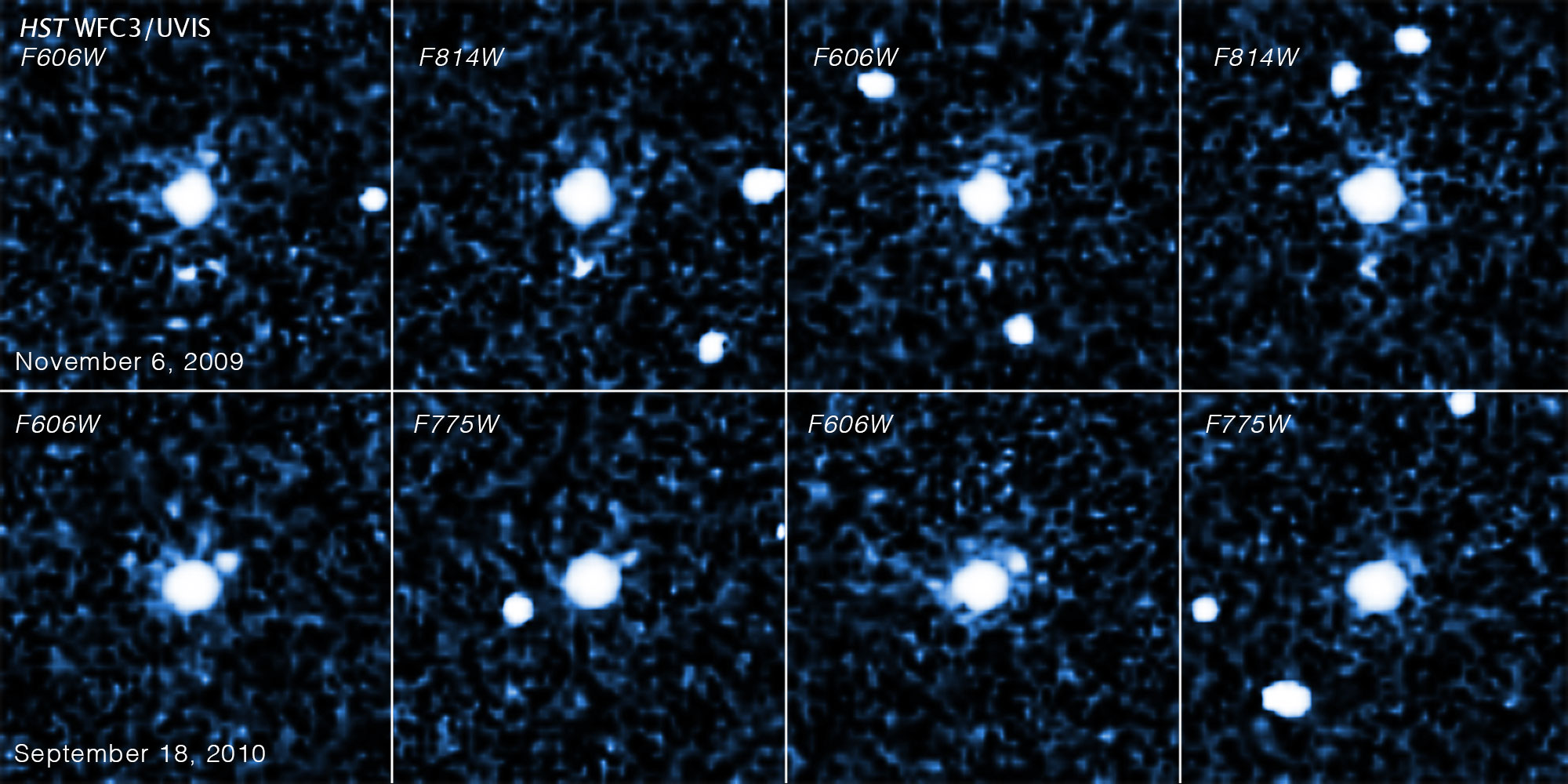
The astronomers spotted the moon in two separate Hubble observations spaced a year apart. The images show that the moon is gravitationally bound to 2007 OR10 because it moves with the dwarf planet, as seen against a background of stars. However, the two observations did not provide enough information for the astronomers to determine an orbit.
“Ironically, because we don’t know the orbit, the link between the satellite and the slow rotation rate is unclear,” Stansberry said.
The astronomers calculated the diameters of both objects based on observations in far-infrared light by the Herschel Space Observatory, which measured the thermal emission of the distant worlds. The dwarf planet is about 950 miles (1,530 kilometers) across, and the moon is estimated to be 150 miles (240 kilometers) to 250 miles (400 kilometers) in diameter. 2007 OR10, like Pluto, follows an eccentric orbit, but it is currently three times farther than Pluto is from the sun.
2007 OR10 is a member of an exclusive club of nine dwarf planets. Of those bodies, only Pluto and Eris are larger than 2007 OR10. It was discovered in 2007 by astronomers Meg Schwamb, Mike Brown, and David Rabinowitz as part of a survey to search for distant solar system bodies using the Samuel Oschin Telescope at the Palomar Observatory in California.
The team’s results appeared in The Astrophysical Journal Letters.
Reference: “Discovery of a Satellite of the Large Trans-Neptunian Object (225088) 2007 OR10” by Csaba Kiss, Gábor Marton, Anikó Farkas-Takács, John Stansberry, Thomas Müller, József Vinkó, Zoltán Balog, Jose-Luis Ortiz, and András Pál, 16 May 2017, The Astrophysical Journal Letters.
DOI: 10.3847/2041-8213/aa6484
PDF
Never miss a breakthrough: Join the SciTechDaily newsletter.
Follow us on Google and Google News.