
Close Menu
    Facebook X (Twitter) Instagram
    SciTechDaily
    • Biology
    • Chemistry
    • Earth
    • Health
    • Physics
    • Science
    • Space
    • Technology
    Facebook X (Twitter) Pinterest YouTube RSS
    SciTechDaily
    Home»Space»Hubble Space Telescope Captures Movie of DART Asteroid Impact Debris
    Space

    Hubble Space Telescope Captures Movie of DART Asteroid Impact Debris

    By ESA/HubbleMarch 5, 2023No Comments3 Mins Read
    Facebook Twitter Pinterest Telegram LinkedIn WhatsApp Email Reddit
    Share
    Facebook Twitter LinkedIn Pinterest Telegram Email Reddit
    Didymos-Dimorphos System After DART Impact
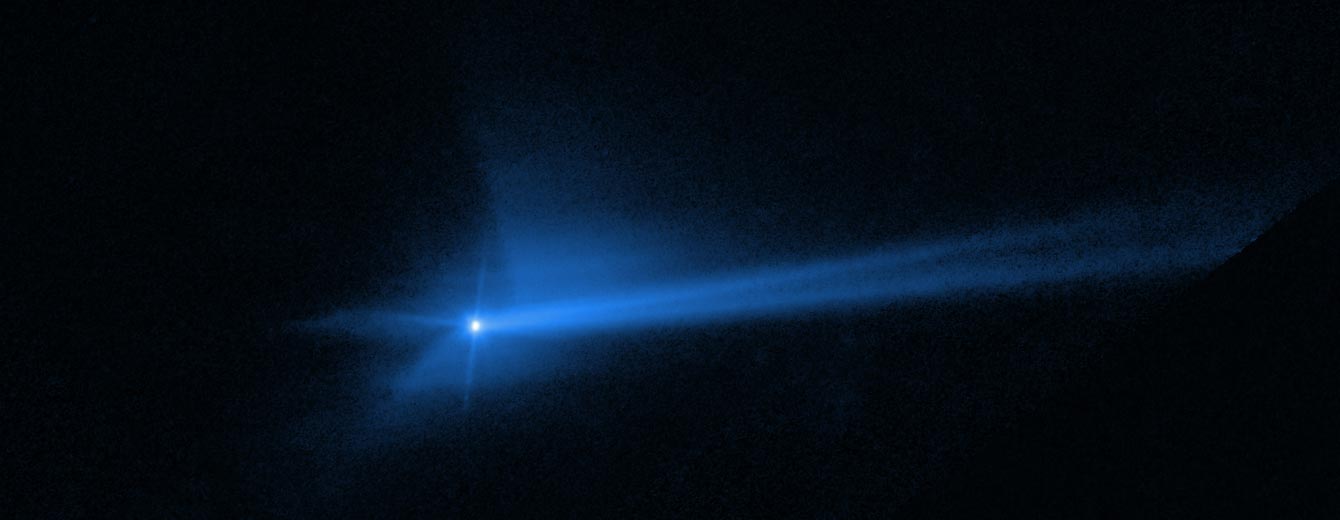
    Hubble captures the debris from the DART impact being swept back into a comet-like tail by the pressure of sunlight on the tiny dust particles. This stretches out into a debris train where the lightest particles travel the fastest and farthest from the asteroid. The mystery is compounded when Hubble records the tail splitting in two for a few days. Credit: NASA, ESA, STScI, J. Li (PSI)

    This movie captures the breakup of the asteroid Dimorphos when it was deliberately hit by NASA’s 545-kilogram Double Asteroid Redirection Test (DART) mission spacecraft on 26 September 2022. The NASA/ESA Hubble Space Telescope had a ringside view of the space demolition derby.

    The Hubble movie starts at 1.3 hours before impact. The first post-impact snapshot is 20 minutes after the event. Debris flies away from the asteroid in straight lines, moving faster than four miles per hour (fast enough to escape the asteroid’s gravitational pull, so it does not fall back onto the asteroid). The ejecta forms a largely hollow cone with long, stringy filaments.

    At about 17 hours after the impact the debris pattern entered a second stage. The dynamic interaction within the binary system started to distort the cone shape of the ejecta pattern. The most prominent structures are rotating, pinwheel-shaped features. The pinwheel is tied to the gravitational pull of the companion asteroid, Didymos.

    Hubble next captures the debris being swept back into a comet-like tail by the pressure of sunlight on the tiny dust particles. This stretches out into a debris train where the lightest particles travel the fastest and farthest from the asteroid. The mystery is compounded later when Hubble records the tail splitting in two for a few days.
    Hubble Captures DART Asteroid Impact Debris Annotated
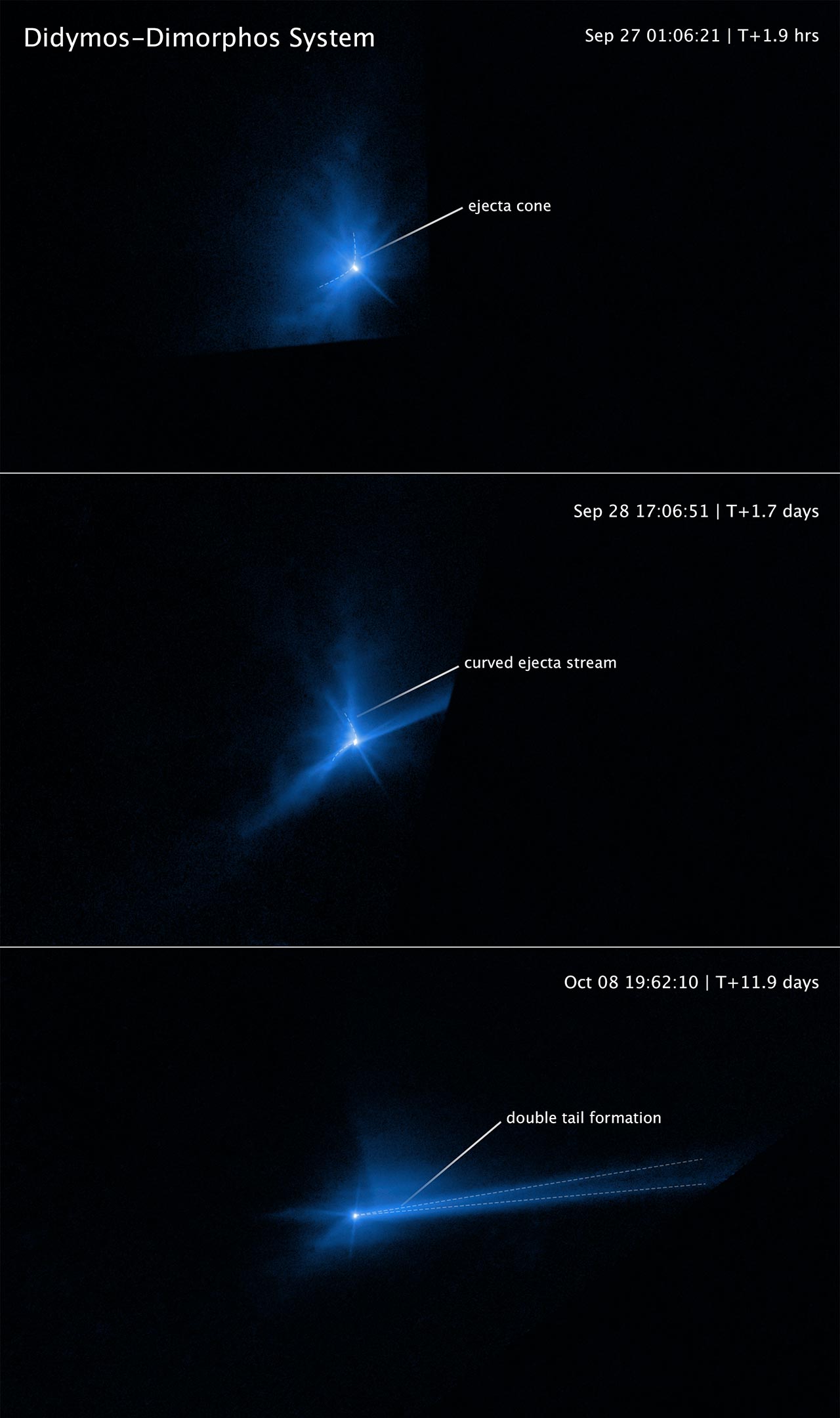
    These three panels capture the breakup of the asteroid Dimorphos when it was deliberately hit by NASA’s 545-kilogram Double Asteroid Redirection Test (DART) mission spacecraft on September 26, 2022. The NASA/ESA Hubble Space Telescope had a ringside view of the space demolition derby. The top panel, taken 2 hours after impact, shows an ejecta cone amounting to an estimated 900 000 kilograms of dust.
    The center frame shows the dynamic interaction within the asteroid’s binary system that starts to distort the cone shape of the ejecta pattern about 17 hours after the impact. The most prominent structures are rotating, pinwheel-shaped features. The pinwheel is tied to the gravitational pull of the companion asteroid, Didymos.
    In the bottom frame, Hubble next captures the debris being swept back into a comet-like tail by the pressure of sunlight on the tiny dust particles. This stretches out into a debris train where the lightest particles travel the fastest and farthest from the asteroid. The mystery is compounded when Hubble records the tail splitting in two for a few days.
    Credit: NASA, ESA, STScI, J. Li (PSI)

    Never miss a breakthrough: Join the SciTechDaily newsletter.
    Follow us on Google and Google News.

    Asteroid Hubble Space Telescope NASA NASA DART Planetary Defense
    Share. Facebook Twitter Pinterest LinkedIn Email Reddit

    Related Articles

    Hubble Movie of DART Asteroid Impact Debris Reveals Surprising and Remarkable Changes

    NASA’s DART Confirmed on Target To Impact Asteroid Dimorphos

    Planetary Defense: Study Finds That NASA’s DART Spacecraft Could Obliterate Asteroids

    We Asked a NASA Expert: Is NASA Really Crashing a Spacecraft Into an Asteroid? [Video]

    NASA DART Launch: Key Step Forward in Planetary Defense

    NASA’s DART Kinetic Impactor Spacecraft Launches in World’s First Planetary Defense Test Mission

    NASA’s DART Mission To Crash a Spacecraft Into an Asteroid Is Set To Launch – Watch It Live

    We Asked a NASA Scientist: What if an Asteroid Was Going To Hit Earth? [Video]

    NASA To Launch Double Asteroid Redirection Test Mission – Preventing a Hazardous Asteroid From Striking Earth

    Leave A Reply Cancel Reply

    • Facebook
    • Twitter
    • Pinterest
    • YouTube

    Don't Miss a Discovery

    Subscribe for the Latest in Science & Tech!

    Trending News

    Scientists May Have Found the Key to Jupiter and Saturn’s Moon Mystery

    Scientists Uncover Brain Changes That Link Pain to Depression

    Saunas May Do More Than Raise Body Temperature – They Activate Your Immune System

    Exercise in a Pill? Metformin Shows Surprising Effects in Cancer Patients

    Hidden Oceans of Magma Could Be Protecting Alien Life

    New Study Challenges Alzheimer’s Theories: It’s Not Just About Plaques

    Artificial Sweeteners May Harm Future Generations, Study Suggests

    Splashdown! NASA Artemis II Returns From Record-Breaking Moon Mission

    Follow SciTechDaily
    • Facebook
    • Twitter
    • YouTube
    • Pinterest
    • Newsletter
    • RSS
    SciTech News
    • Biology News
    • Chemistry News
    • Earth News
    • Health News
    • Physics News
    • Science News
    • Space News
    • Technology News
    Recent Posts
    • Scientists Make Breakthrough on 40-Year-Old 2D Physics Puzzle
    • As Cities Invade the Amazon, Yellow Fever Makes a Dangerous Comeback
    • “Asian Flush” May Be a Hidden Trigger for Deadly Heart Damage
    • AI Could Detect Early Signs of Alzheimer’s in Under a Minute – Far Before Traditional Tests
    • What if Dark Matter Has Two Forms? Bold New Hypothesis Could Explain a Cosmic Mystery
    Copyright © 1998 - 2026 SciTechDaily. All Rights Reserved.
    • Science News
    • About
    • Contact
    • Editorial Board
    • Privacy Policy
    • Terms of Use

    Type above and press Enter to search. Press Esc to cancel.