
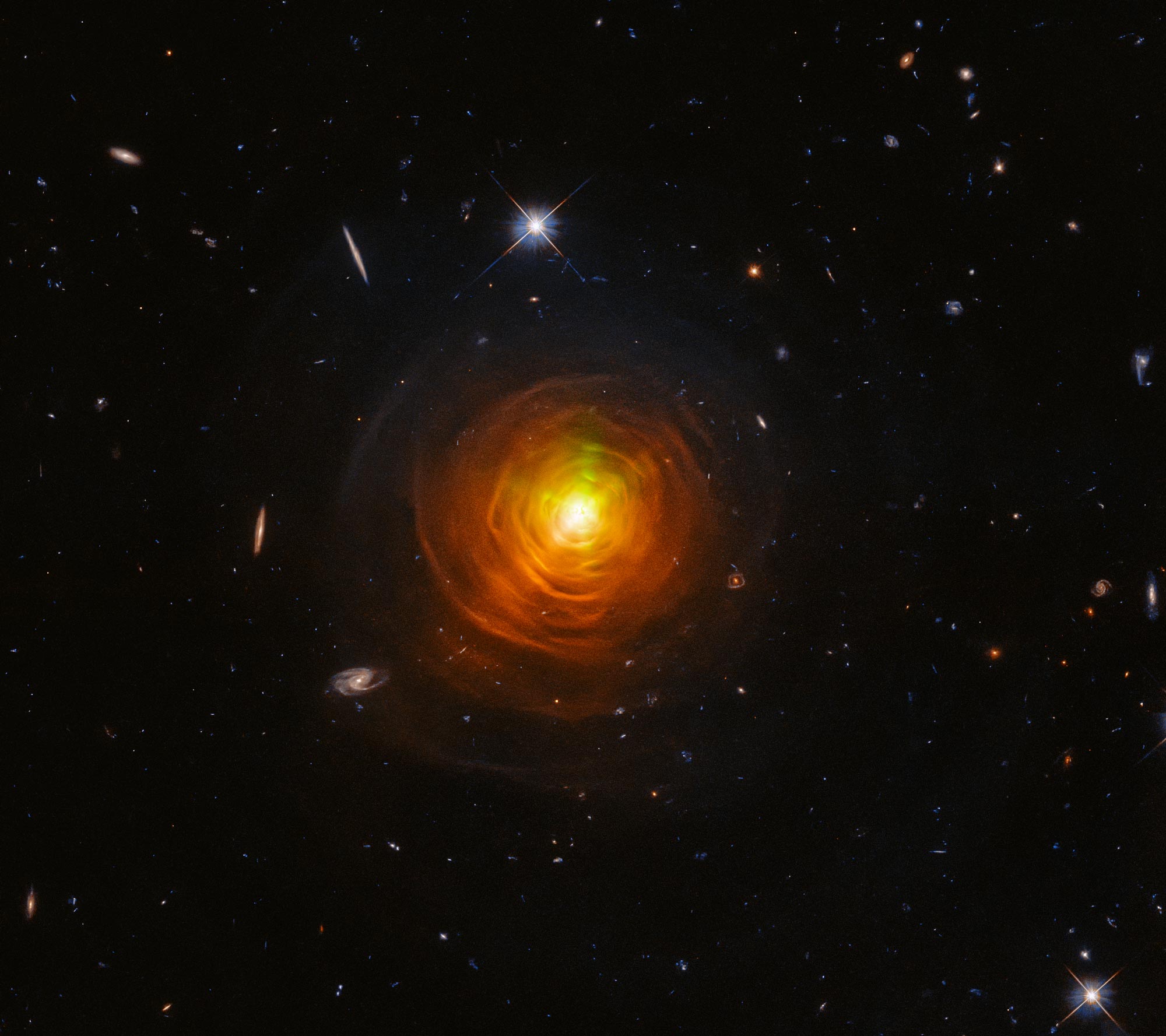
Creepy Look At A Star Weaving A Dust Web
Sometimes, the sudden demise of stars seems rather foreboding. This picture of the CW Leonis, a fading red giant star, looks like it belongs in a ghost story. The star is surrounded by thin orange spider webs that seem to be catching it. Bright beams penetrate the dust, much as on a partially cloudy day. As the star runs out of fuel, it “burps” shells of sooty carbon into space. As a consequence of nuclear fusion in the star’s core, carbon was created. Everyone with a fireplace is aware that soot is a pain. However, carbon that is sent into space serves as the foundation for the development of future stars, planets, and possibly even life. On Earth, complex biological molecules consist of carbon atoms bonded with other common elements.
This is a time-lapse set of images of the aging red giant star CW Leonis, taken on three dates: 2001, 2011, and 2016. The star is embedded inside gossamer cobwebs of dust encircling the star. These are really shells of carbon dust blown off the star. As they expand into space they change shape, as seen between the Hubble Space Telescope exposures. Brilliant searchlight beams from the star’s surface poke through the dust. These beams change orientation through the different dates the Hubble photographs were taken. Credit: Animation: ESA/Hubble, NASA, STScI, Acknowledgment: Toshiya Ueta (University of Denver), Hyosun Kim (KASI), M. Zamani
Hubble Celebrates Halloween with a Glowering, Dying Star
A hypnotizing vortex? A peek into a witch’s cauldron? A giant space-spider web?
In truth, it’s a view of the red giant star CW Leonis as captured by NASA’s Hubble Space Telescope – just in time for Halloween celebrations with spooky cosmic vistas.
The dusty clouds of sooty carbon engulfing the dying star are what are seen as orange-red “cobwebs.” They originated from the CW Leonis’ outer layers being flung into the pitch-black vacuum. The star’s atmosphere is carbon-rich because the carbon was heated up through nuclear fusion in the star’s interior. Returning the carbon to space supplies the building blocks needed for the creation of upcoming stars and planets. The carbon atom serves as the foundation for all known life on Earth. Atoms of carbon are bound together with other common elements in the cosmos to form complex living compounds.
The nearest carbon star to Earth is CW Leonis, which is 400 light-years away. Astronomers now have the ability to comprehend the interaction between the star and its tumultuous envelope. The magnetic field of the star may have formed the intricate interior structure of shells and arcs. In-depth Hubble views of CW Leonis over the past 20 years also demonstrate the expansion of ejected material threads around the star.
One of the star’s most striking aspects is the strong beams of light extending from CW Leonis. They have changed in brightness in just 15 years, which in terms of astronomical time, is a very brief period of time. According to astronomers, CW Leonis’ dust may be illuminated by starlight beams that pass through openings in the dust, much like searchlight beacons through a foggy sky. However, the precise reason for the abrupt variations in their brightness is still unknown.
When the crush of gravity is balanced by the outward pressure from the fusion furnace at the center, a star will shine. The star begins to collapse when its hydrogen fuel runs out due to gravity’s continuous pull. The star receives a new lease on life as the core contracts and the shell of plasma surrounding it heats up enough to start fusing hydrogen. It produces enough heat for the star’s outer layers to drastically expand and swell out into a bloated red giant.
NASA’s Hubble Space Telescope has spotted many bone-chilling objects in the universe. CW Leonis is just the most recent one. Credit: NASA’s Goddard Space Flight Center; Lead Producer: Paul Morris
Due to its comparatively low surface temperature of 2,300 degrees Fahrenheit (1,260 degrees Celsius), CW Leonis has an orange-reddish hue. The star’s green-tinted light beams, on the other hand, glow at infrared wavelengths that are invisible. Green has been added to the infrared image in place of natural color to improve color-contrast analysis.
The Hubble Space Telescope is a NASA and ESA (European Space Agency) joint international project. The telescope is run by NASA’s Goddard Space Flight Center in Greenbelt, Maryland. Hubble science operations are carried out by the Space Telescope Science Institute (STScI) in Baltimore, Maryland. The Association of Universities for Research in Astronomy, based in Washington, D.C., runs STScI for NASA.
Never miss a breakthrough: Join the SciTechDaily newsletter.
Follow us on Google and Google News.
4 Comments
You can see a mile down the road & that road is as clean & green as anyone could hope. But like anything that could be the exact opposite before you cover that (hopeful) mile. What we see past Mars is going to out of our touch for a very very long time. Despite the boneheads blathering about like we’ll be there soonest.
This sentence is incorrect:
As the core shrinks, the shell of plasma surrounding the core becomes hot enough to begin fusing hydrogen, giving the star a second lease on life.
It should read:
As the core shrinks, the shell of plasma surrounding the core becomes hot enough to begin fusing helium, giving the star a second lease on life.
the eyrie tale of a spiders cosmic web tale 20 years in the telling
in the time of hall of owen 2001 how many spider silk threads did you image of a spider web as the spider toiled and coiled around the carbon red giant star
in the time of halloween 2011 how many spider silk threads of carbon had been weaved into the picture frame
in the time of dusty cobweb hall of owens house 2016 the spider took a rest
and in 2021 took out a past scitechdaily hot topics picture image to recall the eerieee days of yore all fado fado 20 years ago
and looked at the work it had done
but the sooty layers are really hampering my style they are clinging on to my filamentary lines and not letting the cruising fly prey to be caught and trapped
after all my hard spider work of creating seven concentric webs layers the image im looking at is faded in the halloween eerriieee night light
black carbon soot must be 36 light days deep covering everywhere
2001 2011 and 2016 and the spider said to itself 2021 that work of 7 carbon filament shells of one silken spider web………is a lot done
in 2001 i toiled and made the outer ring 36 light days radius wide of my spider web of carbon filaments
by 2011 i had toiled and made the next three inner rings 30 25 20 light days radius of a spider web of carbon filaments
by 2016 i had toiled and made the next three innermost rings 15 10 5 light days radius of a spider web of carbon filaments
but there is a lot more to do
did i do no work from 2016 to 2021 was i resting or getting lazy
well well lets make up for that lets go out with a massive last boom
and give a fire works display some hall of owen day soon to really show the extent of my spiderwork
Yeah, we are done for. Definitely. I’m moving to alpha tauri tomorrow.