
Close Menu
    Facebook X (Twitter) Instagram
    SciTechDaily
    • Biology
    • Chemistry
    • Earth
    • Health
    • Physics
    • Science
    • Space
    • Technology
    Facebook X (Twitter) Pinterest YouTube RSS
    SciTechDaily
    Home»Technology»Neural Networks Go Nano: Brain-Inspired Learning Takes Flight
    Technology

    Neural Networks Go Nano: Brain-Inspired Learning Takes Flight

    By University of SydneyNovember 1, 2023No Comments4 Mins Read
    Facebook Twitter Pinterest Telegram LinkedIn WhatsApp Email Reddit
    Share
    Facebook Twitter LinkedIn Pinterest Telegram Email Reddit
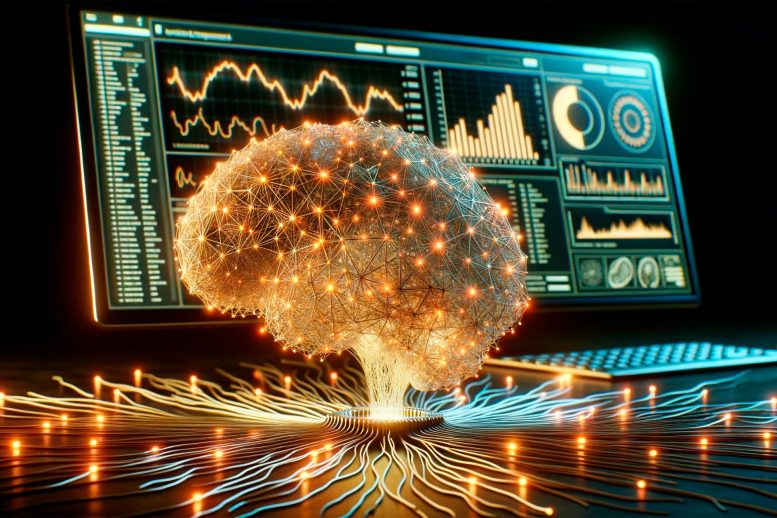
    Nanowire Brain Network Concept
    Researchers from the University of Sydney and UCLA have developed a physical neural network that can learn and remember in real-time, much like the brain’s neurons. This breakthrough utilizes nanowire networks that mirror neural networks in the brain. The study has significant implications for the future of efficient, low-energy machine intelligence, particularly in online learning settings.

    Critical Step Passed for Developing Agile, Low-Energy Machine Intelligence

    For the first time, a physical neural network has successfully been shown to learn and remember ‘on the fly’, in a way inspired by and similar to how the brain’s neurons work.

    The result opens a pathway for developing efficient and low-energy machine intelligence for more complex, real-world learning and memory tasks.

    Published today (November 1) in Nature Communications, the research is a collaboration between scientists at the University of Sydney and the University of California at Los Angeles (UCLA).
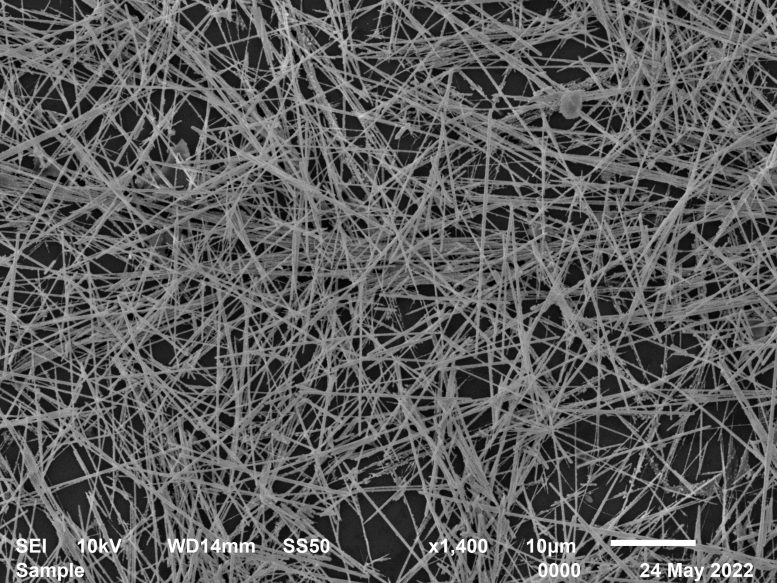
    Nanowire Neural Network
    Electron microscope image of the nanowire neural network that arranges itself like ‘Pick Up Sticks’. The junctions where the nanowires overlap act in a way similar to how our brain’s synapses operate, responding to electric current. Credit: The University of Sydney

    Lead author Ruomin Zhu, a PhD student from the University of Sydney Nano Institute and School of Physics, said: “The findings demonstrate how brain-inspired learning and memory functions using nanowire networks can be harnessed to process dynamic, streaming data.”

    Nanowire Networks

    Nanowire networks are made up of tiny wires that are just billionths of a meter in diameter. The wires arrange themselves into patterns reminiscent of the children’s game ‘Pick Up Sticks’, mimicking neural networks, like those in our brains. These networks can be used to perform specific information processing tasks.
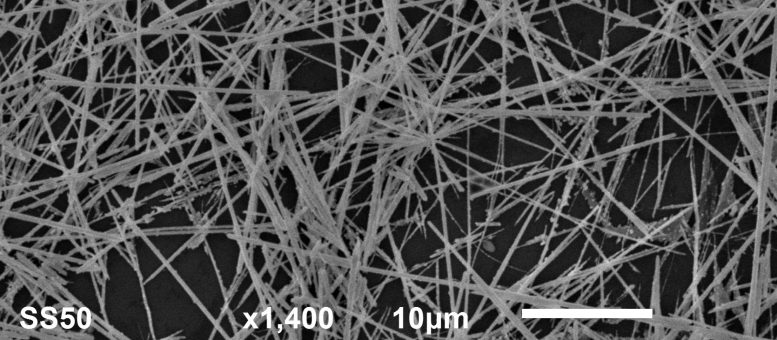
    Nanowire Neural Network Close Up
    Detail of larger image above: nanowire neural network. Credit: The University of Sydney

    Memory and learning tasks are achieved using simple algorithms that respond to changes in electronic resistance at junctions where the nanowires overlap. Known as ‘resistive memory switching’, this function is created when electrical inputs encounter changes in conductivity, similar to what happens with synapses in our brain.

    Research Findings and Implications

    In this study, researchers used the network to recognize and remember sequences of electrical pulses corresponding to images, inspired by the way the human brain processes information.
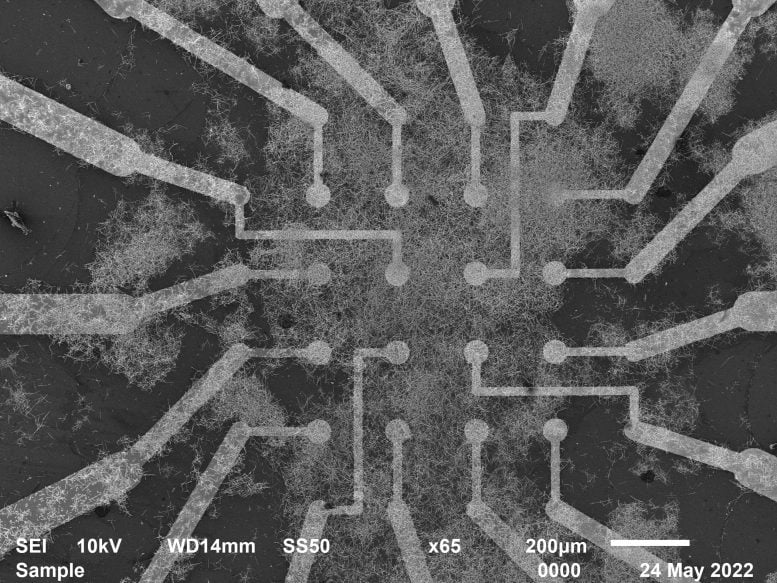
    Electrode Interaction With Nanowire Network
    Electron microscope image of electrode interaction with the nanowire neural network. Credit: The University of Sydney

    Supervising researcher Professor Zdenka Kuncic said the memory task was similar to remembering a phone number. The network was also used to perform a benchmark image recognition task, accessing images in the MNIST database of handwritten digits, a collection of 70,000 small greyscale images used in machine learning.

    “Our previous research established the ability of nanowire networks to remember simple tasks. This work has extended these findings by showing tasks can be performed using dynamic data accessed online,” she said.
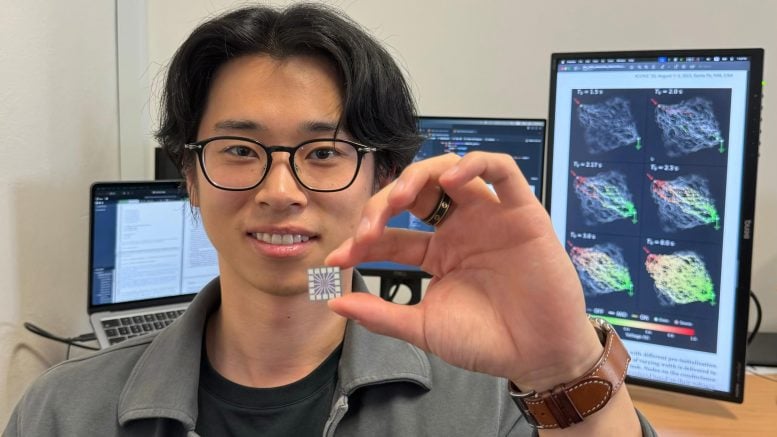
    Ruomin Zhu
    Lead author Ruomin Zhu from the University of Sydney holding the chip designed to manage the nanowire neural network. Credit: The University of Sydney

    “This is a significant step forward as achieving an online learning capability is challenging when dealing with large amounts of data that can be continuously changing. A standard approach would be to store data in memory and then train a machine learning model using that stored information. But this would chew up too much energy for widespread application.

    Professor Zdenka Kuncic
    Supervising researcher and co-author Professor Zdenka Kuncic from the University of Sydney Nano Institute and School of Physics. Credit: The University of Sydney

    “Our novel approach allows the nanowire neural network to learn and remember ‘on the fly’, sample by sample, extracting data online, thus avoiding heavy memory and energy usage.”

    Mr. Zhu said there were other advantages when processing information online.

    “If the data is being streamed continuously, such as it would be from a sensor for instance, machine learning that relied on artificial neural networks would need to have the ability to adapt in real-time, which they are currently not optimized for,” he said.

    In this study, the nanowire neural network displayed a benchmark machine learning capability, scoring 93.4 percent in correctly identifying test images. The memory task involved recalling sequences of up to eight digits. For both tasks, data was streamed into the network to demonstrate its capacity for online learning and to show how memory enhances that learning.

    Reference: “Online dynamical learning and sequence memory with neuromorphic nanowire networks” by Ruomin Zhu, Sam Lilak, Alon Loeffler, Joseph Lizier, Adam Stieg, James Gimzewski and Zdenka Kuncic, 1 November 2023, Nature Communications.
    DOI: 10.1038/s41467-023-42470-5

    Never miss a breakthrough: Join the SciTechDaily newsletter.
    Follow us on Google and Google News.

    Artificial Intelligence Brain Nanotechnology University of Sydney
    Share. Facebook Twitter Pinterest LinkedIn Email Reddit

    Related Articles

    Neural Nanotechnology: Nanowire Networks Learn and Remember Like a Human Brain

    Nanowire Network at the “Edge of Chaos” Opens Pathway to Artificial Intelligence Discoveries

    Engineers Put Tens of Thousands of Artificial Brain Synapses on a Single Chip for Portable AI Devices

    Breaking the Size and Speed Limit of Modulators for Next Generation Internet and Communication Networks

    Brain and Artificial Neurons Link Up Over the Web in New Nanoelectronics Research

    Human Brain-Like Functions Emerge in Neuromorphic Metallic Nanowire Network

    New Type of Artificial Intelligence Inspired by Brain

    New Artificial Intelligence Device Identifies Objects at the Speed of Light

    New Nanostructured Material Mimics the Wettability of a Rose Petal

    Leave A Reply Cancel Reply

    • Facebook
    • Twitter
    • Pinterest
    • YouTube

    Don't Miss a Discovery

    Subscribe for the Latest in Science & Tech!

    Trending News

    First-of-Its-Kind Discovery: Homer’s Iliad Found Embedded in a 1,600-Year-Old Egyptian Mummy

    Beyond Inflammation: Scientists Uncover New Cause of Persistent Rheumatoid Arthritis

    A Simple Molecule Could Unlock Safer, Easier Weight Loss

    Scientists Just Built a Quantum Battery That Charges Almost Instantly

    Researchers Unveil Groundbreaking Sustainable Solution to Vitamin B12 Deficiency

    Millions of People Have Osteopenia Without Realizing It – Here’s What You Need To Know

    Researchers Discover Boosting a Single Protein Helps the Brain Fight Alzheimer’s

    World-First Study Reveals Human Hearts Can Regenerate After a Heart Attack

    Follow SciTechDaily
    • Facebook
    • Twitter
    • YouTube
    • Pinterest
    • Newsletter
    • RSS
    SciTech News
    • Biology News
    • Chemistry News
    • Earth News
    • Health News
    • Physics News
    • Science News
    • Space News
    • Technology News
    Recent Posts
    • After Decades, MIT Researchers Capture the First 3D Atomic View of a Mysterious Material
    • Your Favorite Fishing Spot Is Turning Brown – and the Fish Are Changing
    • 380-Million-Year-Old Fish Fossil Reveals Secrets of Life’s First Steps Onto Land
    • Mezcal “Worm” in a Bottle Mystery: DNA Testing Reveals a Surprise
    • Scientists Turn Red Lettuce Green, Unlocking Hidden Nutrients
    Copyright © 1998 - 2026 SciTechDaily. All Rights Reserved.
    • Science News
    • About
    • Contact
    • Editorial Board
    • Privacy Policy
    • Terms of Use

    Type above and press Enter to search. Press Esc to cancel.