
Close Menu
    Facebook X (Twitter) Instagram
    SciTechDaily
    • Biology
    • Chemistry
    • Earth
    • Health
    • Physics
    • Science
    • Space
    • Technology
    Facebook X (Twitter) Pinterest YouTube RSS
    SciTechDaily
    Home»Health»Peering Into the Womb: Fetal Brain Scans Reveal Autism Clues
    Health

    Peering Into the Womb: Fetal Brain Scans Reveal Autism Clues

    By King’s College LondonApril 24, 2023No Comments3 Mins Read
    Facebook Twitter Pinterest Telegram LinkedIn WhatsApp Email Reddit
    Share
    Facebook Twitter LinkedIn Pinterest Telegram Email Reddit
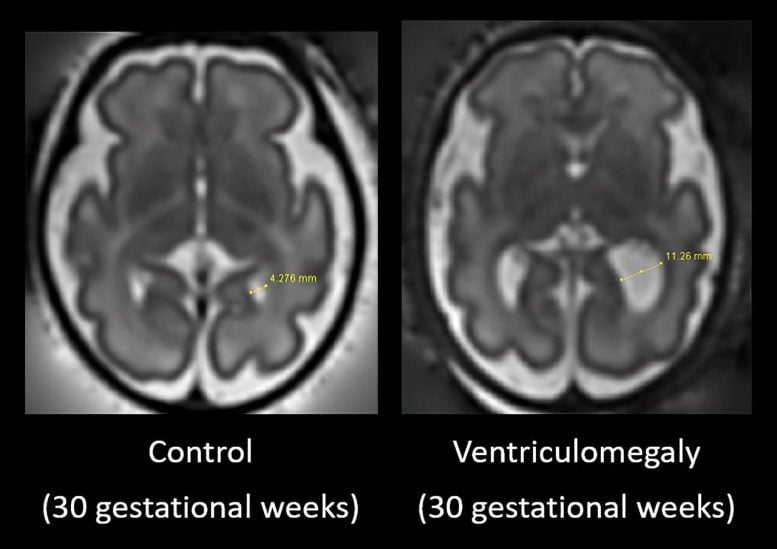
    Fetal Brain Scan Early Indicators of Autism
    Scientists used MRI scans of children with isolated fetal ventriculomegaly and found evidence supporting an association between the condition and autism traits. The study followed two groups of children, those with a normal fetal brain MR assessment and those with isolated ventriculomegaly, and conducted developmental assessments at ages 2 and primary school age. The results could improve family counseling, early identification, and intervention. However, further research is needed to confirm these findings in a larger population and to better understand the susceptibility to developing autism in children with antenatally-diagnosed isolated ventriculomegaly or other common fetal brain anomalies. Credit: King’s College London

    Researchers have used MRI brain scans of children with isolated fetal ventriculomegaly to measure neurodevelopment and investigate the presence of autism traits at school age.

    In a paper published in the journal Nature Communications, King’s College London researchers from the Center for the Developing Brain have discovered evidence supporting an association between isolated ventriculomegaly and autism traits.

    The study followed two groups of children, one with a normal fetal brain MR assessment and those with an antenatal diagnosis of isolated ventriculomegaly, with a developmental follow-up assessments at 2 years of age and primary school age.

    “While this approach offers only a partial indicator of future outcomes, better prediction may have important implications for the long-term support of families. For example, early identification means that parents can be counseled on potential future outcomes and increased awareness of the onset of autism traits in their child would allow earlier and faster access to supporting programs.”
    Dr. Vanessa Kyriakopoulou, Senior Research Associate in Neuroscience & Neuroimaging

    Participating children were initially scanned as fetuses and then tested with a range of developmental measures including IQ, autism traits, sustained attention, neurological functioning, behavior, executive function, sensory processing, coordination, and adaptive behaviors.

    Fetal Ventriculomegaly

    Fetal ventriculomegaly is the most common antenatally-diagnosed brain abnormality and is diagnosed when the lateral ventricles measure larger than normal on antenatal ultrasound or MR imaging.

    This study demonstrates an association between this most common developmental fetal brain anomaly and autism traits. The results may improve counseling for families and aid early identification, support, and intervention, with further research warranted to confirm initial findings within a larger population.

    “There is a clear need for more long-term data combining high quality brain imaging with long term developmental follow up in children with antenatally-diagnosed isolated ventriculomegaly or indeed with other common fetal brain anomalies to improve our understanding about the susceptibility of developing autism.”
    Professor Mary Rutherford, Perinatal Imaging & Health

    Reference: “Characterisation of ASD traits among a cohort of children with isolated fetal ventriculomegaly” by Vanessa Kyriakopoulou, Alice Davidson, Andrew Chew, Nidhi Gupta, Tomoki Arichi, Chiara Nosarti and Mary A. Rutherford, 21 March 2023, Nature Communications.
    DOI: 10.1038/s41467-023-37242-0

    The authors gratefully acknowledge the families who participated in this study.

    This study was supported by the Medical Research Council, the Wellcome Engineering and Physical Sciences Research Council (EPSRC) Centre for Medical Engineering at Kings College London, and the National Institute for Health and Care Research.

    The Centre for the Developing Brain is part of the School of Biomedical Engineering & Imaging Sciences and has advanced MR imaging facilities, including a novel fetal imaging capability and a new dedicated MR imaging suite sited within the Neonatal Intensive Care Unit at St Thomas’ Hospital.

    Never miss a breakthrough: Join the SciTechDaily newsletter.
    Follow us on Google and Google News.

    Autism Spectrum Disorder Brain King’s College London Neuroscience
    Share. Facebook Twitter Pinterest LinkedIn Email Reddit

    Related Articles

    Gene Therapy Reverses Effects of Autism-Linked Mutation in Human Brain Organoids

    Overgrowth of Key Brain Structure Identified in Babies Who Later Develop Autism

    New Clues to Autism Mystery: Different Risk Genes With Same Effects on Brain Development

    Treatment in Early Life Prevents Autism Symptoms From Developing in Mice

    Groundbreaking Experimental Compound Displays Effectiveness in Treating Symptoms of Autism and Alzheimer’s Disease

    Antibiotics in Early Life Could Lead to Brain Disorders

    Some Brain Disorders – Such As Autism and Schizophrenia – Exhibit Similar Circuit Malfunctions

    Simple Blood Test Can Accurately Reveal Underlying Neurodegeneration (Dementia, ALS)

    New Way to Treat Hypersensitivity to Noise and Other Neurological Disorders

    Leave A Reply Cancel Reply

    • Facebook
    • Twitter
    • Pinterest
    • YouTube

    Don't Miss a Discovery

    Subscribe for the Latest in Science & Tech!

    Trending News

    Scientists Discover 132-Million-Year-Old Dinosaur Tracks on South Africa’s Coast

    Scientists Uncover the Secret Ingredient Behind the Spark That May Have Started Life on Earth

    Physicists Observe Matter in Two Places at Once in Mind-Bending Quantum Experiment

    Stanford Scientists Discover Hidden Brain Circuit That Fuels Chronic Pain

    New Study Reveals Why Ozempic Works Better for Some People Than Others

    Climate Change Is Altering a Key Greenhouse Gas in a Way Scientists Didn’t Expect

    New Study Suggests Gravitational Waves May Have Created Dark Matter

    Scientists Discover Why the Brain Gets Stuck in Schizophrenia

    Follow SciTechDaily
    • Facebook
    • Twitter
    • YouTube
    • Pinterest
    • Newsletter
    • RSS
    SciTech News
    • Biology News
    • Chemistry News
    • Earth News
    • Health News
    • Physics News
    • Science News
    • Space News
    • Technology News
    Recent Posts
    • 320 Light-Years Away, a Planet Confirms a Fundamental Cosmic Assumption
    • Astronomers Solve Decades-Long Mystery About Saturn’s Spin – “Something Strange Was Happening”
    • Scientists Uncover Strange New State of Matter Inside Uranus and Neptune
    • The Crown Jewel of Dentistry? Breakthrough Tech Could Transform Tooth Repair
    • The Surprising Non-Medical Factor That Determines Cancer Survival
    Copyright © 1998 - 2026 SciTechDaily. All Rights Reserved.
    • Science News
    • About
    • Contact
    • Editorial Board
    • Privacy Policy
    • Terms of Use

    Type above and press Enter to search. Press Esc to cancel.