
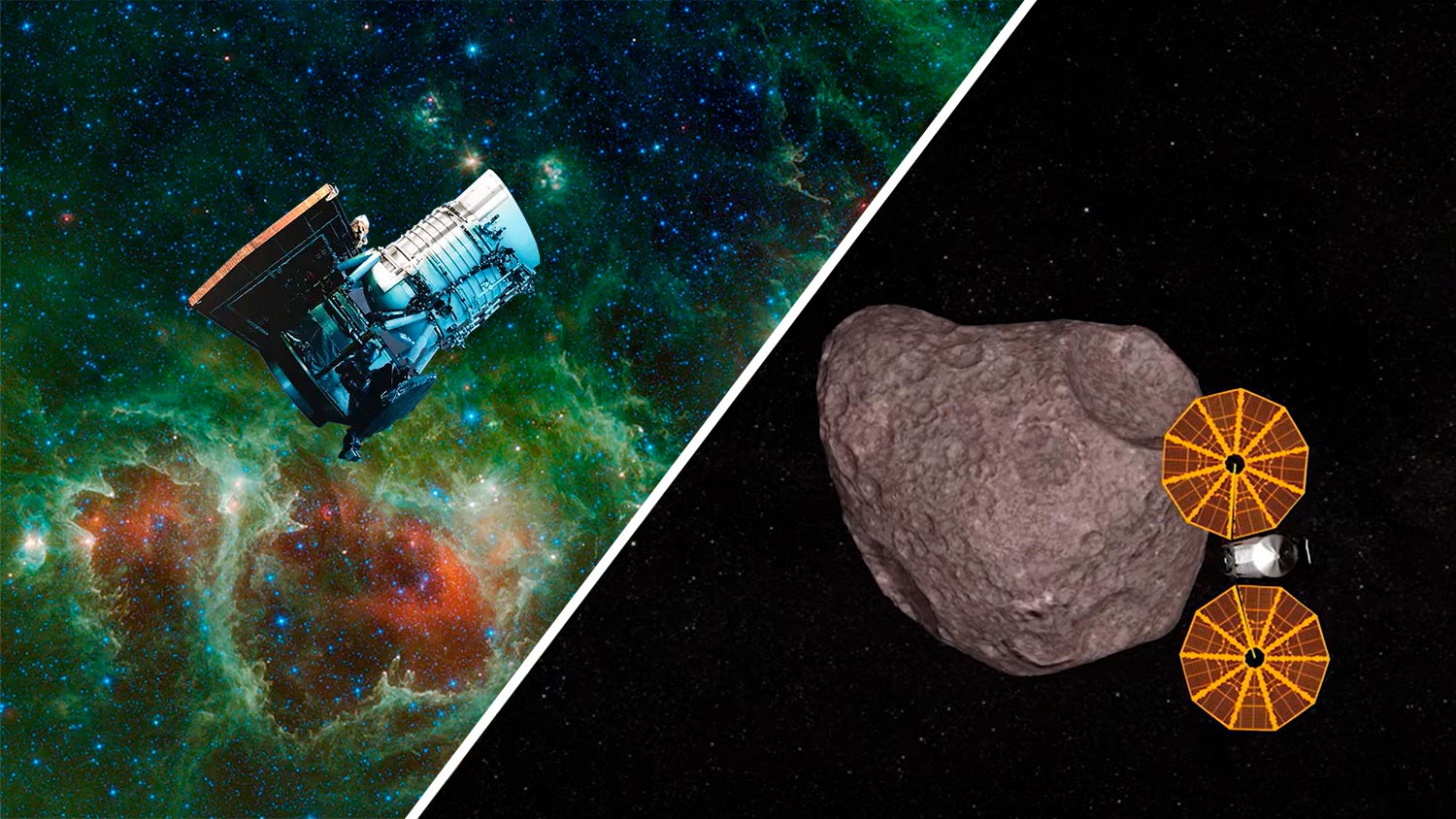
Researchers have utilized infrared survey data to refine the asteroid’s size and surface brightness in support of the November 1 encounter by NASA’s Lucy mission.
Today, NASA’s Lucy mission will have its first asteroid encounter as the spacecraft travels through deep space en route to Jupiter’s orbit. But before the spacecraft passes 265 miles (425 kilometers) from the surface of the small asteroid Dinkinesh, researchers have used 13-year-old infrared data from NASA’s Wide-field Infrared Survey Explorer (WISE) to support the mission’s flyby. Their new study provides updated estimates of the asteroid’s size and albedo – a measurement of surface reflectivity – that could help scientists better understand the nature of some near-Earth objects.
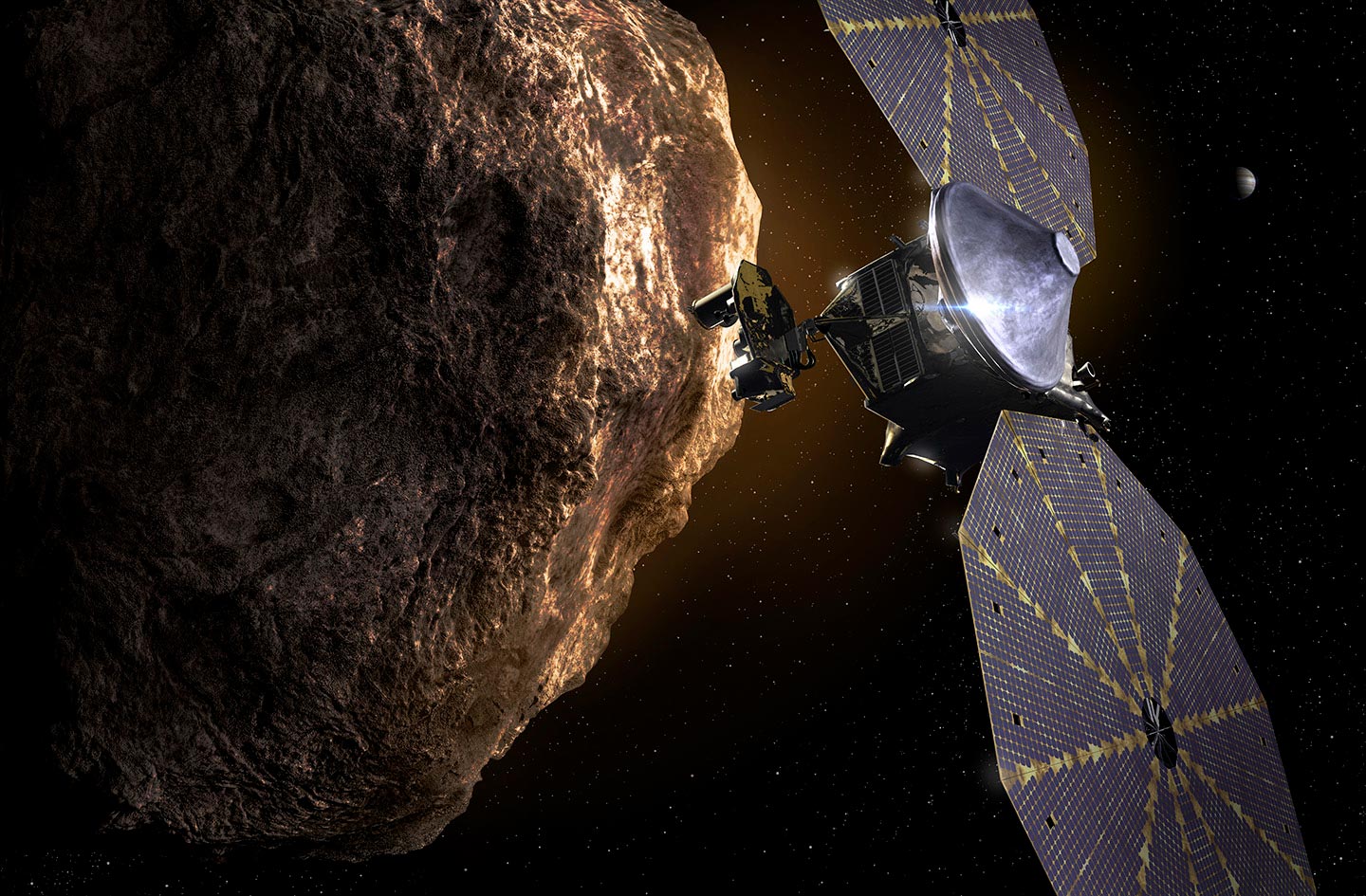
Located between Mars and Jupiter, the main asteroid belt is home to most asteroids in our solar system, including Dinkinesh, which is following an orbit around the Sun that places it near Lucy’s path. The Lucy mission is using the Dinkinesh encounter as an opportunity to test systems and procedures that are designed to keep the asteroid within the science instruments’ fields of view as the spacecraft flies past at 10,000 mph (4.5 kilometers per second). This will help the team prepare for the mission’s primary objective: investigating the Jupiter Trojan asteroids, a population of primitive small bodies orbiting in tandem with Jupiter.
WISE’s Serendipitous Observations
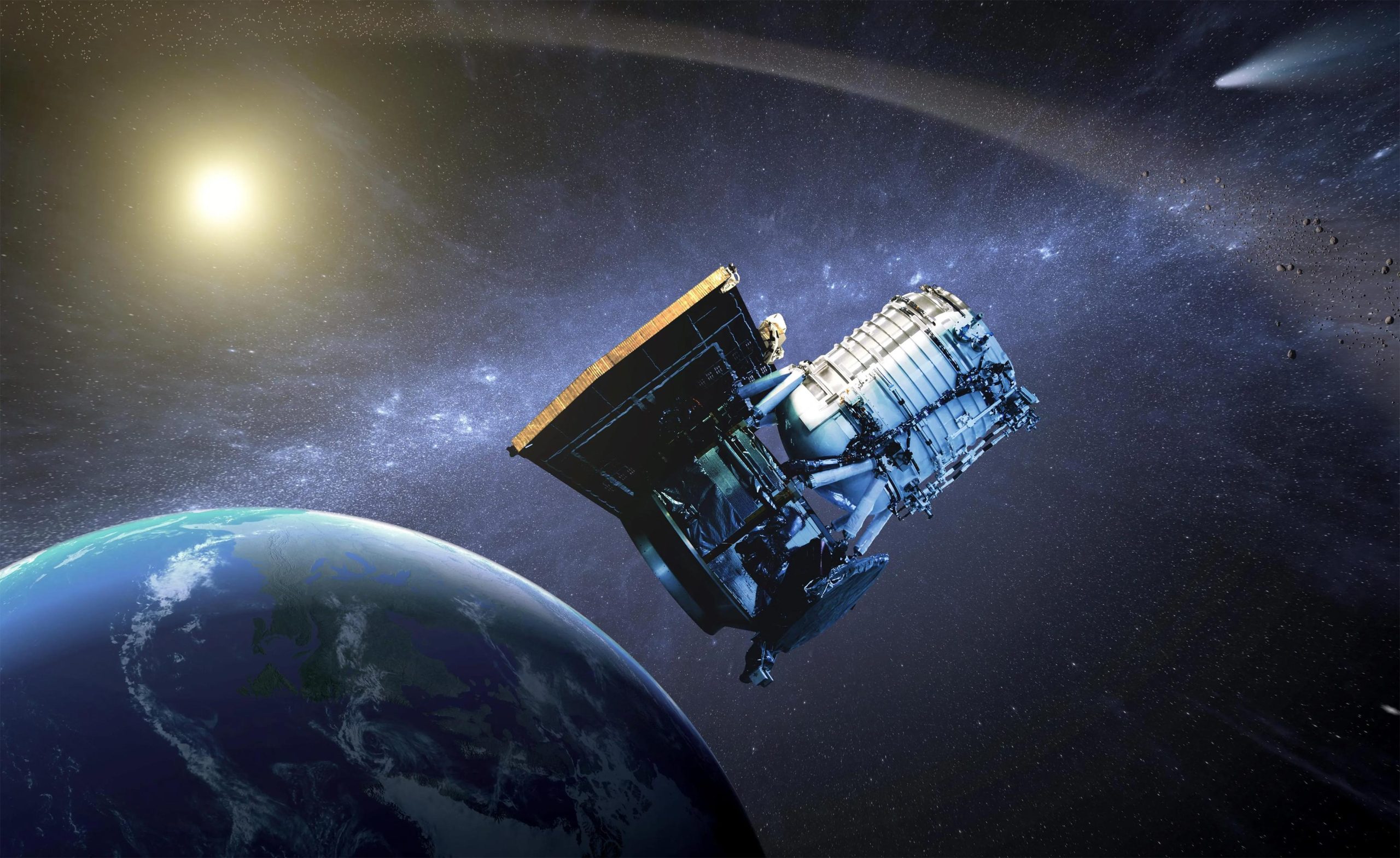
In the new study, published in the Astrophysical Journal Letters, University of Arizona researchers used observations made by the WISE spacecraft, which serendipitously scanned Dinkinesh in 2010 during its prime mission. Managed by NASA’s Jet Propulsion Laboratory (JPL) in Southern California, WISE launched on December 14, 2009, to create an all-sky infrared map of the universe.
Although the signal was weak in the exposures captured by WISE, the authors managed to identify 17 infrared observations of the region of sky where Dinkinesh’s signal could be seen. Then they used an algorithm to align and stack the images. The observations were made in March 2010 and represent 36.5 hours of observing time.
“Dinkinesh wasn’t initially detected by WISE, because the asteroid’s infrared signal was too weak for the software that was designed to find objects in a single exposure,” said Kiana De’Marius McFadden, a graduate student at the University of Arizona and lead author of the study. “But the asteroid’s dim infrared signal was still there, so our main challenge was to first find Dinkinesh and then to stack multiple exposures of the same region of sky to get its signal to emerge from the noise.”
Revealing Details Beyond WISE’s Original Purpose
Dinkinesh was discovered in 1999 – over a decade before WISE made the observations – and although its approximate size has been known, the new analysis refines not only its size, but also its albedo. The WISE observations suggest the asteroid has a diameter of about a half-mile (760 meters) and an albedo consistent with stony (S-type) asteroids.
Although WISE’s purpose wasn’t to detect asteroids, the spacecraft was sensitive to the infrared light (which is invisible to the naked eye) radiating from them as a result of sunlight heating their rocky surfaces. WISE had recorded about 190,000 asteroid observations by the end of its prime mission. In 2013, NASA reactivated WISE and renamed the mission Near-Earth Object Wide-field Survey Explorer (NEOWISE). Its purpose: to detect and track asteroids and comets that stray close to Earth’s orbit.
“Dinkinesh is the smallest main belt asteroid to be studied up-close and could provide valuable information about this type of object,” said the University of Arizona’s Amy Mainzer, a study co-author and the principal investigator for NEOWISE. “This population of main-belt asteroids overlap in size with the potentially hazardous near-Earth object population. Studying Dinkinesh could provide insights as to how these small main-belt asteroids form and where near-Earth asteroids come from.”
The Next Steps in Asteroid Observation
Targeting a late 2027 launch, NASA’s Near-Earth Object Surveyor (NEO Surveyor) will take over where NEOWISE leaves off. Scanning the sky in infrared wavelengths for hard-to-find asteroids and comets, NEO Surveyor could also utilize the same technique used to detect faint signals hiding in WISE observations, boosting the next-generation space telescope’s power. Mainzer is the principal investigator for NEO Surveyor.
Reference: “Size and Albedo Constraints for (152830) Dinkinesh Using WISE Data” by Kiana D. McFadden, Amy K. Mainzer, Joseph R. Masiero, James M. Bauer, Roc M. Cutri, Dar Dahlen, Frank J. Masci, Jana Pittichová, Akash Satpathy and Edward L. Wright, 23 October 2023, The Astrophysical Journal Letters.
DOI: 10.3847/2041-8213/acff61
Lucy’s principal investigator, Hal Levison, is based at the Boulder, Colorado, branch of Southwest Research Institute (SwRI), headquartered in San Antonio, Texas. NASA’s Goddard Space Flight Center in Greenbelt, Maryland, provides overall mission management, systems engineering, and safety and mission assurance. Lockheed Martin Space in Littleton, Colorado, built the spacecraft. Lucy is the 13th mission in NASA’s Discovery Program. NASA’s Marshall Space Flight Center in Huntsville, Alabama, manages the Discovery Program for the Science Mission Directorate at NASA Headquarters in Washington.
Never miss a breakthrough: Join the SciTechDaily newsletter.
Follow us on Google and Google News.