
Close Menu
    Facebook X (Twitter) Instagram
    SciTechDaily
    • Biology
    • Chemistry
    • Earth
    • Health
    • Physics
    • Science
    • Space
    • Technology
    Facebook X (Twitter) Pinterest YouTube RSS
    SciTechDaily
    Home»Space»Hubble Space Telescope: Starstruck in Terzan 4
    Space

    Hubble Space Telescope: Starstruck in Terzan 4

    By ESA/HubbleSeptember 11, 20224 Comments2 Mins Read
    Facebook Twitter Pinterest Telegram LinkedIn WhatsApp Email Reddit
    Share
    Facebook Twitter LinkedIn Pinterest Telegram Email Reddit
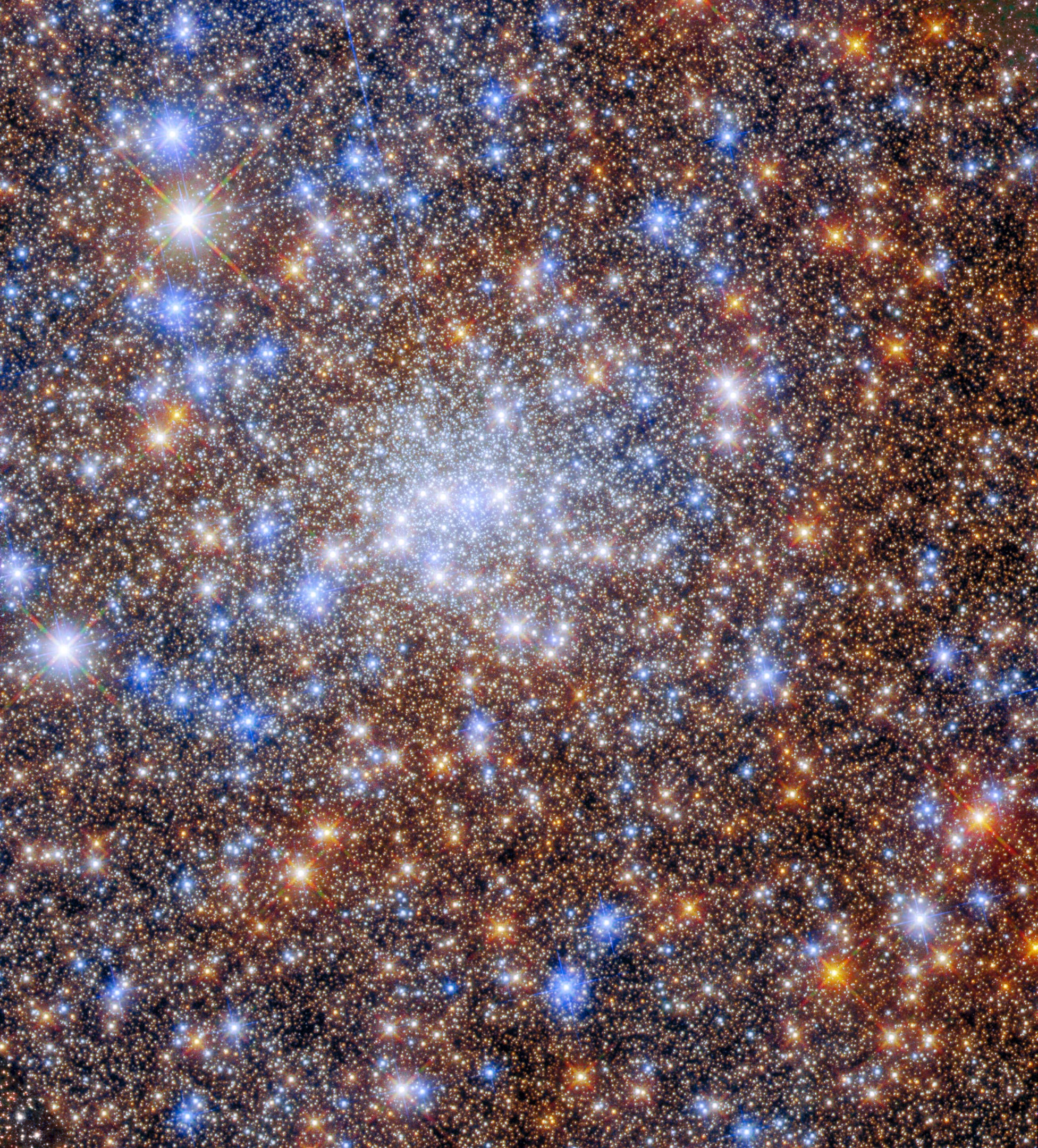
    Globular Cluster Terzan 4
    Hubble Space Telescope of globular cluster Terzan 4. Credit: ESA/Hubble & NASA, R. Cohen

    A glittering multitude of stars in the globular cluster Terzan 4 fills this image from the Hubble Space Telescope. Globular clusters are collections of stars bound together by their mutual gravitational attraction, and can contain millions of individual stars. As this image shows, the heart of a globular cluster such as Terzan 4 is a densely packed, crowded field of stars — which makes for spectacular images!

    The study of globular clusters was revolutionized by the launch of Hubble in 1990. That’s because the individual stars in these dense crowds are almost impossible to distinguish from one another with ground-based telescopes. However, they can be picked apart using the precise imaging of space telescopes. Astronomers have taken advantage of Hubble’s crystal-clear vision to study the stars making up globular clusters, as well as how these systems change over time.

    This particular observation comes from astronomers using Hubble to explore Terzan 4 and other globular clusters in order to understand the shape, density, age, and structure of globular clusters close to the center of the Milky Way. Unlike globular clusters elsewhere in the sky, these globular clusters have evaded detailed observation because of the clouds of gas and dust swirling around the galactic core. These clouds blot out starlight in a process that astronomers refer to as ‘extinction’, which complicates astronomical observations.

    Astronomers took advantage of the sensitivity of two of Hubble’s instruments — the Advanced Camera for Surveys and Wide Field Camera 3 — to overcome the impact of extinction on Terzan 4. By combining Hubble imagery with sophisticated data processing, astronomers were able to determine the ages of galactic globular clusters to within a billion years — a relatively accurate measurement in cosmic terms!

    Never miss a breakthrough: Join the SciTechDaily newsletter.
    Follow us on Google and Google News.

    Astronomy European Space Agency Hubble Space Telescope Popular
    Share. Facebook Twitter Pinterest LinkedIn Email Reddit

    Related Articles

    NASA’s Hubble Accidentally Witnesses a Comet Shattering in Space

    Hubble’s Newest Discovery Isn’t a Star, It’s a Window Into the Dark Universe

    Hubble Captures the Best Ever Image of the Antennae Galaxies

    Hubble Captures Face-On Image of Messier 61

    Hubble Views an Ongoing Cosmic Collision

    Hubble Views Newborn Stars in Galaxy IC 5052

    New XDF Image, The Deepest-Ever View of the Universe

    Hubble Zooms in on the Center of M4

    Hubble Image of Peculiar Galaxy Pair Arp 116

    4 Comments

    1. Jim on September 14, 2022 5:51 am

      Incredible views!

      Reply
    2. Zack on September 14, 2022 8:57 am

      Yah this image convinced me of the saying “there are more stars/galaxies in the Universe than the total number of san grains in ALL beaches on Earth”, but still wondering @ its accuracy. 😀

      Reply
    3. Jorge Garcia on September 14, 2022 7:00 pm

      You can see that far and still you can’t see no UFO sightings

      Reply
    4. ND on September 20, 2022 9:35 am

      It’s hard to fathom that each each of these points of light are lightyears away from one another. You have to remember the view goes from front to back rather than left to right visually speaking.

      Reply
    Leave A Reply Cancel Reply

    • Facebook
    • Twitter
    • Pinterest
    • YouTube

    Don't Miss a Discovery

    Subscribe for the Latest in Science & Tech!

    Trending News

    A SpaceX Falcon 9 Rocket Hit the Moon and Blasted Open a 60-Foot Crater

    Study Reveals Your Organs May Be Aging at Very Different Speeds

    Scientists Finally Solve a 20-Year Mystery About Diamond Melting

    Ultra-Processed Foods Linked to 30% Higher Prostate Cancer Risk

    More Screen Time, Better Thinking? An 8-Year Study Finds a Surprising Link

    Cleaner Cars May Be Hiding a New Pollution Problem

    Common Plant Chemical Linked to Widespread Organ Damage in Aquatic Animals

    Dogs and Humans May Share a Surprising Biological Secret to Longevity

    Follow SciTechDaily
    • Facebook
    • Twitter
    • YouTube
    • Pinterest
    • Newsletter
    • RSS
    SciTech News
    • Biology News
    • Chemistry News
    • Earth News
    • Health News
    • Physics News
    • Science News
    • Space News
    • Technology News
    Recent Posts
    • Tiny Stars Are Making the Early Universe Much Harder to Explain
    • Dark Stars May Have Left a Gravitational-Wave Signal We Can Detect Today
    • NASA’s Powerful New Roman Space Telescope Is Cleared for Launch
    • Scientists Reveal How Cells Tame One of Biology’s Most Dangerous Metals
    • Hurricane Forecast Maps Are Getting Better – but One Big Problem Remains
    Copyright © 1998 - 2026 SciTechDaily. All Rights Reserved.
    • Science News
    • About
    • Contact
    • Editorial Board
    • Privacy Policy
    • Terms of Use

    Type above and press Enter to search. Press Esc to cancel.