
Close Menu
    Facebook X (Twitter) Instagram
    SciTechDaily
    • Biology
    • Chemistry
    • Earth
    • Health
    • Physics
    • Science
    • Space
    • Technology
    Facebook X (Twitter) Pinterest YouTube RSS
    SciTechDaily
    Home»Space»Hubble Telescope Confirms New Dark Spot on Neptune
    Space

    Hubble Telescope Confirms New Dark Spot on Neptune

    By Donna Weaver / Ray Villard, Space Telescope Science InstituteJune 23, 2016No Comments4 Mins Read
    Facebook Twitter Pinterest Telegram LinkedIn WhatsApp Email Reddit
    Share
    Facebook Twitter LinkedIn Pinterest Telegram Email Reddit
    New Dark Spot on Neptune Confirmed
    Neptune’s dark vortices are high-pressure systems and are usually accompanied by bright “companion clouds,” which are also now visible on the distant planet. The bright clouds form when the flow of ambient air is perturbed and diverted upward over the dark vortex, causing gases to likely freeze into methane ice crystals.

    NASA’s Hubble Space Telescope has confirmed the presence of a dark vortex in the atmosphere of Neptune. Though similar features were seen during the Voyager 2 flyby of Neptune in 1989 and by the Hubble Space Telescope in 1994, this vortex is the first one observed on Neptune in the 21st century.

    The discovery was announced on May 17, 2016, in a Central Bureau for Astronomical Telegrams (CBAT) electronic telegram by University of California at Berkeley research astronomer Mike Wong, who led the team that analyzed the Hubble data.

    Neptune’s dark vortices are high-pressure systems and are usually accompanied by bright “companion clouds,” which are also now visible on the distant planet. The bright clouds form when the flow of ambient air is perturbed and diverted upward over the dark vortex, causing gases to likely freeze into methane ice crystals.

    “Dark vortices coast through the atmosphere like huge, lens-shaped gaseous mountains,” Wong said. “And the companion clouds are similar to so-called orographic clouds that appear as pancake-shaped features lingering over mountains on Earth.”

    Beginning in July 2015, bright clouds were again seen on Neptune by several observers, from amateurs to astronomers at the W. M. Keck Observatory in Hawaii. Astronomers suspected that these clouds might be bright companion clouds following an unseen dark vortex. Neptune’s dark vortices are typically only seen at blue wavelengths, and only Hubble has the high resolution required for seeing them on distant Neptune.
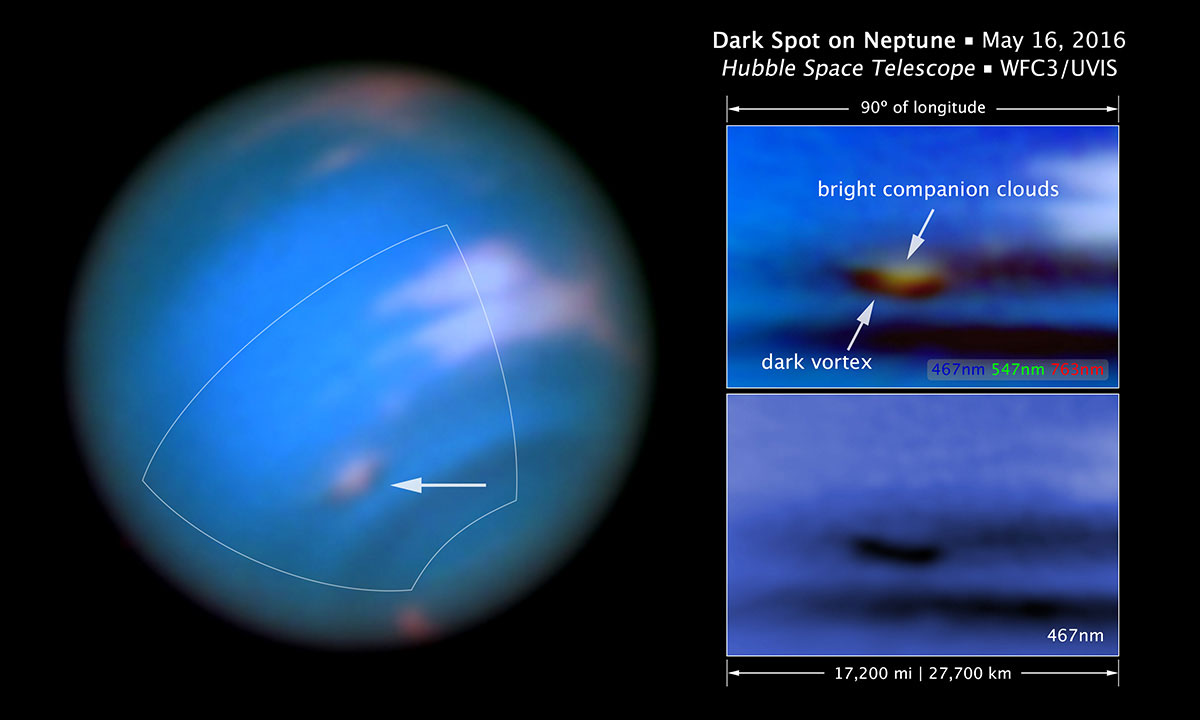
    Astronomers Confirm New Dark Spot on Neptune
    This new Hubble Space Telescope image confirms the presence of a dark vortex in the atmosphere of Neptune. The full visible-light image at left shows that the dark feature resides near and below a patch of bright clouds in the planet’s southern hemisphere. The full-color image at top right is a close-up of the complex feature. The vortex is a high-pressure system. The image at bottom right shows that the vortex is best seen at blue wavelengths

    In September 2015, the Outer Planet Atmospheres Legacy (OPAL) program, a long-term Hubble Space Telescope project that annually captures global maps of the outer planets, revealed a dark spot close to the location of the bright clouds, which had been tracked from the ground. By viewing the vortex a second time, the new Hubble images confirm that OPAL really detected a long-lived feature. The new data enabled the team to create a higher-quality map of the vortex and its surroundings.

    Neptune’s dark vortices have exhibited surprising diversity over the years, in terms of size, shape, and stability (they meander in latitude, and sometimes speed up or slow down). They also come and go on much shorter timescales compared to similar anticyclones seen on Jupiter; large storms on Jupiter evolve over decades.

    Planetary astronomers hope to better understand how dark vortices originate, what controls their drifts and oscillations, how they interact with the environment, and how they eventually dissipate, according to UC Berkeley doctoral student Joshua Tollefson, who was recently awarded a prestigious NASA Earth and Space Science Fellowship to study Neptune’s atmosphere. Measuring the evolution of the new dark vortex will extend knowledge of both the dark vortices themselves, as well as the structure and dynamics of the surrounding atmosphere.

    The team, led by Wong, also included the OPAL team (Wong, Amy Simon, and Glenn Orton), UC Berkeley collaborators (Imke de Pater, Joshua Tollefson, and Katherine de Kleer), Heidi Hammel (AURA), Statia Luszcz-Cook (AMNH), Ricardo Hueso and Agustin Sánchez-Lavega (Universidad del Pais Vasco), Marc Delcroix (Société Astronomique de France), Larry Sromovsky and Patrick Fry (University of Wisconsin), and Christoph Baranec (University of Hawaii).

    Never miss a breakthrough: Join the SciTechDaily newsletter.
    Follow us on Google and Google News.

    Astronomy Hubble Space Telescope NASA Planetary Science Popular
    Share. Facebook Twitter Pinterest LinkedIn Email Reddit

    Related Articles

    Hubble Finds a Planet Orbiting Pair of Stars in System OGLE-2007-BLG-349

    Hubble Telescope Views Vivid Auroras in Jupiter’s Atmosphere

    Hubble Telescope Close-up of the Red Planet

    Hubble Reveals a Dry Atmosphere Around Super-Earth 55 Cancri e

    Hubble at 25 Series: How Hubble Has Helped Pave the Way for Interplanetary Missions

    Hubble Detects Water Vapor Over Jupiter’s Moon Europa

    Hubble Finds Signatures of Water on Distant Exoplanets

    Hubble Data Reveals a New Neptune Moon

    New Study Revives Doubted Exoplanet Fomalhaut b

    Leave A Reply Cancel Reply

    • Facebook
    • Twitter
    • Pinterest
    • YouTube

    Don't Miss a Discovery

    Subscribe for the Latest in Science & Tech!

    Trending News

    Millions Take These IBS Drugs, But a New Study Finds Serious Risks

    Scientists Unlock Hidden Secrets of 2,300-Year-Old Mummies Using Cutting-Edge CT Scanner

    Bread Might Be Making You Gain Weight Even Without Eating More Calories

    Scientists Discover Massive Magma Reservoir Beneath Tuscany

    Europe’s Most Active Volcano Just Got Stranger – Here’s Why Scientists Are Rethinking It

    Alzheimer’s Symptoms May Start Outside the Brain, Study Finds

    Millions Take This Popular Supplement – Scientists Discover a Concerning Link to Heart Failure

    The Universe Is Expanding Too Fast and Scientists Can’t Explain Why

    Follow SciTechDaily
    • Facebook
    • Twitter
    • YouTube
    • Pinterest
    • Newsletter
    • RSS
    SciTech News
    • Biology News
    • Chemistry News
    • Earth News
    • Health News
    • Physics News
    • Science News
    • Space News
    • Technology News
    Recent Posts
    • Simple Blood Test May Predict Alzheimer’s Years Before Brain Scans Show Signs
    • Scientists Say Adding This Unusual Seafood to Your Diet Could Reverse Signs of Aging
    • U.S. Waste Holds $5.7 Billion Worth of Crop Nutrients
    • Scientists Say a Hidden Structure May Exist Inside Earth’s Core
    • Doctors Surprised by the Power of a Simple Drug Against Colon Cancer
    Copyright © 1998 - 2026 SciTechDaily. All Rights Reserved.
    • Science News
    • About
    • Contact
    • Editorial Board
    • Privacy Policy
    • Terms of Use

    Type above and press Enter to search. Press Esc to cancel.