
Close Menu
    Facebook X (Twitter) Instagram
    SciTechDaily
    • Biology
    • Chemistry
    • Earth
    • Health
    • Physics
    • Science
    • Space
    • Technology
    Facebook X (Twitter) Pinterest YouTube RSS
    SciTechDaily
    Home»Space»Hubble Telescope Spots Asteroids Photobombing Distant Galaxies
    Space

    Hubble Telescope Spots Asteroids Photobombing Distant Galaxies

    By Ann Jenkins / Ray Villard, Space Telescope Science InstituteNovember 3, 2017No Comments3 Mins Read
    Facebook Twitter Pinterest Telegram LinkedIn WhatsApp Email Reddit
    Share
    Facebook Twitter LinkedIn Pinterest Telegram Email Reddit
    Hubble Views Nearby Asteroids Photobombing Distant Galaxies
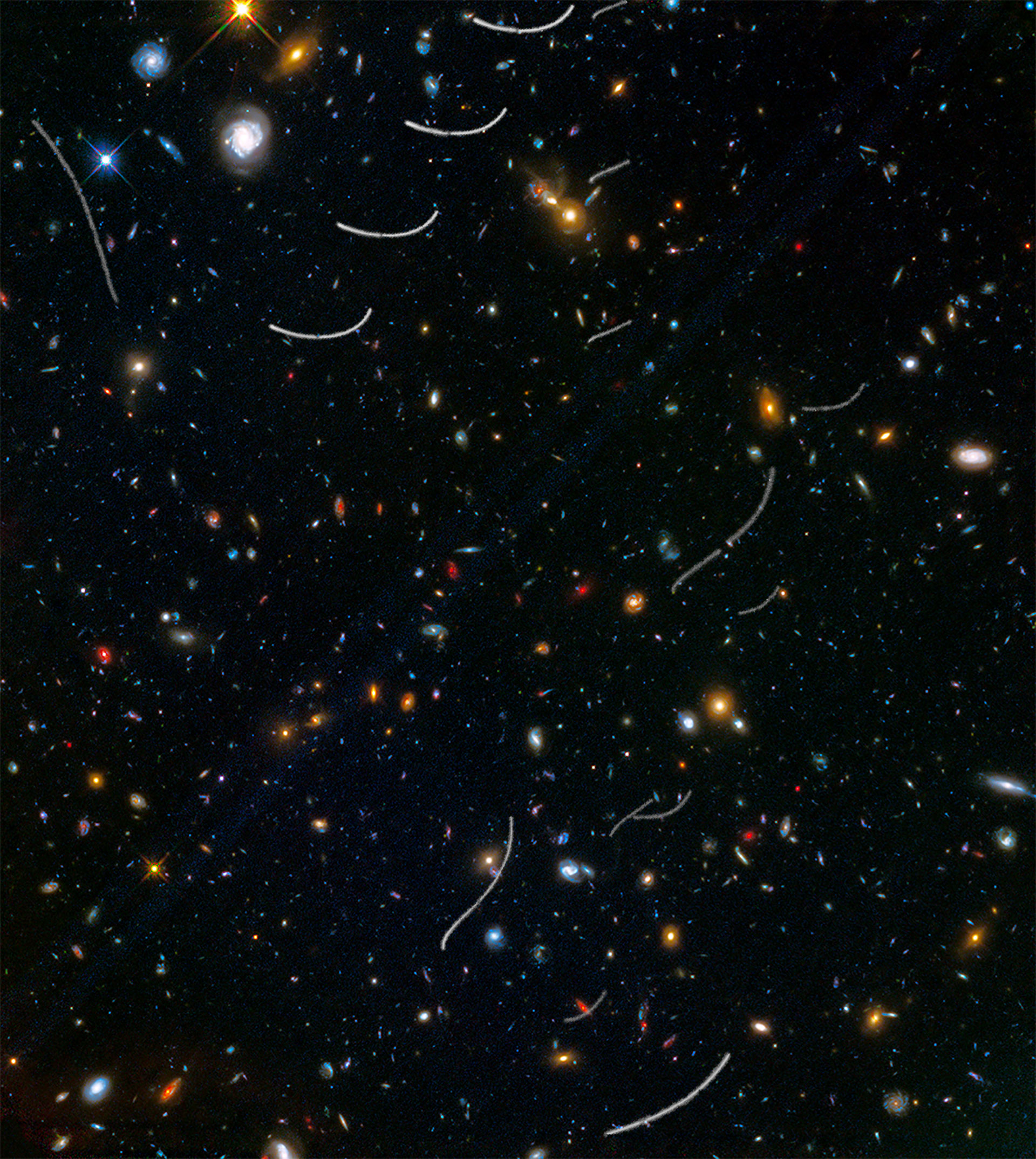
    This Hubble photo of a random patch of sky is part of a survey called Frontier Fields. It contains thousands of galaxies, including massive yellowish ellipticals and majestic blue spirals. Much smaller, fragmentary blue galaxies are sprinkled throughout the field. The reddest objects are most likely the farthest galaxies. Asteroid trails appear as curved or S-shaped streaks. Asteroids appear in multiple Hubble exposures that have been combined into one image. Of the 20 total asteroid sightings for this field, seven are unique objects. Credits: NASA, ESA, and B. Sunnquist and J. Mack (STScI)

    Like rude relatives who jump in front of your vacation snapshots of landscapes, some of our solar system’s asteroids have photobombed deep images of the universe taken by NASA’s Hubble Space Telescope. These asteroids reside, on average, only about 160 million miles from Earth — right around the corner in astronomical terms. Yet they’ve horned their way into this picture of thousands of galaxies scattered across space and time at inconceivably farther distances.

    Intruding across the above picture are asteroid trails that appear as curved or S-shaped streaks. Rather than leaving one long trail, the asteroids appear in multiple Hubble exposures that have been combined into one image. Of the 20 total asteroid sightings for this field, seven are unique objects. Of these seven asteroids, only two were earlier identified. The others were too faint to be seen previously.

    The trails look curved due to an observational effect called parallax. As Hubble orbits around Earth, an asteroid will appear to move along an arc with respect to the vastly more distant background stars and galaxies.

    This parallax effect is somewhat similar to the effect you see from a moving car, in which trees by the side of the road appear to be passing by much more rapidly than background objects at much larger distances. The motion of Earth around the Sun, and the motion of the asteroids along their orbits, are other contributing factors to the apparent skewing of asteroid paths.

    All the asteroids were found manually, the majority by “blinking” consecutive exposures to capture apparent asteroid motion. Astronomers found a unique asteroid for every 10 to 20 hours of exposure time.
    Hubble Spots Asteroids Photobombing Distant Galaxies
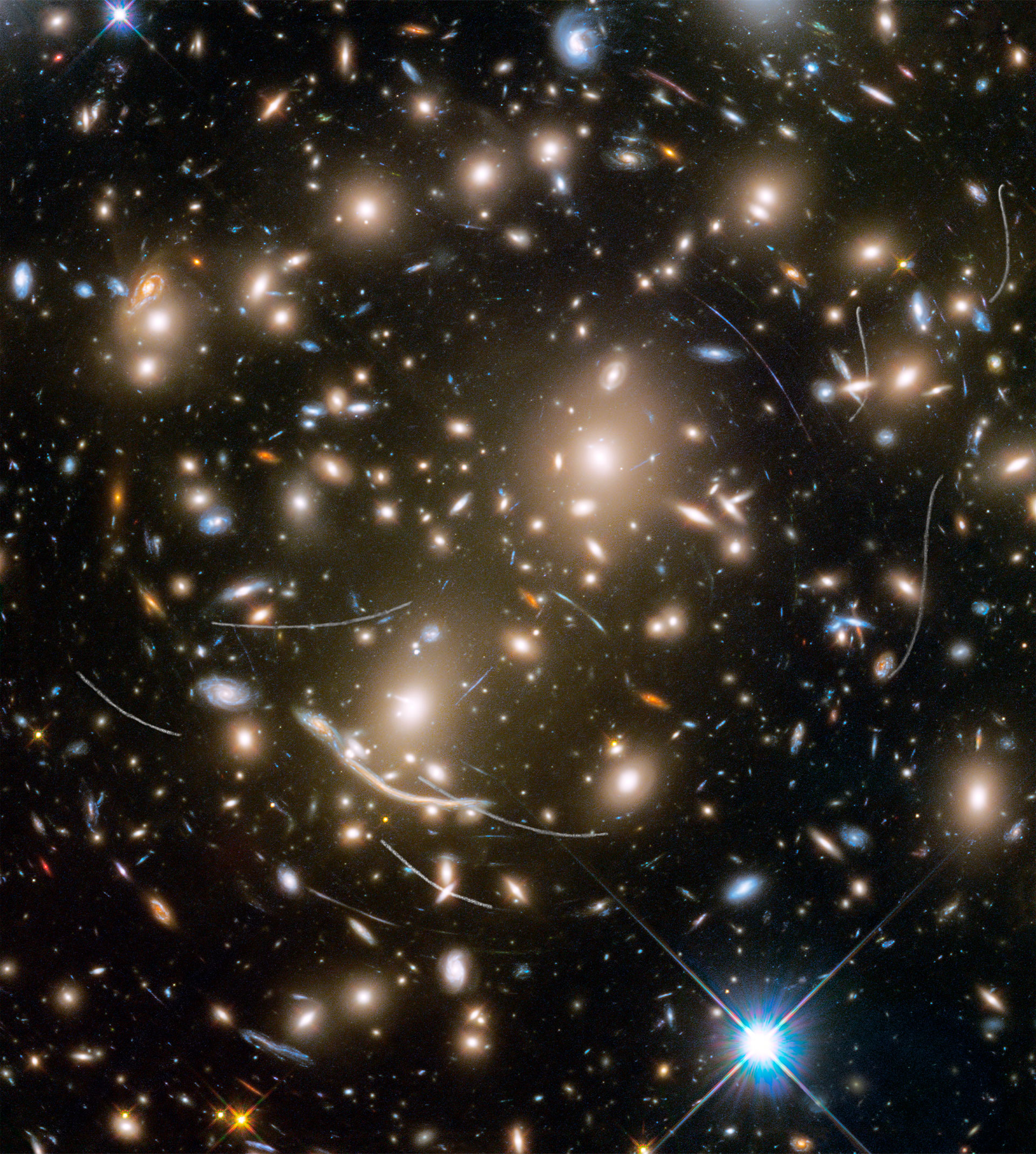
    Galaxy cluster Abell 370 contains several hundred galaxies tied together by the mutual pull of gravity. It is located approximately 4 billion light-years away in the constellation Cetus, the Sea Monster. The thin, white trails that look like curved or S-shaped streaks are from asteroids that reside, on average, only about 160 million miles from Earth. The trails appear in multiple Hubble exposures that have been combined into one image. Of the 22 total asteroid sightings for this field, five are unique objects. These asteroids are so faint that they were not previously identified. Credits: NASA, ESA, and STScI

    The Frontier Fields program is a collaboration among NASA’s Great Observatories and other telescopes to study six massive galaxy clusters and their effects. Using a different camera, pointing in a slightly different direction, Hubble photographed six so-called “parallel fields” at the same time it photographed the massive galaxy clusters. This maximized Hubble’s observational efficiency in doing deep space exposures. These parallel fields are similar in depth to the famous Hubble Deep Field, and include galaxies about four-billion times fainter than can be seen by the human eye.

    The above picture is of the parallel field for the galaxy cluster Abell 370. It was assembled from images taken in visible and infrared light. The field’s position on the sky is near the ecliptic, the plane of our solar system. This is the zone in which most asteroids reside, which is why Hubble astronomers saw so many crossings. Hubble deep-sky observations taken along a line-of-sight near the plane of our solar system commonly record asteroid trails.

    Never miss a breakthrough: Join the SciTechDaily newsletter.
    Follow us on Google and Google News.

    Asteroid Astronomy Hubble Space Telescope
    Share. Facebook Twitter Pinterest LinkedIn Email Reddit

    Related Articles

    DART Asteroid Impact Aftermath: Hubble Spots Unexpected Twin Tails in “Stunning Surprise”

    Webb and Hubble Space Telescopes Capture Detailed Views of DART Asteroid Impact

    Astronomers Catch Asteroid in the Act of Changing Color – For the First Time Ever

    Hubble Telescope Views Spun-Up Asteroid Coming Apart

    Hubble Views Asteroid P/2013 R3 Mysteriously Disintegrating

    Hubble Sees an Asteroid with Six Comet-Like Tails

    Hubble Discovers NGC 1073, A Barred Spiral Galaxy Similar to Milky Way

    SN Primo Is Farthest Type Ia Supernova Discovered

    Hubble Observes Rare Blue Stars in Andromeda’s Core

    Leave A Reply Cancel Reply

    • Facebook
    • Twitter
    • Pinterest
    • YouTube

    Don't Miss a Discovery

    Subscribe for the Latest in Science & Tech!

    Trending News

    Why Popular Diabetes Drugs Like Ozempic Don’t Work for Everyone: The “Genetic Glitch”

    Scientists Stunned After Finding Plant Thought Extinct for 60 Years

    Scientists Discover Tiny New Spider That Hunts Prey 6x Its Size

    Natural Component From Licorice Shows Promise for Treating Inflammatory Bowel Disease

    Scientists Warn: Popular Sweetener Linked to Dangerous Metabolic Effects

    Monster Storms on Jupiter Unleash Lightning Beyond Anything on Earth

    Scientists Create “Liquid Gears” That Spin Without Touching

    The Simple Habit That Could Help Prevent Cancer

    Follow SciTechDaily
    • Facebook
    • Twitter
    • YouTube
    • Pinterest
    • Newsletter
    • RSS
    SciTech News
    • Biology News
    • Chemistry News
    • Earth News
    • Health News
    • Physics News
    • Science News
    • Space News
    • Technology News
    Recent Posts
    • Hidden Ocean Currents Revealed in Stunning Detail by AI
    • Trees Emit Tiny Lightning Flashes During Storms and Scientists Finally Prove It
    • Forget Chemicals. This Plant Removes Microplastics From Water
    • Breakthrough Crystal Lets Scientists “Write” Nanoscale Patterns With Light
    • Pomegranate Compound Could Help Protect Against Heart Disease
    Copyright © 1998 - 2026 SciTechDaily. All Rights Reserved.
    • Science News
    • About
    • Contact
    • Editorial Board
    • Privacy Policy
    • Terms of Use

    Type above and press Enter to search. Press Esc to cancel.