
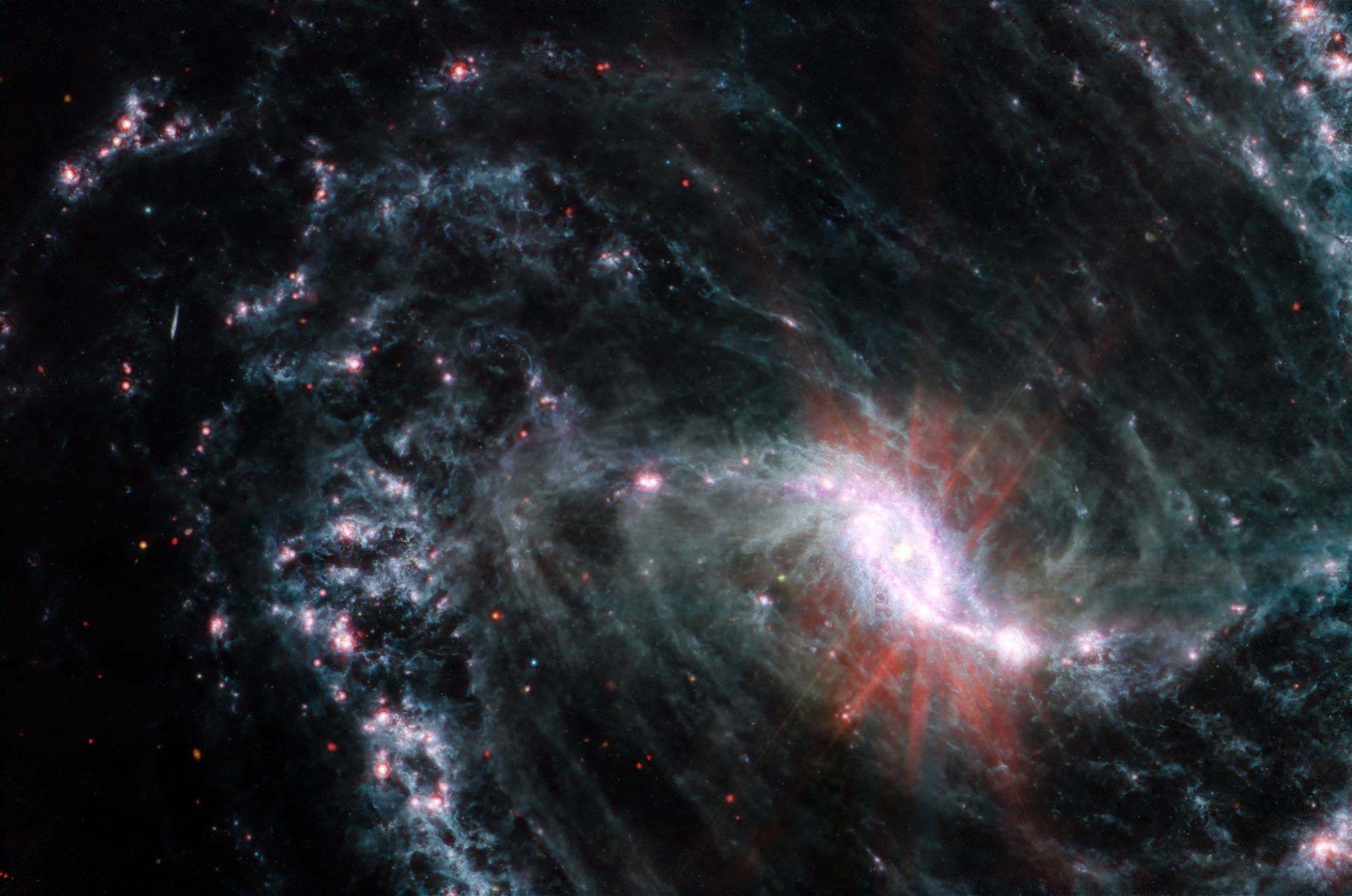
Scientists have long puzzled over a discrepancy in how fast the universe is expanding, but new, sharper data from the James Webb Space Telescope may finally be solving the mystery.
By refining distance measurements using powerful infrared instruments and analyzing exploding stars and red giants, researchers led have brought previously conflicting values of the Hubble Constant into agreement.
A Cosmic Puzzle: Conflicting Expansion Rates
For years, scientists have been chasing a puzzling inconsistency in our understanding of the universe.
We know the universe is expanding, but measurements of how fast it’s growing have given different answers depending on whether we look at the early universe or the present day. If both were correct, it would challenge the very foundation of modern cosmology.
Now, new and more precise data from the James Webb Space Telescope is offering a fresh perspective—and it looks like the universe may not be misbehaving after all.
“This new evidence is suggesting that our Standard Model of the universe is holding up,” said University of Chicago Prof. Wendy Freedman, a leading figure in the debate over this rate of expansion, known as the Hubble Constant.
“It doesn’t mean we won’t find things in the future that are inconsistent with the model, but at the moment the Hubble Constant doesn’t seem to be it,” she said.
The findings were published in the May 27 issue of The Astrophysical Journal.
Two Ways to Measure the Universe’s Growth
To figure out how fast the universe is expanding, scientists use two major techniques.
The first involves studying the ancient light left over from the Big Bang. This glow, called the cosmic microwave background, is still spreading through space and provides a snapshot of the early universe.
Freedman focuses on the second method—measuring how fast the universe is expanding in the present day, closer to home. Surprisingly, this is the harder task. Measuring distances across vast cosmic scales is incredibly complex and requires careful observation of stars and galaxies.
Supernovae and Stellar Benchmarks
Over the last half century or so, scientists have come up with a number of ways to measure relatively nearby distances. One relies on catching the light of a particular class of star at its peak brightness, when it explodes as a supernova, at the end of its life. If we know the maximum brightness of these supernovae, measuring their apparent luminosities allows us to calculate its distance. Additional observations tell us how fast the galaxy in which that supernova occurred is moving away from us. Freedman has also pioneered two other methods that use what we know about two other types of stars: red giant stars and carbon stars.
However, there are many corrections that must be applied to these measurements before a final distance can be declared. Scientists must first account for cosmic dust that dims the light between us and these distant stars in their host galaxies. They must also check and correct for luminosity differences that may arise over cosmic time. And finally, subtle measurement uncertainties in the instrumentation used to make the measurements must be identified and corrected for.
Sharper Eyes in the Sky
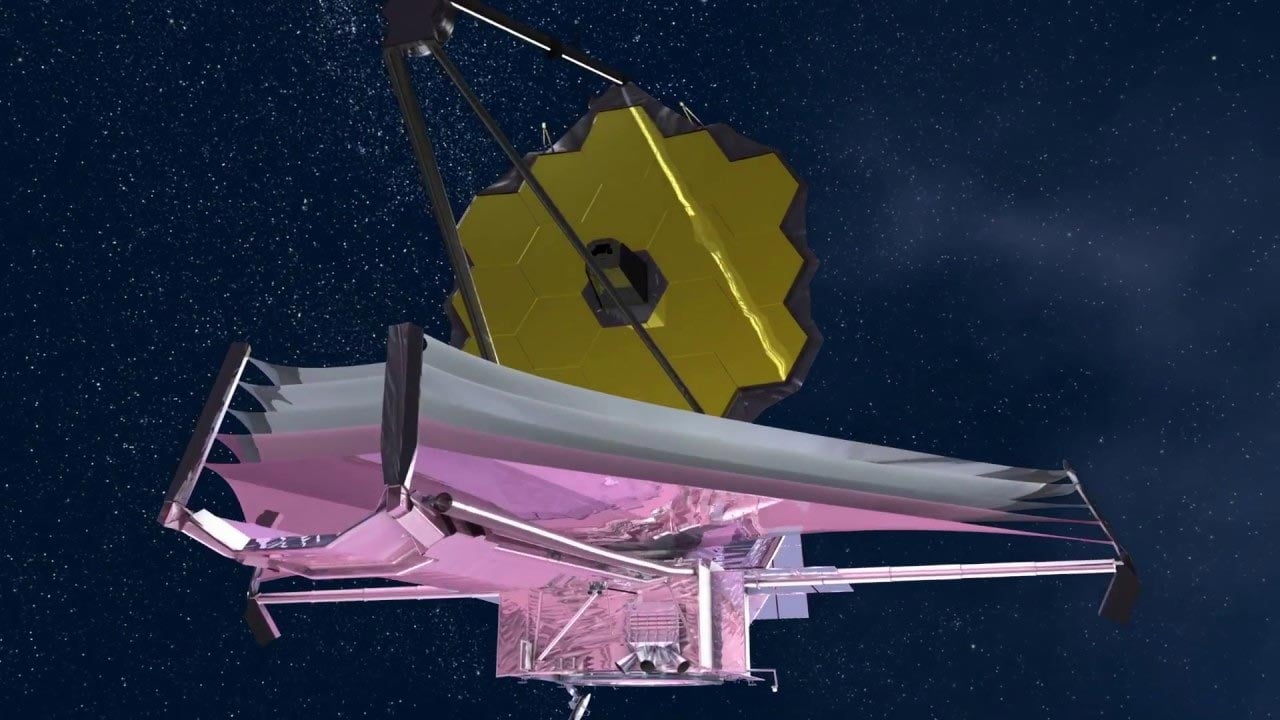
But with technological advances such as the launch of the much more powerful James Webb Space Telescope in 2021, scientists have been able to increasingly refine these measurements.
“We’ve more than doubled our sample of galaxies used to calibrate the supernovae,” Freedman said. “The statistical improvement is significant. This considerably strengthens the result.”
Numbers Align at Last
Freedman’s latest calculation, which incorporates data from both the Hubble Telescope and the James Webb Space Telescope, finds a value of 70.4 kilometers per second per megaparsec, plus or minus 3%.
That brings her value into statistical agreement with recent measurements from the cosmic microwave background, which is 67.4, plus or minus 0.7%.
“This new evidence is suggesting that our Standard Model of the universe is holding up.”
Prof. Wendy Freedman
Webb has four times the resolution of the Hubble Telescope, which allows it to identify individual stars previously detected in blurry groups. It’s also about 10 times as sensitive, which provides higher precision, and the ability to find even fainter objects of interest.
“We’re really seeing how fantastic the James Webb Space Telescope is for accurately measuring distances to galaxies,” said co-author Taylor Hoyt of the Lawrence Berkeley Laboratory. “Using its infrared detectors, we can see through dust that has historically plagued accurate measurement of distances, and we can measure with much greater accuracy the brightnesses of stars,” added co-author Barry Madore, of the Carnegie Institution for Science.
Decoding the Universe’s Mysteries
Freedman explained that astrophysicists have been trying to come up with a theory that would have explained different rates of expansion as the universe ages.
“There have been well over 1,000 papers trying to attack this problem, and it’s just turned out to be extraordinarily difficult to do,” she said.
Scientists are still trying to find cracks in the Standard Model that describes the universe, which could provide clues to the nature of two big outstanding mysteries—dark matter and dark energy. But the Hubble Constant increasingly seems not to be the place to look.
Looking Ahead with Optimism
Freedman and her team will be using the Webb Telescope next year to get measurements in a group of galaxies called the Coma cluster, which should provide more data from a different angle, she said. “These measurements will allow us to measure the Hubble constant directly, without the additional step of needing the supernovae.”
“I am optimistic about resolving this in the next few years, as we boost the accuracy to make these measurements,” she said.
Reference: “Status Report on the Chicago-Carnegie Hubble Program (CCHP): Measurement of the Hubble Constant Using the Hubble and James Webb Space Telescopes” by Wendy L. Freedman, Barry F. Madore, Taylor J. Hoyt, In Sung Jang, Abigail J. Lee and Kayla A. Owens, 27 May 2025, The Astrophysical Journal.
DOI: 10.3847/1538-4357/adce78
Other UChicago coauthors included In Sung Jang, Abigail Lee and Kayla Owens.
Funding: NASA
Never miss a breakthrough: Join the SciTechDaily newsletter.
Follow us on Google and Google News.
17 Comments
These are amazing pictures, I believe there is life ion distance exoplanets . The Jame Webb telescope is fantastic with it awesome pictures of the nebula and Black Holes . Hopefully with more information we will be able actually confirm life does exist and are not alone. Thanks
There is a huge number of planets in the habitable zone. And life arose on earth soon after it became habitable. These two factors together suggest that there is life elsewhere in the universe.
At the same time, the probability we will directly encounter any extraterrestrial life is almost zero. The reason is the huge distances between planets, and the impossibility of travel at immense speeds.
So, in all likelihood, we are not alone, but we are quite isolated.
At the quantum level, distance is irrelevant. If an advanced civilization found the ability to create a quantum means of travel, they could go hither and yon at will. Now, put your thinking cap on and invent it.
That’s what I’ve been trying to do.
Based on our knowledge of physics, we are isolated. It can be argued that it has to be so for an average inhabited planet, since a more crowded universe with a higher universal speed limit (of light speed in vacuum) would have less habitable planets.
The “not alone” feeling could be broken by discovering independent processes of evolution – that splits biology from geology – on in-system ice moons. Or possibly by gathering enough statistics of “could be life” thermodynamic imbalanced atmospheres on habitable type planets from spectroscopy that we could conclude a high enough likelihood for life within the sample.
While it’s fun to explore and in most cases speculate as to what’s “out there,” it is very doubtful that our time line will ever match up with another intelligent being. That is unless they decide to communicate with us. When one considers how distant the Andromeda galaxy is (it being the closest to us) the enormity of the universe begins to take form in our small minds.
To AG3: very true. I wonder if anyone has reworked the Drake equation based on the new information we now have available? Also, has the ‘possibility of a self replicating cell’ formula been reformulated?
Many planets could create “life”, but to sustain it one needs life that is self replicating.
I would like to believe in the ‘cherry tree’ idea that if life flowers in one place, it will flower all across that same galaxy at nearly the same time. But last I heard: self replicating life cannot exist anywhere in the universe. Well, one chance in ten to the eightieth power. (Oops!)
Search SciTechDaily, Nov.12 2024: Reimagining the Drake Equation.
Yes Human indeed! Lol
It is possible, that the universe developed became into existence on a second reaction related to the Big bang which was the first reaction these two reactions were spontaneously in association with each other The second reaction I speak of is the retraction. I feel the universe was created during the retraction as the expansion ended in came back into its shelf , and with a void that was created during me first reaction, energy in Black matter was able to come contact with . To create matter as we know it this reaction slow down and retraction thus the universe was created. Matter maintains existence through a repetitive cycle, this cycle that I speak of allows matter to copy itself or to identify with itself
. You have pure energy black matter in current matter current matter is what we exist of presently after each cycle matter that is used shed its self from the process thus gives you change constant change in all matter. We see this change as age. As we go back to center we will see your view galaxies with more clarity and stars before clarity for the matter that exist closer to the center of the reaction is matter that I’ve gone through less cycles which has less remnants to disrupt it’s view from us or current matter that has gone through cycle more so will be harder to view.
I as going to say just that ! lol
Seriously though, very interesting and thought provoking …thanks for sharing!
The Webb telescope result suggests that current cosmology is correct and that implies that there will be no universe contraction (as dark energy wins out).
Else, yes, the most general definition of “big bang” is the observed space expansion process (which can be described by a scale factor, see “Scale factor (cosmology)” in Wikipedia) – which produces the universe.
By changing our understanding of gravity we unlock the universe. And explain all the unexplainable https://zenodo.org/records/15531326
https://zenodo.org/records/15531326
This is a link to the only new theory that makes sense.
Random Zenodo (or other) links are unlikely to be references to scientific peer reviewed published theory, and such links are not to be encouraged to be spammed in popular science outlet sites. Try pseudoscience sites instead.
There’s been many controversies on string theory and loop quantum gravity but the answer isn’t loop quantum gravity. its actually Luke quantum gravity and sting they combined. compound said theory from a black hole. study densities and make universe.
The paper argues, convincingly IMO, that the conservative error estimates has a 3 sigma significance, not the claimed 5 sigma of a particular “camp”. That is no tension and in more fast moving fields such as particle accelerators 3 sigma significance results come and go all the time.
It also notes on Hubble constant estimates over history [their figure 18] that the Cepheids are the odd method out: “The Cepheid-based values of H0 are systematically higher than the mean, median, or mode of the distribution of other determinations (I. Steer 2020, 2024 private communication).”
With this result there is no disagreement between near and far field methods, which aligns with the general absence of bimodality [Their figure 18 again]. The only worry is that they had to base the light sensitive JWST calibrations on a single geometrical distance calibrator (the less bright NGC 4258), though of course the result could be cross checked with HST data.
For the future they see 6 areas where improvements can happen and the time scales are about a decade for each.
“That brings her value into statistical agreement with recent measurements from the cosmic microwave background, which is 67.4, plus or minus 0.7%.”
A context is that the last Atacama Cosmology Telescope cosmic microwave background data release DR6 confirms Planck. They claim H0 = 68.22 ± 0.36 km/s/Mpc (which is plus or minus 0.5 %).
Introduction to Rotational Energy Field Theory (REFT)
REFT (Rotational Energy Field Theory) is a theory that explains the energy of objects in the universe as a fundamental force activated through the frequency of their rotation. This force, which operates on both macro and micro levels, arises from the resonance generated by the rotation of objects in space. Instead of adhering to traditional approaches to forces such as gravity or electromagnetism, REFT proposes that the motion of objects—specifically their rotation—forms the basis of a new fundamental force that influences both the cosmos and quantum scales. In the context of REFT, the energy generated by the Big Bang is stored in the matter of the universe. This energy manifests through the rotation of objects and is transmitted via the frequency of that rotation. This rotation generates a force capable of influencing the movement of objects, which on a cosmological scale results in the acceleration of the universe’s expansion and on a quantum scale in phenomena such as tunneling and entanglement.
The force described by REFT is not merely an abstract concept but is explained through the interaction of resonances generated by the rotation of objects in space. The frequency of rotation determines the strength of this force, indicating that the dynamics of objects in the universe are directly related to the speed at which they spin. This provides a new way of understanding the structure of the universe while simultaneously offering explanations for both the cosmological expansion and the strange phenomena observed at the quantum level. In REFT, resonance is seen as the connecting force between objects across scales, from galaxies to subatomic particles. The resonance generated by the rotation of objects can lead to both repulsive and attractive forces, depending on the specific dynamics of the system. This not only explains the observed expansion of the universe but also the complex interactions seen at the quantum level.
Conclusion
REFT offers a fresh perspective on the fundamental forces of the universe. Rather than focusing on mass interactions as in the classical law of gravity and rather than considering gravity as the primary force, REFT suggests that motion—specifically the frequency of rotation of objects—forms the basis for the interactions we observe. This rotation, causing resonance on various scales, is responsible for the repulsive force driving cosmic expansion and simultaneously forms the core of the quantum interactions observed on the smallest scales. This fundamental force of rotation plays a role at both the macro and micro levels in the dynamics of the universe and physics as we know it. The implications of REFT are far-reaching, from explaining the current acceleration of cosmic expansion to providing new insights into the nature of quantum mechanical phenomena such as superposition, entanglement, and tunneling.
What Makes REFT Unique?
REFT shifts the way we view forces in the universe. It not only emphasizes mass interactions, such as Newtonian gravity, but also highlights that rotation and frequency of rotation are the primary drivers behind the fundamental interactions we observe. This paves the way for an entirely new approach to both cosmology and quantum mechanics, where rotation and resonance become key to understanding the universe.
The Resonance of the Big Bang: Origin, Release, and Impact on the Universe
The Rotational Energy Field Theory (REFT) provides an innovative way of thinking about the origin of the universe and the dynamics driving the movement of matter on both cosmic and quantum levels. This theory posits that the resonance generated by the Big Bang is the fundamental force shaping the structure of the universe. Instead of gravity or dark energy as explanations for the universe’s expansion, REFT introduces a new concept: the resonance generated by the origin of the universe has been embedded in matter and continues to influence objects in space.
1. The Origin of Resonance: The Big Bang as a Source
The Big Bang is often described as the beginning of the universe. REFT introduces the idea that the energy generated during the Big Bang propagated as resonance throughout the universe and became embedded in matter. This energy drives the dynamics of the cosmos. Rather than merely an explosion of matter and energy, the Big Bang could be seen as having created an initial resonance that spread over time and became ingrained in the matter present in the universe.
This resonance is not a simple force but a dynamic field that extends throughout the universe and settles in matter. It causes objects, from the smallest particles to the largest galaxies, to rotate. According to REFT, this rotation is a dynamic manifestation of the resonance of the Big Bang and continues to propagate through the rotation of matter in the universe.
2. The Release of Energy Through Rotation
As objects in the universe evolved and continue to evolve, the energy stored in matter is released through their rotation. When objects spin, their rotation resonates with the surrounding matter, producing a repulsive force that influences the movement of objects.
Energy is thus released through the rotation of objects, and the strength of the repulsive force generated depends on the frequency of rotation. The faster an object rotates, the stronger the resonance and, consequently, the repulsive force. This mechanism explains the expansion of the universe: the rotation of objects releases the energy originally generated by the Big Bang, widening the space between galaxies.
3. The Dynamics of Water Waves: An Analogy for the Universe
To understand the dynamics of these processes, the analogy of water waves can be used. Imagine the universe as a vast body of water where waves propagate. These waves represent the resonance generated by the Big Bang and spreading throughout the universe. The movement of water molecules in response to these waves is analogous to the movement of galaxies and other objects in the universe, influenced by the resonance of the Big Bang.
In water waves, the propagation affects the water molecules, leading to patterns of motion. Similarly, the resonance in the universe affects the motion of matter on various scales, from the smallest particles to the largest cosmic structures. The repulsive force generated by the rotation of objects acts like the wave motion driving the structures in the universe.
4. The Expansion of the Universe: Resonance as a Cause
The expansion of the universe is often explained by dark energy or gravity, but REFT provides an alternative explanation: the expansion of the universe results from the resonance generated by the Big Bang, which continues to influence objects through their rotation. This resonance creates the repulsive forces that push galaxies apart, causing the universe to expand continuously.
Because the resonance generated by the Big Bang permeates the entire universe and is transmitted through the rotation of objects, the expansion of the universe is not merely a consequence of the initial explosion but an ongoing process driven by dynamic interactions between objects in the cosmos.
5. Superposition and Repulsion: What Happens on the Quantum Level?
On the quantum level, similar dynamics of resonance can be observed, where the energy generated by the resonance of the Big Bang influences particles. In quantum mechanics, phenomena like superposition, where a particle exists in multiple states simultaneously, can be explained by the various resonances affecting the particles. The superposition of particles could be seen as an expression of the resonance that influences them in multiple ways, allowing them to exist in several positions at once.
This could not only explain quantum mechanical phenomena such as entanglement and tunneling but also the behavior of particles themselves, which act as dynamic wholes influenced by the resonance present throughout the universe.
6. Connecting the Micro and Macro Levels
The fundamental force generated by the resonance of the Big Bang uniquely connects the micro and macro levels of the universe. On a cosmological scale, we see the expansion of galaxies driven by resonance and rotation. On a quantum scale, we observe particles influenced by resonance, determining their behavior and interactions.
Chapter 1: The Formula of REFT
Introduction
The Rotational Energy Field Theory (REFT) is based on a simple yet powerful mathematical relationship that explains the interactions between objects in the universe. This formula focuses on the frequency of rotation of objects as the primary driver behind the forces we observe, such as gravity, repulsion, and other fundamental interactions. In this chapter, we will describe the REFT formula step by step, explain the significance of the different variables, and explore its implications.
The Formula of REFT
Hier zijn de formules uit de eerdere verzoeken vertaald naar het Engels:
—
1. Formula from REFT:
F = k \cdot \fra{v} {r} \cdot f
F : The force generated by resonance, describing the interaction between two objects.
k : A constant that determines the strength of the resonance, dependent on the nature of the system (e.g., the properties of particles or objects interacting).
v: The rotational velocity of the object (the speed at which it rotates around its axis).
f: The of the object’s rotation (e.g., rotations per second).
The basic formula of REFT is as follows:
Where:
F is the force generated by resonance, describing the interaction between two objects.
k is a constant that determines the strength of the force, dependent on the nature of the system (e.g., the properties of the particles or objects interacting).
v is the rotational velocity of the object, representing the speed at which it spins around its axis.
r is the distance between the two interacting objects. This could be the distance between two particles or galaxies, depending on the scale of application.
f is the frequency of rotation, measuring how quickly the object rotates (e.g., the number of rotations per second).
Significance of the Variables
1. Force (F):
The force generated by the rotation of objects is the central concept of REFT. The formula describes the interaction between two objects based on their rotational frequency and the distance between them. Unlike gravity, which is always an “attractive” force, REFT describes forces that can be either repulsive or attractive, depending on the specific conditions.
2. Rotational Velocity (v):
The rotational velocity of an object is a critical factor in determining the force generated by resonance. Faster rotation results in a stronger emitted force, influencing the motion of planets, stars, or even subatomic particles. Velocity is a measure of the kinetic energy stored in the system.
3. Distance (r):
The distance between two objects determines the strength of the interaction between them. Similar to Coulomb’s law in electrostatic interactions, the force diminishes as the distance between two interacting objects increases. In REFT, the force is inversely proportional to the distance between objects, meaning objects closer together experience stronger interactions.
4. Rotational Frequency (f):
The rotational frequency measures how fast an object spins. This variable is essential in REFT because it determines the strength of the resonance generated by the object. Higher frequencies produce stronger forces, while lower frequencies have less influence. On a cosmic scale, objects with higher rotational frequencies, such as rapidly spinning stars or black holes, exert greater influence on their surroundings.
Implications of the Formula
The REFT formula has profound implications for understanding the universe’s dynamics, providing an alternative to classical laws from Newton and Einstein. Instead of mass being the primary driving force, REFT emphasizes the rotation of objects as the fundamental driver behind interactions.
1. Repulsion and Attraction:
The force described by REFT is not always attractive, as with gravity, but can also be repulsive. This makes REFT suitable for explaining the phenomenon of the accelerating expansion of the universe. The idea that space itself is being pushed outward by resonance between objects could account for the observed acceleration of cosmic expansion, without requiring mysterious “dark energy.”
2. Rotation and Superposition:
The frequency of rotation plays a crucial role in how particles and objects behave. In quantum mechanics, this could lead to phenomena like superposition and quantum entanglement, where the resonance of rotating particles enables them to communicate over disenergy.
3. Cosmological Structures:
The force described by REFT could also explain the formation of galaxies and other cosmic structures. The resonance between objects on various scales could lead to the creation of larger structures, such as galaxies, clusters of galaxies, and the expansion of the universe. This provides an alternative to traditional explanations of gravity and material attraction.
Rewriting Gravity: Repulsion Instead of Attraction
In the context of REFT, where we propose the ‘repulsion’ of objects through rotational resonance, Newton’s gravitational law can be reinterpreted. If we assume that the force traditionally considered attractive is now understood as a repulsive force (due to rotational resonance), the equation would appear as:
Where:
F_{repulsion} is the repulsive force.
k is a new constant reflecting the strength of the repulsive force, depending on the specific nature of the resonance.
The negative sign indicates that the force works in the opposite direction relative to the masses (repelling instead of attracting).
Comparisons with Established Physical Laws
1. Einstein’s Formula (E=mc²):
REFT expands on Einstein’s formula by describing not only the conversion of mass into energy but also the dynamics of this energy through resonance and rotation.
2. Coulomb’s Law:
Unlike Coulomb’s law, which focuses on charges, REFT emphasizes mass and rotation as the source of forces. This introduces rotation as a new dimension in traditional force interactions.
3. Newton’s Gravitational Law:
REFT transforms Newton’s gravitational force into a dynamic system of attraction and repulsion, governed by rotational resonance.
The Resonance of Rotational Energy in the Universe: New Horizons
1. Measuring Cosmic Expansion Through Rotation
One of REFT’s most groundbreaking propositions is that the universe’s accelerating expansion is driven by rotational resonance. Current observations attribute this expansion to dark energy, but REFT offers an alternative perspective: the rotation of cosmic objects generates repulsive forces via resonance, which drive galaxies apart. Future experiments measuring the rotation of galaxies and their correlation with expansion rates can help validate this hypothesis.
2. Observing the Rotational Dynamics of Galaxies
Galactic rotation curves, which show stars at the edges of galaxies moving faster than expected, have led to the dark matter hypothesis. REFT challenges this, proposing that rotational resonance causes the repulsive forces that explain these velocities. Detailed analysis of galactic rotational frequencies and the resulting resonance effects may provide alternative insights.
3. Gravitational Waves and Resonance Waves
The discovery of gravitational waves revealed new dimensions of spacetime interactions. REFT posits the existence of resonance waves, akin to gravitational waves but driven by rotational dynamics. Studying the interaction between these waves and their effects on cosmic structures could offer a broader understanding of the universe’s forces.
4. Quantum-Scale Experiments
On the quantum scale, particle spin plays a crucial role. REFT suggests that the rotational frequency of particles generates resonance, affecting their interactions. Experiments that examine how rotational resonance influences phenomena like quantum entanglement or tunneling could provide empirical evidence for REFT.
Predictions and Implications of REFT
1. Cosmic Expansion through Rotation
REFT predicts that the universe’s expansion is not driven by mysterious forces like dark energy but by the repulsive forces generated by rotational resonance. This would suggest that areas of the universe with more rotationally active matter contribute more significantly to the overall expansion.
2. Amplification of Interactions by Resonance
In REFT, the interaction between objects is not solely determined by their mass and distance but also by their rotational resonance. Objects with higher rotational velocities and frequencies exert stronger forces on their surroundings. This could explain anomalies like galaxies moving faster than traditional physics predicts.
3. Superposition and Resonance
On the quantum scale, REFT predicts that rotational resonance underlies phenomena like superposition. The resonance field generated by particle rotation might allow particles to exist in multiple states simultaneously, offering a new perspective on quantum mechanics.
Potential Applications of REFT
1. Rethinking Dark Matter and Dark Energy
REFT provides an alternative explanation for phenomena traditionally attributed to dark matter and dark energy. Instead of invoking unknown particles or forces, REFT highlights the role of rotational resonance in shaping the universe.
2. Advancements in Quantum Mechanics
REFT introduces resonance and rotation as key factors in quantum interactions. This could lead to new theories that better explain phenomena like entanglement and tunneling, and pave the way for technological advancements in quantum systems.
3. Astrophysical and Cosmological Insights
REFT’s approach to rotational resonance offers new explanations for the formation and expansion of galaxies and the dynamic forces shaping the cosmos. By focusing on rotation, REFT bridges the gap between micro and macro scales, offering a unified framework for understanding the universe.
Conclusion: A New Perspective on the Universe
The Rotational Energy Field Theory revolutionizes our understanding of the universe by integrating rotational resonance into its fundamental forces. From the accelerating expansion of the cosmos to the strange behaviors of quantum particles, REFT provides a cohesive explanation for phenomena across all scales. By testing its predictions and refining its principles, REFT has the potential to reshape modern physics and expand our understanding of the cosmos.
Same variables, same conclusion
https://figshare.com/articles/dataset/Geometric_Scale_Contrast_Predicts_Hubble_Tension_and_Dark_Matter_Phenomena/28783040