
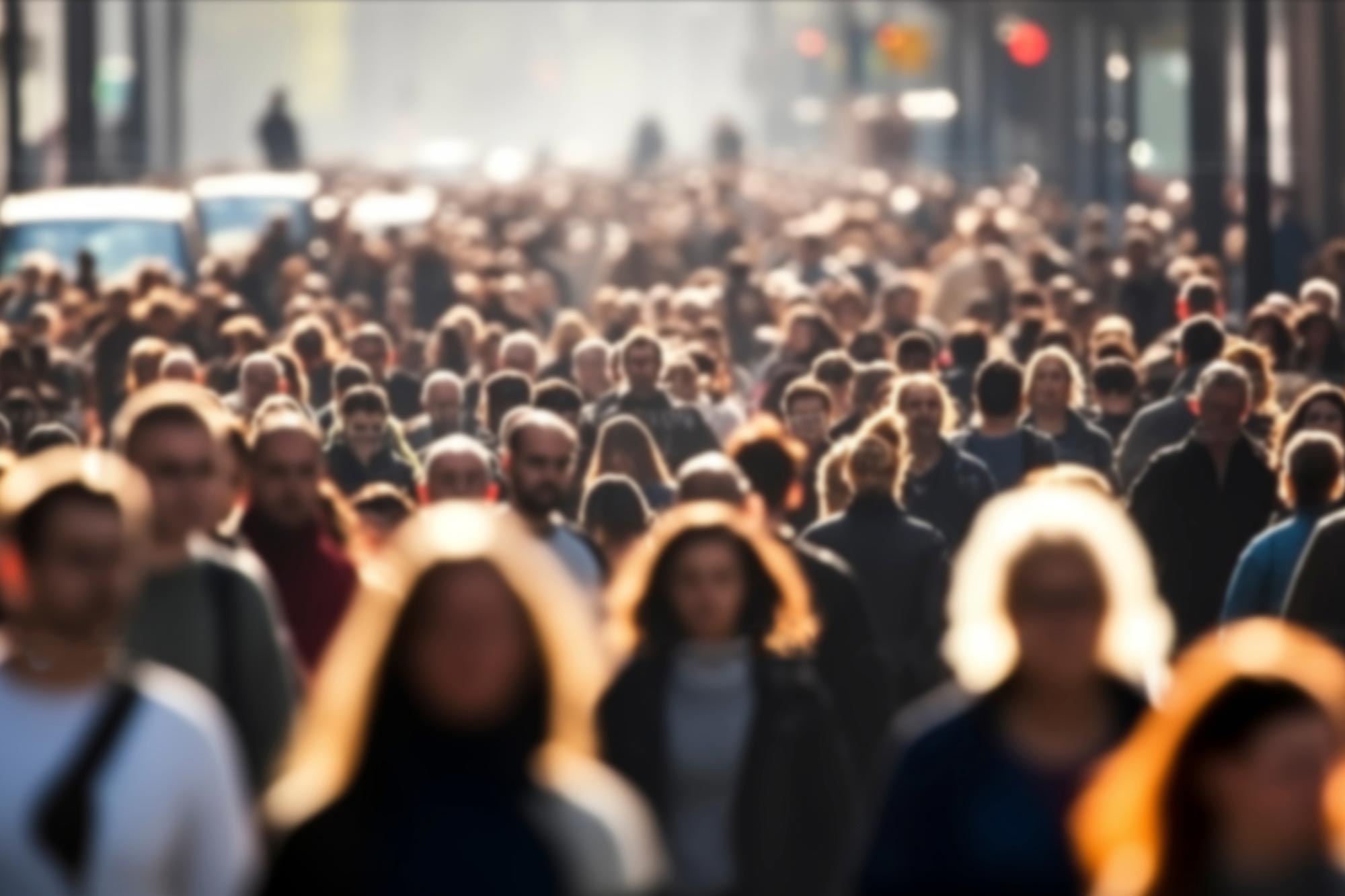
Human population and consumption have surpassed Earth’s limits, increasing risks to climate and global stability.
The Earth is already operating beyond its capacity to sustainably support the global population, according to new research highlighting growing strain on food systems, climate stability, and human well-being. Despite this, researchers say that slowing population growth and increasing global awareness could still help reduce long-term risks.
Published in Environmental Research Letters, the study concludes that human activity has exceeded the planet’s long-term limits. If current patterns of consumption continue, environmental and social pressures are expected to intensify across the world.
Population growth now exceeds planetary limits
Drawing on more than two centuries of global population data, the study identifies a major shift in population dynamics that began in the mid-twentieth century.
Lead author, Matthew Flinders Professor of Global Ecology Corey Bradshaw from Flinders University, says the findings reveal a clear biological signal that humanity is exceeding what Earth can sustain.
“Earth cannot keep up with the way in which we are using resources. It cannot support even today’s demand without major changes, with our findings showing that we are pushing the planet harder than it can possibly cope,” says Professor Bradshaw from the Global Ecology Laboratory in the College of Science and Engineering.
Growth dynamics shifted after mid-century
The research team, including distinguished Professor Paul Ehrlich who recently passed away, analyzed more than 200 years of global population records and applied ecological growth models to examine how population size and growth rates have evolved over time.
They assessed long-term trends across different regions and compared population changes with shifts in climate, emissions, and ecological footprint to better understand how human numbers contribute to environmental stress.
Before the 1950s, population growth accelerated as human numbers increased. Larger populations supported more innovation, greater energy use, and faster technological development, which in turn enabled further expansion.
This pattern changed in the early 1960s, when growth rates began to decline even as the total population continued to rise.
“This shift marked the beginning of what we call ‘a negative demographic phase,” says Professor Bradshaw.
“It means that adding more people no longer translates into faster growth. When we examined this phase, we found the global population is likely to peak somewhere between 11.7 and 12.4 billion people by the late 2060s or 2070s if current trends hold.”
Sustainable population far below current levels
Professor Bradshaw explains that this projected peak is risky and has only been made possible by heavy reliance on fossil fuels and the rapid depletion of natural resources.
“The truly sustainable population is much lower and closer to what the world supported in the mid-twentieth century. Our calculations show a sustainable global population closer to about 2.5 billion people if everyone were to live within ecological limits and comfortable, economically secure living standards,” he says.
The gap between this estimate and the current global population of about 8.3 billion highlights the scale of overconsumption. According to the researchers, decades of fossil fuel use have masked this imbalance by boosting food production, energy supply, and industrial output, while also driving climate change and pollution.
Population size drives environmental stress
The study identifies a strong connection between population size and rising global temperatures, increasing ecological footprints, and higher carbon emissions during the negative demographic phase. In many cases, total population size explained more variation in these environmental indicators than per capita consumption.
Professor Bradshaw says this demonstrates how both population growth and consumption patterns contribute to environmental pressure. “Humanity’s current path will push societies into deeper crises unless we make major changes,” he says.
“The planet’s life support systems are already under strain and without rapid shifts in how we use energy, land, and food, billions of people will face increasing instability. Our study shows these limits are not theoretical but unfolding right now.”
Long-term risks and possible pathways
The researchers emphasize that their findings do not predict an abrupt collapse, but instead outline the long-term pressures shaping humanity’s future. Exceeding Earth’s ‘biocapacity’ is expected to lead to stronger climate impacts, biodiversity loss, reduced food and water security, and widening inequality.
Professor Bradshaw says societies must rethink how they manage land, water, energy, and materials to ensure stable conditions for future generations.
“Smaller populations with lower consumption create better outcomes for both people and the planet,” he says. “The window to act is narrowing, but meaningful change is still achievable if nations work together.”
The team hopes the findings will encourage governments, organizations, and communities to adopt long-term strategies that respect environmental limits, stabilize population growth, and protect natural systems.
“The choices we make over the coming decades will determine the well-being of future generations and the resilience of the natural world that supports all life,” concludes Professor Bradshaw.
Reference: “Global human population has surpassed Earth’s sustainable carrying capacity” by Corey J A Bradshaw, Melinda A Judge, Daniel T Blumstein, Paul R Ehrlich, Aisha N Z Dasgupta, Mathis Wackernagel, Lewis J Z Weeda and Peter N Le Souëf, 27 March 2026, Environmental Research Letters.
DOI: 10.1088/1748-9326/ae51aa
The Kids Research Institute Australia and Population Matters supported various aspects of the project.
Never miss a breakthrough: Join the SciTechDaily newsletter.
Follow us on Google and Google News.
8 Comments
Don’t try to blame humanity. Blame the greedy corporations that decided resources should be locked away and resold to the masses. The same ones cutting down trees because their greed knows no end. Blame the rich elite few not the many.
The corporations are made up of humans. The ones cutting down the trees are all humans. The people buying all the products made by the corporations are humans. The rich elite are all humans. Humanity is 100% to blame.
I think your simplistic analysis is both flawed and overly influenced by the voices of communist sirens promising what they have never been able to deliver. The difference between capitalists and communists is who is living well and calling the shots.
I guess the professor forgets boomers were alive and not stupid in the 60’s and 70’s. ‘The world is ging to end, do not have children, only the elite can save the world’. We have already seen the huge amount of money that has been made by trying to scare the unaware.
More people, more problems. STOP HAVING BABIES.
That is a difficult goal to achieve when not everyone agrees with your view and some of the major religions encourage procreation. Also, in many of the under-developed countries, children help in growing food for the family and children are viewed as an alternative to government-funded social security for for the elderly.
Basically, I think that you are right. However, I don’t think that you appreciate just how impractical your demand is.
“The study identifies a strong connection between population size and rising global temperatures, increasing ecological footprints, and higher carbon emissions during the negative demographic phase.”
Assuming that their choice of “connection” means, more formally, a statistical correlation, it doesn’t establish causation. Warmer probably results in larger harvests and more children surviving and thus larger populations. Similarly, warming reduces the solubility of CO2 in water and thus an increase in the amount in the atmosphere. Warmth increases the rate of microbial and fungal decomposition of organic detrital material, resulting in more CO2 and methane produced. Also, warmer Winters result in increased respiration from the roots of dormant (not photosynthesizing) trees, particularly boreal trees. Those who claim to be experts may not even have the sign (+/-) for the net effect of interacting feedback loops correct. It is difficult to know whether the net effect is positive or negative when there isn’t even agreement on the Climate Sensitivity for a doubling of atmospheric concentration of so-called ‘greenhouse gases.’
Humanity has managed to avoid a population crash for decades, however don’t think this situation will continue indefinitely. The larger the population the bigger the crash will be when it happens.