
Close Menu
    Facebook X (Twitter) Instagram
    SciTechDaily
    • Biology
    • Chemistry
    • Earth
    • Health
    • Physics
    • Science
    • Space
    • Technology
    Facebook X (Twitter) Pinterest YouTube RSS
    SciTechDaily
    Home»Space»Hubble Views Galaxies NGC 5011B and NGC 5011C
    Space

    Hubble Views Galaxies NGC 5011B and NGC 5011C

    By NASAJanuary 7, 2013No Comments2 Mins Read
    Facebook Twitter Pinterest Telegram LinkedIn WhatsApp Email Reddit
    Share
    Facebook Twitter LinkedIn Pinterest Telegram Email Reddit
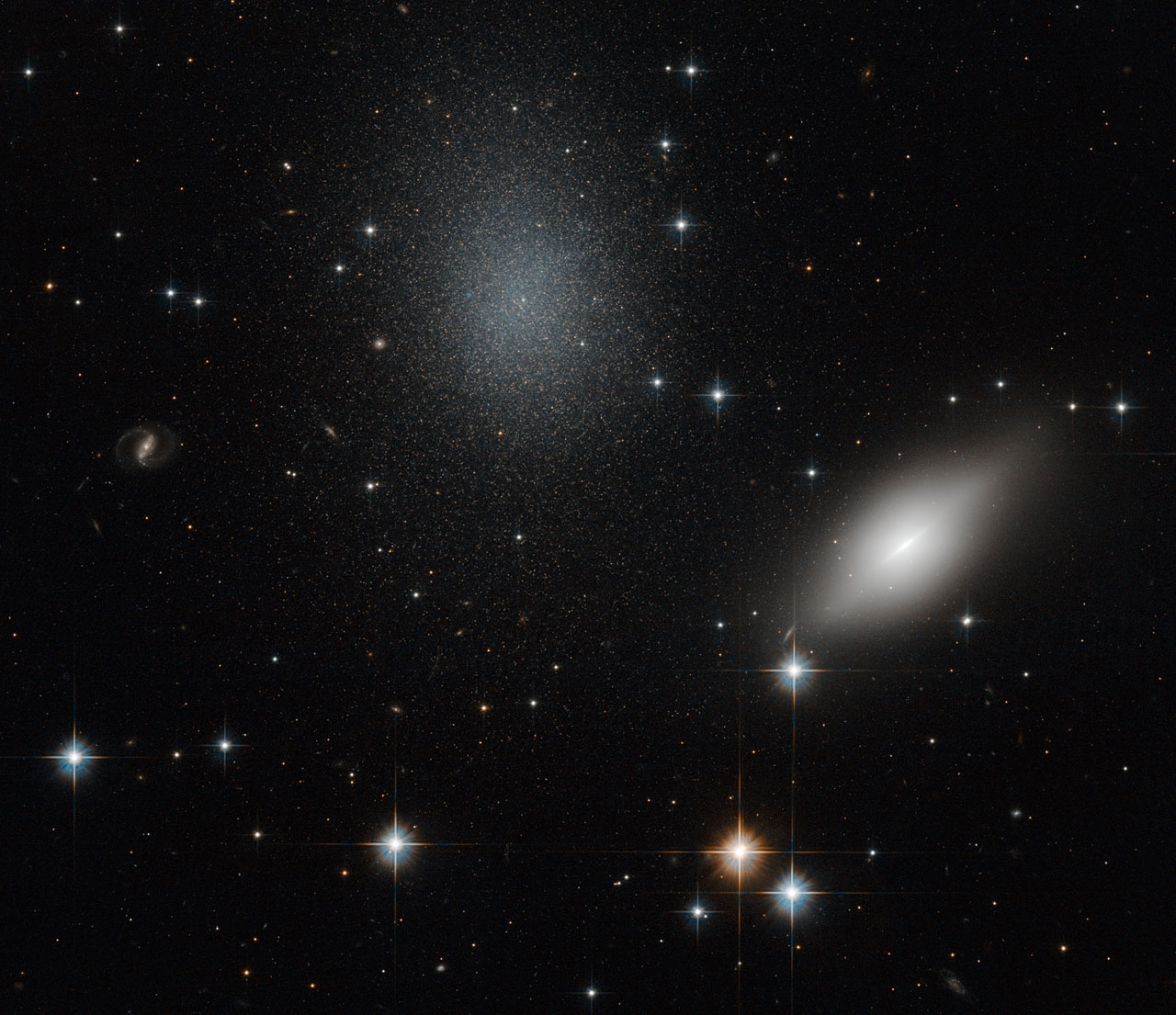
    Galaxies NGC 5011B and NGC 5011C
    Hubble Space Telescope image of galaxy NGC 5011C. Credit: ESA/Hubble & NASA

    A new Hubble image shows galaxy NGC 5011C, which astronomers now believe is a dwarf galaxy and not a member of the distant Centaurus Cluster as was previously thought, and spiral galaxy NGC 5011B.

    The Universe loves to fool our eyes, giving the impression that celestial objects are located at the same distance from Earth. A good example can be seen in this spectacular image produced by the NASA/ESA Hubble Space Telescope. The galaxies NGC 5011B and NGC 5011C are imaged against a starry background.

    Located in the constellation of Centaurus, the nature of these galaxies has puzzled astronomers. NGC 5011B (on the right) is a spiral galaxy belonging to the Centaurus Cluster of galaxies lying 156 million light-years away from the Earth. Long considered part of the faraway cluster of galaxies as well, NGC 5011C (the bluish galaxy at the center of the image) is a peculiar object, with the faintness typical of a nearby dwarf galaxy, and the size of an early-type spiral.

    Astronomers were curious about the appearance of NGC 5011C. If the two galaxies were at roughly the same distance from Earth, they would expect the pair to show signs of interactions between them. However, there was no visual sign of interaction between the two. How could this be possible?

    To solve this problem, astronomers studied the velocity at which these galaxies are receding from the Milky Way and found that NGC 5011C is moving away far more slowly than its apparent neighbor, and its motion is more consistent with that of the nearby Centaurus A group at a distance of 13 million light-years. Thus, NGC 5011C, with only about ten million times the mass of the sun in its stars, must indeed be a nearby dwarf galaxy rather than a member of the distant Centaurus Cluster as was believed for many years.

    Problem solved.

    This image was taken with Hubble’s Advanced Camera for Surveys using visual and infrared filters.

    Never miss a breakthrough: Join the SciTechDaily newsletter.
    Follow us on Google and Google News.

    Astronomy Hubble Space Telescope NASA
    Share. Facebook Twitter Pinterest LinkedIn Email Reddit

    Related Articles

    Hubble Reveals a Star Disk Three Times Hotter Than the Sun’s Surface

    A Star’s Unexpected Heatwave: FU Orionis Challenges Astrophysics Models

    NASA’s Hubble Reveals How the LMC Defied Galactic Destruction

    Legendary Star’s Smooth Disk Mystifies Astronomers, Challenges Planet Formation Theories

    Cosmic Horror Unveiled: NASA Reveals “Blood-Soaked Eyes” Staring From Deep Space [Video]

    Spanning 248 Billion Miles: Stunning Hubble Timelapse Captures a Star’s Violent Eruptions

    Jupiter’s Great Red Spot Enigma: Unexplained Oscillations Baffle Astronomers

    Unlocking Uranus: NASA’s Dual Observations Pave the Way to Discovering New Worlds

    Astronomers Baffled by Black Hole Jets Igniting Star Explosions

    Leave A Reply Cancel Reply

    • Facebook
    • Twitter
    • Pinterest
    • YouTube

    Don't Miss a Discovery

    Subscribe for the Latest in Science & Tech!

    Trending News

    Scientists Uncover Promising New Strategy To Stop Parkinson’s in Its Tracks

    Experts Reveal the Surprising Cancer Link Behind a Common Vitamin

    This Strange “Golden Orb” Found 2 Miles Deep Stumped Scientists for Years

    Giant “Last Titan” Dinosaur Discovered in Thailand Was Bigger Than 9 Elephants

    This “Longevity Gene” May Protect the Brain From Aging and Dementia

    Common Cleaning Chemical Could Triple Your Risk of a Dangerous Liver Disease

    Scientists Discover Bizarre 100-Million-Year-Old Insect With Giant Claws

    Scientists Discover “Good” Gut Microbes That Could Protect Against Autism and ADHD

    Follow SciTechDaily
    • Facebook
    • Twitter
    • YouTube
    • Pinterest
    • Newsletter
    • RSS
    SciTech News
    • Biology News
    • Chemistry News
    • Earth News
    • Health News
    • Physics News
    • Science News
    • Space News
    • Technology News
    Recent Posts
    • Scientists Turn Wool Into Bone-Healing Material in Medical Breakthrough
    • NASA’s Roman Space Telescope Nears Launch for Epic Hunt Across the Universe
    • Ancient Mega-Floods Once Ripped Across Mars and Left This Giant Scar
    • Scientists Just Used Sunlight To Pull Off a Quantum Physics Feat Once Thought Impossible
    • Scientists Discover “Immature” Brain Cells That May Defy Alzheimer’s
    Copyright © 1998 - 2026 SciTechDaily. All Rights Reserved.
    • Science News
    • About
    • Contact
    • Editorial Board
    • Privacy Policy
    • Terms of Use

    Type above and press Enter to search. Press Esc to cancel.