
Close Menu
    Facebook X (Twitter) Instagram
    SciTechDaily
    • Biology
    • Chemistry
    • Earth
    • Health
    • Physics
    • Science
    • Space
    • Technology
    Facebook X (Twitter) Pinterest YouTube RSS
    SciTechDaily
    Home»Space»Hubble Views Galaxy Pair MRK 1034
    Space

    Hubble Views Galaxy Pair MRK 1034

    By ESA; NASAJuly 2, 20132 Comments2 Mins Read
    Facebook Twitter Pinterest Telegram LinkedIn WhatsApp Email Reddit
    Share
    Facebook Twitter LinkedIn Pinterest Telegram Email Reddit
    Hubble Views Galaxy Pair MRK 1034
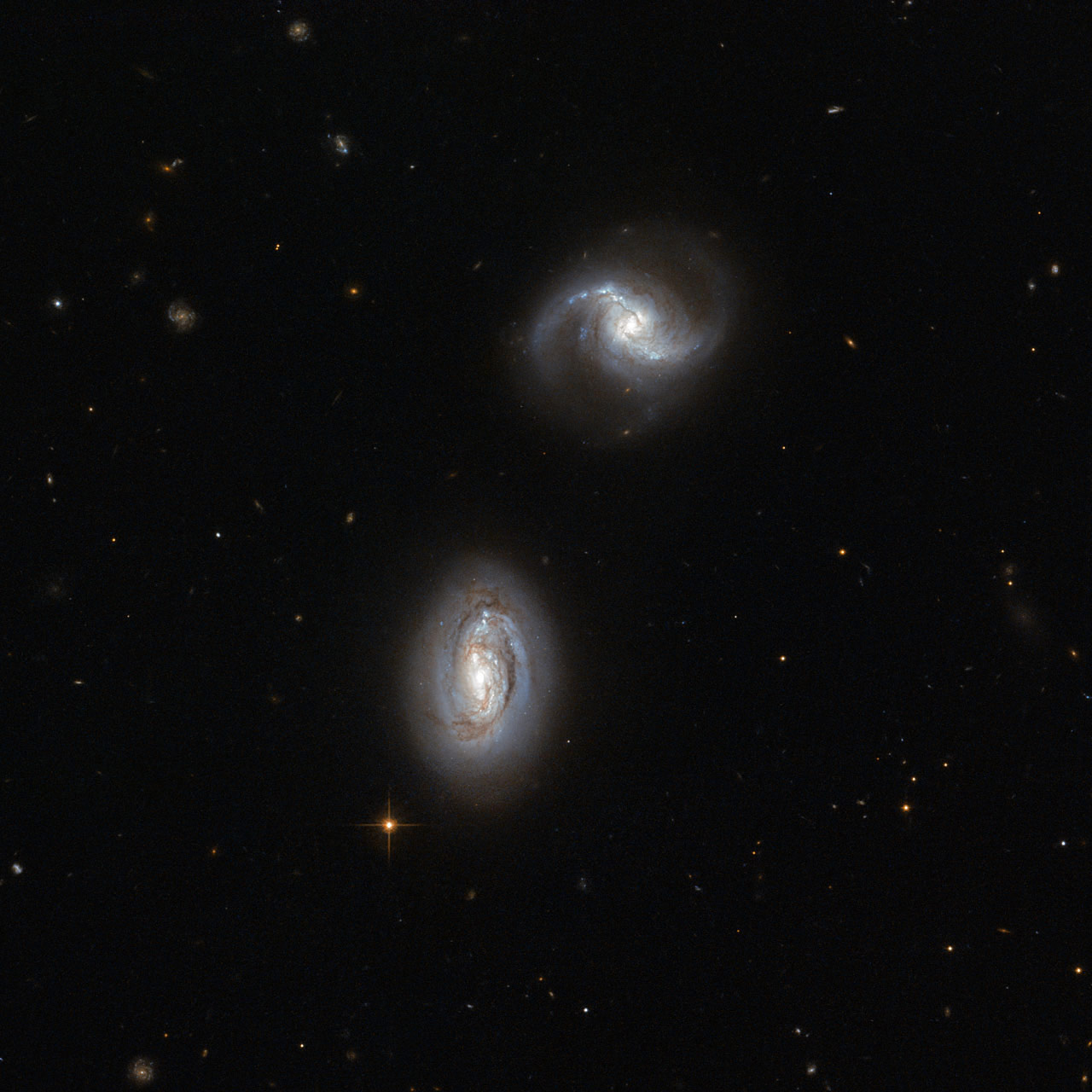
    To the left of the image, PGC 9074 is a type Sa spiral galaxy with a bright bulge and tightly wound arms. Nearby, PGC 9071 is a type Sb galaxy, similar in size but with a fainter bulge and more spaced-out spiral arms. Credit: ESA/Hubble and NASA (acknowledgment, Judy Schmidt)

    This Hubble image shows spiral galaxies PGC 9074 and PGC 9071, also known as galaxy pair MRK 1034.

    Looking towards the constellation of Triangulum (The Triangle), in the northern sky, lies the galaxy pair MRK 1034. The two very similar galaxies, named PGC 9074 and PGC 9071, are close enough to one another to be bound together by gravity, although no gravitational disturbance can yet be seen in the image. These objects are probably only just beginning to interact gravitationally.

    Both are spiral galaxies, and are presented to our eyes face-on, so we are able to appreciate their distinctive shapes. On the left of the image, spiral galaxy PGC 9074 shows a bright bulge and two spiral arms tightly wound around the nucleus, features which have led scientists to classify it as a type Sa galaxy. Close by, PGC 9071 — a type Sb galaxy — although very similar and almost the same size as its neighbor, has a fainter bulge and a slightly different structure to its arms: their coils are further apart.

    The spiral arms of both objects clearly show dark patches of dust obscuring the light of the stars lying behind, mixed with bright blue clusters of hot, recently-formed stars. Older, cooler stars can be found in the glowing, compact yellowish bulge towards the center of the galaxy. The whole structure of each galaxy is surrounded by a much fainter round halo of old stars, some residing in globular clusters.

    Gradually, these two neighbors will attract each other, the process of star formation will be increased and tidal forces will throw out long tails of stars and gas. Eventually, after maybe hundreds of millions of years, the structures of the interacting galaxies will merge together into a new, larger galaxy.

    The images combined to create this picture were captured by Hubble’s Advanced Camera for Surveys.


    Never miss a breakthrough: Join the SciTechDaily newsletter.
    Follow us on Google and Google News.

    Astronomy European Space Agency Hubble Space Telescope NASA
    Share. Facebook Twitter Pinterest LinkedIn Email Reddit

    Related Articles

    Hubble’s Newest Discovery Isn’t a Star, It’s a Window Into the Dark Universe

    This Nearby Galaxy Shows How Frozen Clouds Ignite Into Stars

    This Chaotic Spiral Galaxy Is Still Recovering From a Cosmic Collision

    This Strange Spiral Galaxy Is Hiding a Massive Black Hole

    Hubble Zooms In on a Galaxy That Maps the Universe’s Expansion

    Hubble Captures a Dazzling Spiral Galaxy Alive With Birth and Destruction

    Hubble Spots a Glowing “Ring of Fire” in a Distant Spiral Galaxy

    Dust, Light & Ancient Collisions: The Sombrero Galaxy Like You’ve Never Seen It

    Star Formation in Motion: Hubble Reveals Spiraling Stars and Sculpted Nebulae

    2 Comments

    1. kopernik2 on July 3, 2013 12:28 pm

      MRK 1034. How do we know that in this system of two galaxies that the two are approaching each other rather than receding?

      Reply
    2. Madanagopal.V.C on July 4, 2013 9:29 pm

      Galaxies will generally gravitationaly attract each other for final gobbling up in galactic cannibalism of the smaller one by the big. The repulsion of galaxies will be found only in case of Dark Matter found in between which will throw them out (An Anti-Gravitation between a Matter and Dark Matter).
      Thank You.

      Reply
    Leave A Reply Cancel Reply

    • Facebook
    • Twitter
    • Pinterest
    • YouTube

    Don't Miss a Discovery

    Subscribe for the Latest in Science & Tech!

    Trending News

    The Universe Is Expanding Too Fast and Scientists Can’t Explain Why

    “Like Liquid Metal”: Scientists Create Strange Shape-Shifting Material

    Early Warning Signals of Esophageal Cancer May Be Hiding in Plain Sight

    Common Blood Pressure Drug Shows Surprising Power Against Deadly Antibiotic-Resistant Superbug

    Scientists Uncover Dangerous Connection Between Serotonin and Heart Valve Disease

    Scientists Discover a “Protector” Protein That Could Help Reverse Hair Loss

    Bone-Strengthening Discovery Could Reverse Osteoporosis

    Scientists Uncover Hidden Trigger Behind Stem Cell Aging

    Follow SciTechDaily
    • Facebook
    • Twitter
    • YouTube
    • Pinterest
    • Newsletter
    • RSS
    SciTech News
    • Biology News
    • Chemistry News
    • Earth News
    • Health News
    • Physics News
    • Science News
    • Space News
    • Technology News
    Recent Posts
    • Scientists Overcome Major Quantum Bottleneck, Potentially Transforming Teleportation and Computing
    • Quantum Physics’ Strangest Problem May Hold the Key to Time Itself
    • Scientists Create “Liquid Gears” That Spin Without Touching
    • The Simple Habit That Could Help Prevent Cancer
    • Forgotten Medicinal Plant Shows Promise in Fighting Dangerous Superbugs
    Copyright © 1998 - 2026 SciTechDaily. All Rights Reserved.
    • Science News
    • About
    • Contact
    • Editorial Board
    • Privacy Policy
    • Terms of Use

    Type above and press Enter to search. Press Esc to cancel.