
Close Menu
    Facebook X (Twitter) Instagram
    SciTechDaily
    • Biology
    • Chemistry
    • Earth
    • Health
    • Physics
    • Science
    • Space
    • Technology
    Facebook X (Twitter) Pinterest YouTube RSS
    SciTechDaily
    Home»Space»Hubble Views Hazy Planetary Nebula NGC 1501
    Space

    Hubble Views Hazy Planetary Nebula NGC 1501

    By Hubble Space TelescopeNovember 3, 20141 Comment2 Mins Read
    Facebook Twitter Pinterest Telegram LinkedIn WhatsApp Email Reddit
    Share
    Facebook Twitter LinkedIn Pinterest Telegram Email Reddit
    New Hubble Image of NGC 1501
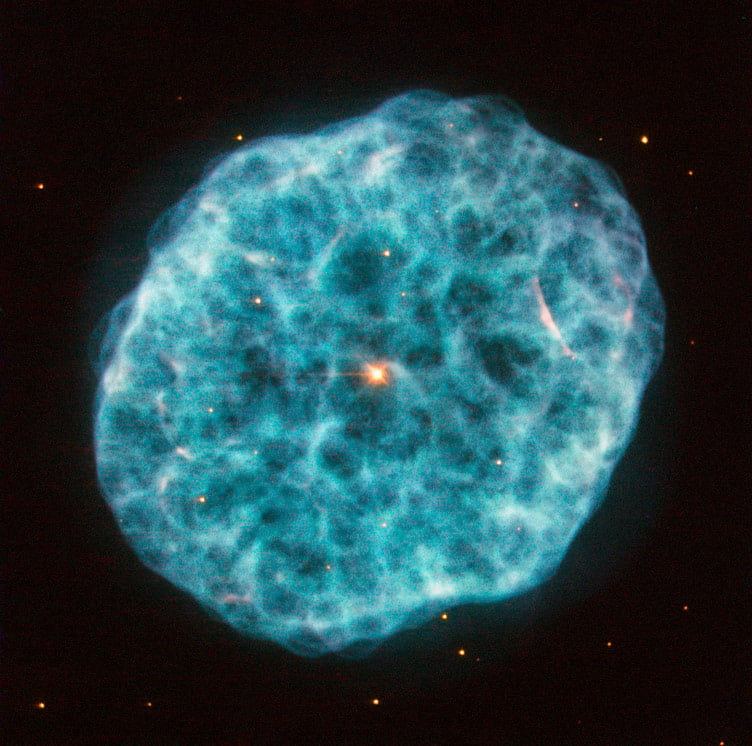
    NGC 1501 is a complex planetary nebula located in the large but faint constellation of Camelopardalis (The Giraffe). Credit: ESA/Hubble & NASA, Acknowledgement: Marc Canale

    This newly released Hubble image shows planetary nebula NGC 1501, which is located roughly 5,000 light-years away from Earth.

    This new image from Hubble’s Wide Field Planetary Camera 2 showcases NGC 1501, a complex planetary nebula located in the large but faint constellation of Camelopardalis (The Giraffe).

    Discovered by William Herschel in 1787, NGC 1501 is a planetary nebula that is just under 5000 light-years away from us. Astronomers have modeled the three-dimensional structure of the nebula, finding it to be a cloud shaped as an irregular ellipsoid filled with bumpy and bubbly regions. It has a bright central star that can be seen easily in this image, shining brightly from within the nebula’s cloud. This bright pearl embedded within its glowing shell inspired the nebula’s popular nickname: the Oyster Nebula.

    While NGC 1501’s central star blasted off its outer shell long ago, it still remains very hot and luminous, although it is quite tricky for observers to spot through modest telescopes. This star has actually been the subject of many studies by astronomers due to one very unusual feature: it seems to be pulsating, varying quite significantly in brightness over a typical timescale of just half an hour. While variable stars are not unusual, it is uncommon to find one at the heart of a planetary nebula.

    It is important to note that the colors in this image are arbitrary.

    A version of this image was entered into the Hubble’s Hidden Treasures image processing competition by contestant Marc Canale.

    Never miss a breakthrough: Join the SciTechDaily newsletter.
    Follow us on Google and Google News.

    Astronomy Hubble Space Telescope
    Share. Facebook Twitter Pinterest LinkedIn Email Reddit

    Related Articles

    A Morphing Spiral Galaxy Amongst Friends

    Hubble Views Magnificent Lopsided Galaxy NGC 2276

    Hubble Captures Fantastic Detail of Eponymous Spiral Galaxy NGC 691

    Spectacular Image Captured by Hubble Shows a Strangely Contorted Spiral Galaxy

    A Distant Spiral in Virgo: Extraordinary Detail Seen in a Galaxy 150 Million Light-Years Away From Earth

    Magnetic Monsters: Hubble Tracks Down Location of Mysterious Radio Signals From Intergalactic Space

    A Menagerie of Galaxies: Hubble Captures a Cluster With Galaxies of All Shapes and Sizes

    How Habitable Are Planets That Orbit Red Dwarfs – The Most Common Type of Stars in the Galaxy?

    Cosmic Silver Lining: Hubble Spots V565 Surrounded by Four Prominent Diffraction Spikes

    1 Comment

    1. Mandy Smith on January 6, 2015 9:27 am

      Absolutely amazing.. Just amazes me.

      Reply
    Leave A Reply Cancel Reply

    • Facebook
    • Twitter
    • Pinterest
    • YouTube

    Don't Miss a Discovery

    Subscribe for the Latest in Science & Tech!

    Trending News

    Beyond Pain Relief: Scientists Discover a Protein That Could Stop Osteoarthritis in Its Tracks

    Scientists Discover Why Alcohol Prevents the Liver From Healing, Even After You Quit

    Scientists Stunned As Volcano Removes Methane From the Air

    Scientists Discover Signs Africa May Be Splitting Apart Beneath Zambia

    Common Blood Pressure Drug Supercharges Cancer Treatment in Surprising New Study

    540-Million-Year-Old Fossils Reveal a Huge Surprise About Early Life on Earth

    Scientists Reverse Stroke Damage Using Stem Cells in Breakthrough Study

    Eating One Egg a Day Could Cut Alzheimer’s Risk by 27%

    Follow SciTechDaily
    • Facebook
    • Twitter
    • YouTube
    • Pinterest
    • Newsletter
    • RSS
    SciTech News
    • Biology News
    • Chemistry News
    • Earth News
    • Health News
    • Physics News
    • Science News
    • Space News
    • Technology News
    Recent Posts
    • Scientists Uncover Promising New Strategy To Stop Parkinson’s in Its Tracks
    • New Study Reveals How Vitamin D Could Calm Gut Inflammation
    • Experts Reveal the Surprising Cancer Link Behind a Common Vitamin
    • NASA’s Roman Space Telescope Could Finally Find the Milky Way’s Missing Neutron Stars
    • Strange “Worm Towers” Found in the Wild for the First Time May Be Hitchhiking on Beetles
    Copyright © 1998 - 2026 SciTechDaily. All Rights Reserved.
    • Science News
    • About
    • Contact
    • Editorial Board
    • Privacy Policy
    • Terms of Use

    Type above and press Enter to search. Press Esc to cancel.