
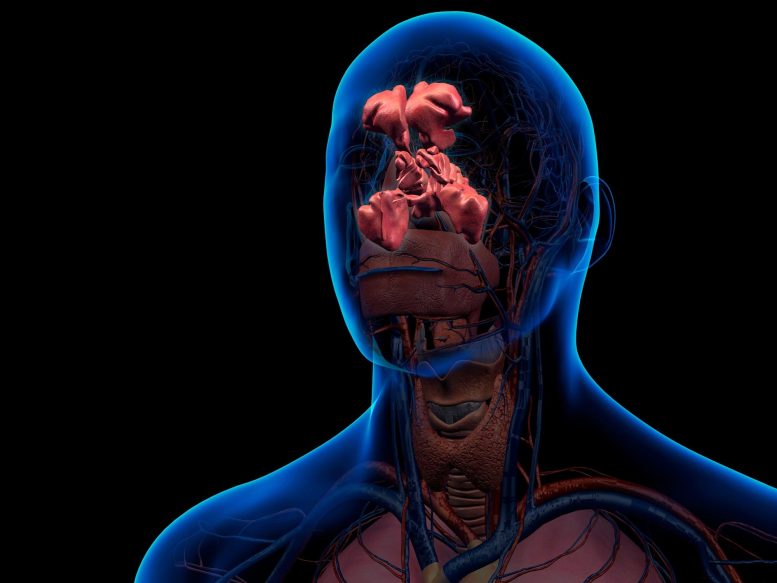
Baylor College of Medicine researchers created a human nose organoid to study viral infections, revealing that SARS-CoV-2 and RSV have different impacts on the nose’s epithelial cells.
Preclinical models that recapitulate aspects of human airway disease are essential for the advancement of novel therapeutics and vaccines. In the current study published in the journal mBIO, researchers at Baylor College of Medicine report the development of a versatile human nose organoid – a laboratory representation of the cells layering the inside of the nose where the first events of a natural viral infection take place.
Using nose organoids, which model the complex interactions between human cells and virus, the team showed key differences between the infection by SARS-CoV-2, the virus that causes COVID-19, and that of respiratory syncytial virus (RSV), a major pediatric respiratory virus, providing a better understanding of the first steps toward disease and leading to potential new therapies.
The model also proved to be a useful tool to test the efficacy of therapeutics such as palivizumab, an FDA-approved monoclonal antibody to prevent severe RSV disease in high-risk infants. The human nose organoid system is part of preclinical evaluation of therapies that would help accelerate the transfer of lab-developed therapeutics to the bedside.
SARS-CoV-2 vs. RSV Infections
“In the case of respiratory viruses, such as SARS-CoV-2 and RSV, the infection begins in the nose when one breathes in the virus,” said corresponding author Dr. Pedro Piedra, professor of molecular virology and microbiology, pediatrics, and of pharmacology and chemical biology at Baylor. He also is the director of Baylor’s Clinical Laboratory Improvement Amendments (CLIA)-Certified Respiratory Virus Diagnostic Laboratory. “The human nose organoids we have developed provide access to the inside of the human nose, enabling us to study the early events of the infection in the lab, something we had not had before. We have successfully developed human nose organoids from both adults and infants.”
The cells lining the inside of the nose, the epithelium, are exposed to air on one side and to the blood circulatory system on their opposite side.
“Our three-dimensional organoid system replicates this natural situation in the lab using nose epithelium harvested with a nasal swab,” explained first author Dr. Anubama Rajan, postdoctoral associate in the Piedra lab. “We grow the harvested epithelium in tissue culture plates that provide an air-liquid interphase, where the top side of the epithelium is exposed to air and the bottom side is bathed in liquid with nutrients and other factors.”
To study the interaction between SARS-CoV-2 or RSV and the nose epithelium, the researchers simulated a natural infection by placing each virus separately on the air side of the culture plates and studying the changes that occurred on the nose organoid.
“We observed divergent responses to SARS-CoV-2 and RSV infection,” said co-author Dr. Vasanthi Avadhanula, assistant professor of molecular virology and microbiology at Baylor . “SARS-CoV-2 induces severe damage to the epithelium, no interferon response (an antiviral first defense response), and minimal mucus secretion. In striking contrast, RSV induces abundant mucus secretion and a profound interferon response.”
Testing Therapeutics: Palivizumab Against RSV
The team also used their human nose organoid model of RSV infection to test the efficacy of palivizumab. In this case, they placed the therapeutic monoclonal antibody in the liquid-filled chamber to more closely resemble the human experience where therapeutic antibodies enter the blood circulation and provide protection of the airways against RSV infection.
“In our model, palivizumab effectively prevented RSV infection in a concentration-dependent manner,” said Avadhanula, co-director of the (CLIA)-Certified Respiratory Virus Diagnostic Laboratory and of the lab’s research program.
In this study, for the first time, the team described a noninvasive, reproducible and reliable approach to establish human nose organoids that allow for long-term studies. Previous models were produced using invasive lung or nose biopsy or broncho alveolar lavage. “The ease in obtaining the nasal swab samples facilitates our noninvasive approach in the general adult population as well as the vulnerable pediatric population,” Piedra said.
Another advantage of using this novel human nose organoid system is that it can reveal how a person’s initial control of the infection occurs and provide insights into what would make a person more susceptible to a virus than another. This system also can be used to study other respiratory viruses and potentially other disease-causing microbes.
Reference: “The Human Nose Organoid Respiratory Virus Model: an Ex Vivo Human Challenge Model To Study Respiratory Syncytial Virus (RSV) and Severe Acute Respiratory Syndrome Coronavirus 2 (SARS-CoV-2) AQ: A Pathogenesis and Evaluate Therapeutics” by Authors: Anubama Rajan, Ashley Morgan Weaver, Gina Marie Aloisio, Joseph Jelinski, Hannah L. Johnson, Susan F. Venable, Trevor McBride, Letisha Aideyan, Felipe-Andrés Piedra, Xunyan Ye, Ernestina Melicoff-Portillo, Malli Rama Kanthi Yerramilli, Xi-Lei Zeng, Michael A. Mancini, Fabio Stossi, Anthony W. Maresso, Shalaka A. Kotkar, Mary K. Estes, Sarah Blutt, Vasanthi Avadhanula and Pedro A. Piedra, 15 February 2022, mBio.
DOI: 10.1128/mbio.03511-21
Other contributors to this work include Ashley Morgan Weaver, Gina Marie Aloisio, Joseph Jelinski, Hannah L. Johnson, Susan F. Venable, Trevor McBride, Letisha Aideyan, Felipe-Andrés Piedra, Xunyan Ye, Ernestina Melicoff-Portillo, Malli Rama Kanthi Yerramilli, Xi-Lei Zeng, Michael A. Mancini, Fabio Stossi, Anthony W. Maresso, Shalaka A. Kotkar, Mary K. Estes and Sarah Blutt, all at Baylor College of Medicine.
This work was supported by Public Health Service grant P30DK056338, NIH grants (DK56338, CA125123, ES030285, T32AI055413, U19 AI144297 and U19 Al116497), Cancer Prevention and Research Institute of Texas (CPRIT; RP150578, RP170719), the Dan L. Duncan Comprehensive Cancer Center and the John S. Dunn Gulf Coast Consortium for Chemical Genomics.
Never miss a breakthrough: Join the SciTechDaily newsletter.
Follow us on Google and Google News.
3 Comments
Start working from home! Great work for-Ever, Stay at Home Moms OR anyone needs an extra income. Get started. You only need a computer and a reliable computer connection so don’t
get late try……http://www.worksilver.cf
Medical clinics and hospitals in USA are denying life-saving Ivermectin medicine even with court orders. Big Pharma doing all that they can to push the vaxx and inoculate us while effective and cheap COVID cures exist. There turns out to be censorship that we have never seen before for those who are looking for these treatments. We say over and over again that indepenedent researchers found Ivermectin safe and very effective for these Flu-Corona symptoms. Getting Ivermectin is easy ivmcures.com
Three weeks from now you will wish you had started today. Simply give it a shot on the accompanying site.
GOOD LUCK……http://Www.WORKPAY1.com