

Powerful neutrinos from a distant galaxy hint at a surprising origin: helium atoms torn apart by UV light near a black hole, reshaping what we thought we knew about cosmic jets.
- In deep space, powerful neutrinos are typically found alongside bursts of gamma rays. But galaxy NGC 1068 is behaving differently—it’s sending out a strong stream of neutrinos with surprisingly little gamma radiation, leaving scientists with a cosmic mystery.
- A new study offers a bold explanation: helium atoms in the galaxy’s jet collide with intense ultraviolet light near its center. These collisions break the atoms apart, releasing neutrons that decay into neutrinos without giving off much gamma-ray light.
- This discovery sheds new light on the extreme conditions near supermassive black holes, like the one in NGC 1068, and even the one in our own galaxy. It also deepens our understanding of how radiation and subatomic particles interact, possibly paving the way for future breakthroughs in science and technology.
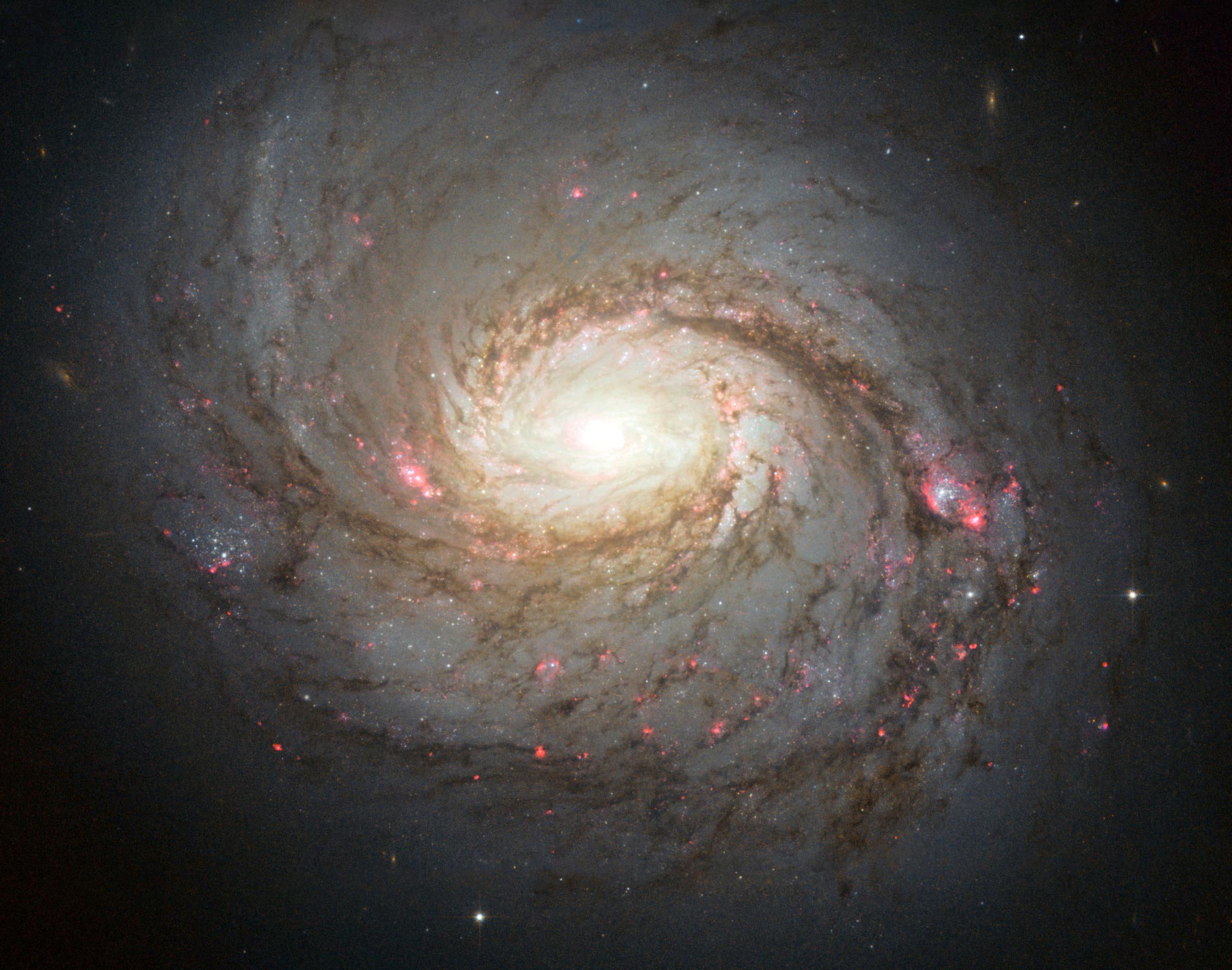
Neutrino Mystery in the Squid Galaxy
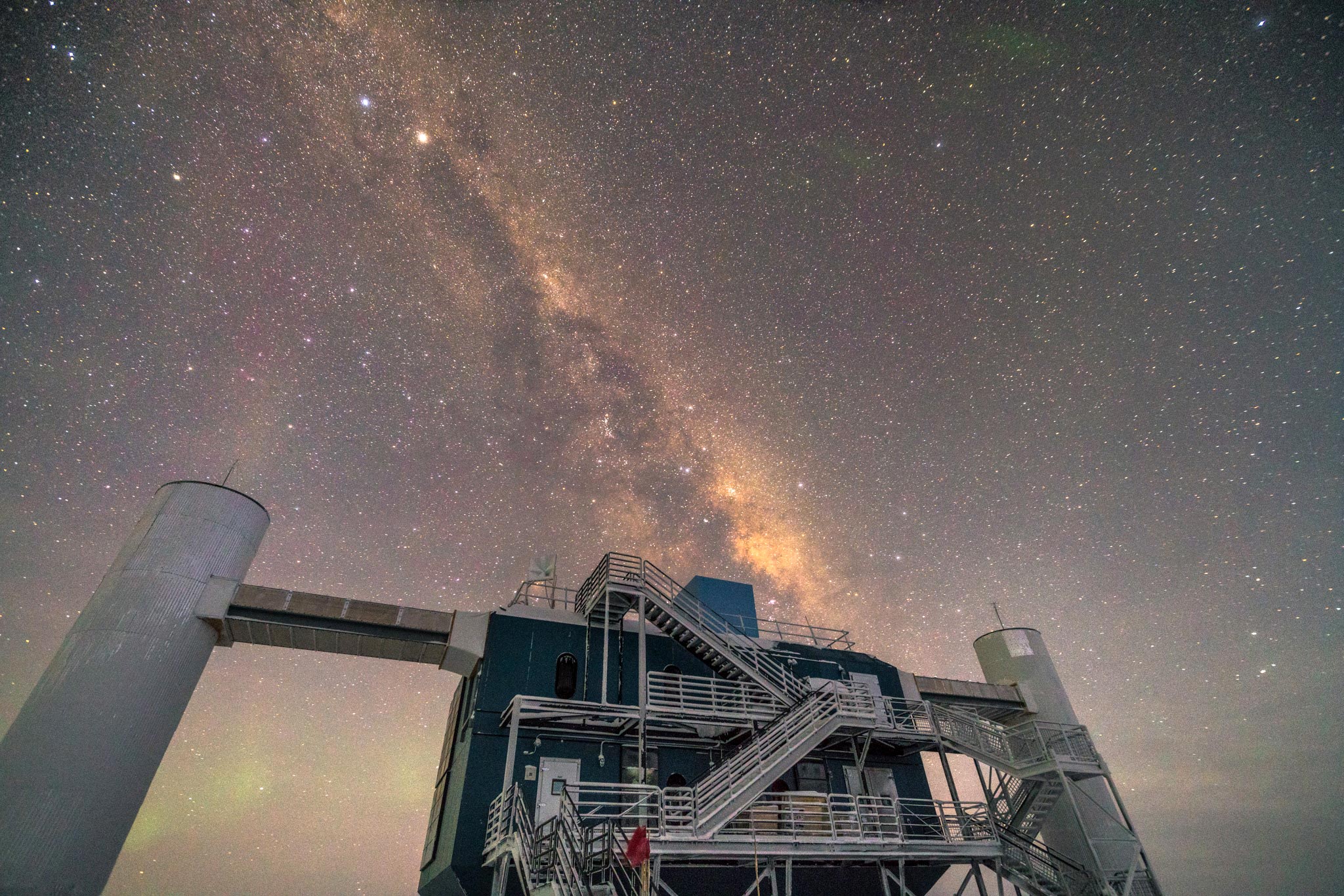
Deep beneath the Antarctic ice lies a remarkable scientific instrument—thousands of sensors that act like “eyes,” able to detect one of the universe’s most elusive particles: the neutrino. Recently, these sensors picked up something unexpected. In a distant galaxy called NGC 1068, also known as the Squid Galaxy, scientists detected an unusually strong burst of neutrinos. But what makes this discovery so puzzling is that it came with very little gamma-ray radiation, which normally appears alongside energetic neutrinos.
The sensors belong to the IceCube Neutrino Observatory, a massive experiment embedded in a cubic kilometer of clear Antarctic ice. Now, a team of theoretical physicists from UCLA, the University of Osaka, and the University of Tokyo’s Kavli Institute is proposing a bold new idea. They believe the neutrinos from NGC 1068 may be produced in a completely different way than expected, opening up an exciting new chapter in particle astrophysics.
What Makes Neutrinos So Elusive
Neutrinos are tiny subatomic particles that barely interact with matter. Unlike other particles such as electrons, neutrinos can pass straight through planets, stars, and even our own bodies without leaving a trace. That’s what makes them so hard to detect. IceCube’s 5,160 sensors were built to capture the rare moments when a neutrino does interact with the ice, creating a charged particle that leaves a detectable trail.
“We have telescopes that use light to look at stars, but many of these astrophysical systems also emit neutrinos,” said Alexander Kusenko, professor of physics and astronomy at UCLA and a senior fellow at Kavli IPMU. “To see neutrinos, we need a different type of telescope, and that’s the telescope we have at the South Pole.”
Unexpected Data from NGC 1068
The IceCube neutrino telescope detected very energetic neutrinos coming from NGC 1068 accompanied by a weak gamma-ray flux, hinting that these neutrinos may have been produced in a different way than previously thought. The NGC 1068 data is perplexing because, typically, energetic neutrinos from active galactic centers are thought to originate from interactions between protons and photons, producing gamma rays of comparable intensity. Thus, energetic neutrinos are usually paired with energetic gamma rays.
NGC 1068’s gamma-ray emission is significantly lower than expected and shows a distinctly different spectral shape. Traditional models, including those based on proton-photon collisions and emission from the galaxy’s hot plasma region known as the “corona,” have been widely used to explain such neutrino signals, but they have faced theoretical limitations, prompting the search for a new explanation.
A Radical New Neutrino Theory Emerges
In a new paper published in Physical Review Letters, Kusenko and colleagues suggest that the high-energy neutrinos from NGC 1068 primarily result from the decay of neutrons when helium nuclei in the galaxy’s jet break apart under intense ultraviolet radiation. When these helium nuclei collide with ultraviolet photons emitted by the galaxy’s central region, they fragment, releasing neutrons that subsequently decay into neutrinos. The energies of the resulting neutrinos match the observations.
Additionally, electrons generated by these nuclear decays interact with surrounding radiation fields, creating gamma rays consistent with the observed lower intensity. This scenario elegantly explains why the neutrino signal dramatically outshines the gamma-ray emission and accounts for the distinct energy spectrum observed in both neutrinos and gamma rays.
Unlocking Secrets of Supermassive Black Holes
The breakthrough helps scientists understand how cosmic jets in active galaxies can emit powerful neutrinos without a corresponding gamma-ray glow, shedding new light on the extreme, complex conditions surrounding supermassive black holes, including the one at the center of our own galaxy.
“We don’t know very much about the central, extreme region near the galactic center of NGC1068,” said Kusenko. “If our scenario is confirmed, it tells us something about the environment near the supermassive black hole at the center of that galaxy.”
The new paper proposes that if a helium nucleus accelerates in the jet of a supermassive black hole, it crashes into photons and breaks apart, spilling its two protons and two neutrons into space. The protons can fly away, but the neutrons are unstable and fall apart, or decay, into neutrinos without producing gamma rays.
“Hydrogen and helium are the two most common elements in space,” said first author and UCLA doctoral student Koichiro Yasuda. “But hydrogen only has a proton, and if that proton runs into photons, it will produce both neutrinos and strong gamma rays. But neutrons have an additional way of forming neutrinos that don’t produce gamma rays. So helium is the most likely origin of the neutrinos we observe from NGC 1068.”
Faint Signals, Big Revelations
The work reveals the existence of hidden astrophysical neutrino sources, whose signals may previously have gone unnoticed due to their faint gamma-ray signatures.
“This idea offers a new perspective beyond traditional corona models. NGC 1068 is just one of many similar galaxies in the universe, and future neutrino detections from them will help test our theory and uncover the origin of these mysterious particles,” said co-author and the University of Osaka professor of astrophysics Yoshiyuki Inoue.
Like NGC 1068, our galaxy also has a supermassive black hole at its center, where unfathomably immense gravity and energy literally tear atoms apart, and the neutrino discovery holds for our galaxy, too. Although there’s not necessarily a straight line from understanding the galactic center to improvements in human welfare, knowledge gained through the study of particles like neutrinos and radiation like gamma rays has a tendency to lead technology down surprising and transformative paths.
From Useless Discovery to Global Tech
“When J.J. Thompson received the 1906 Nobel Prize in physics for the discovery of electrons, he famously gave a toast at a dinner after the ceremony, saying that this was probably the most useless discovery in history,” said Kusenko. “And, of course, every smartphone, every electronic device today, uses the discovery that Thompson made nearly 125 years ago.”
Kusenko also said that particle physics gave birth to the World Wide Web, which originated as a network developed by physicists who needed to move large amounts of data between labs. He pointed out that the discovery of nuclear magnetic resonance seemed obscure at the time but led to the development of magnetic resonance imaging technology, which is now used routinely in medicine.
“We stand at the very beginning of the new field of neutrino astronomy, and the mysterious neutrinos from NGC 1068 are one of the puzzles we have to solve along the way,” said Kusenko. “Investment in science is going to produce something that you may not be able to appreciate now, but could produce something big decades later. It’s a long-term investment, and private companies are reluctant to invest in the kind of research we’re doing. That’s why government funding for science is so important, and that’s why universities are so important.”
Reference: “Neutrinos and Gamma Rays from Beta Decays in an Active Galactic Nucleus NGC 1068 Jet” by Koichiro Yasuda, Nobuyuki Sakai, Yoshiyuki Inoue and Alexander Kusenko, 18 April 2025, Physical Review Letters.
DOI: 10.1103/PhysRevLett.134.151005
The research was funded by the Department of Energy, the World Premier International Research Center Initiative (WPI), and the Japan Society for the Promotion of Science.
Never miss a breakthrough: Join the SciTechDaily newsletter.
Follow us on Google and Google News.
1 Comment
““Hydrogen and helium are the two most common elements in space,” said first author and UCLA doctoral student Koichiro Yasuda. “But hydrogen only has a proton, …”. There is also the np hydrogen deuterium nuclei, but Sun abundance is only about 0.01 %.
But they do mention Fe and other heavier nuclei as possible neutrino signal contributors.