
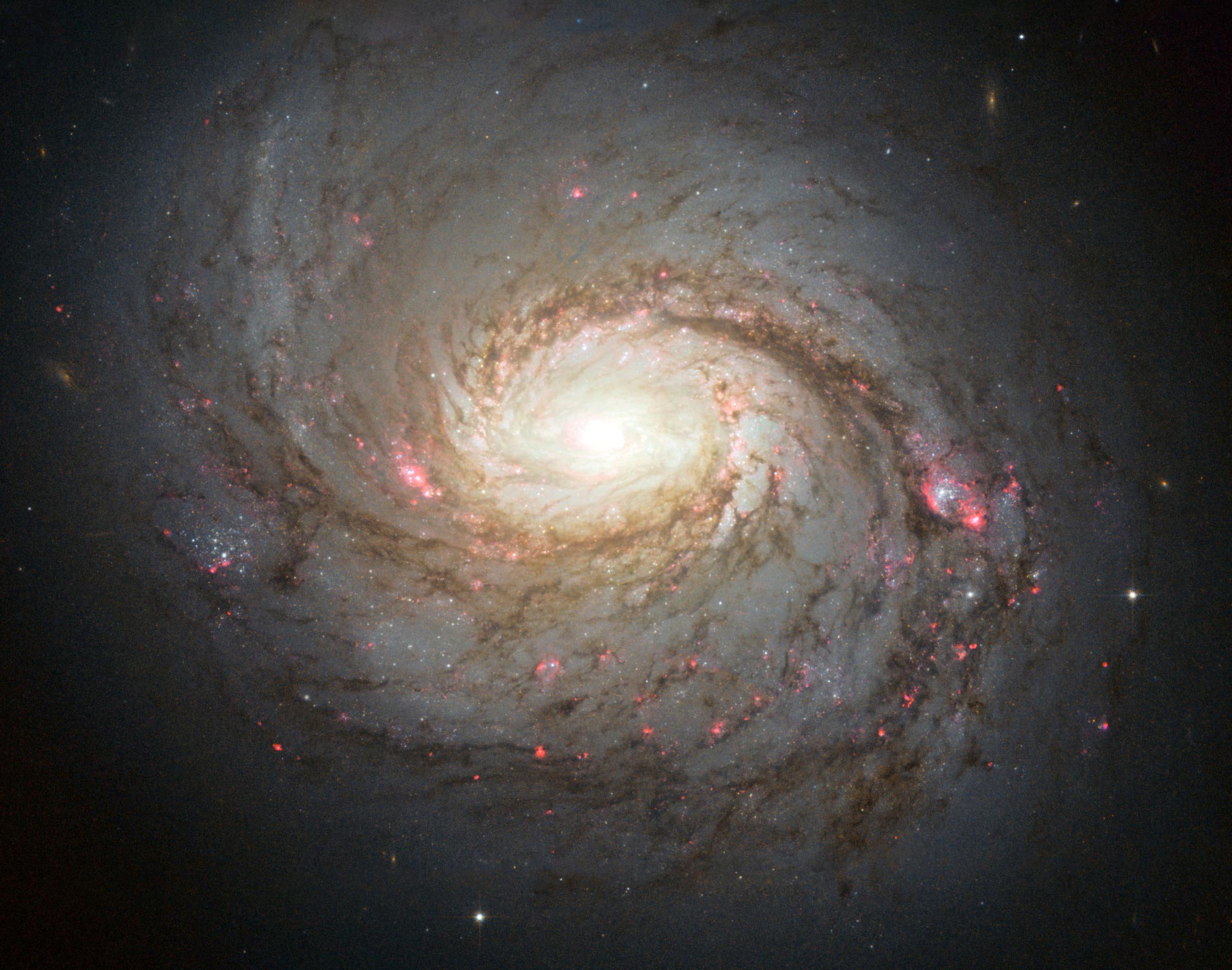
A mysterious stream of neutrinos detected by a massive Antarctic observatory is rewriting what scientists thought they knew about how these elusive particles are formed in distant galaxies.
The galaxy NGC 1068, instead of emitting strong gamma rays alongside its neutrinos as expected, reveals a strange mismatch.
Unexpected Neutrino Clues From a Cosmic Squid
A team of international scientists has uncovered a surprising cosmic mystery, thanks to a galaxy nicknamed the Squid Galaxy and an enormous detector buried deep in Antarctic ice. Their research may reveal a brand new way that ghost-like particles called neutrinos are born in the universe.
The key to this discovery comes from unusual observations of NGC 1068, a galaxy located about 47 million light-years away. There, scientists detected a powerful stream of neutrinos—but surprisingly, the accompanying gamma rays were much weaker than expected. This odd mismatch is challenging long-standing ideas about how high-energy particles are created in space.
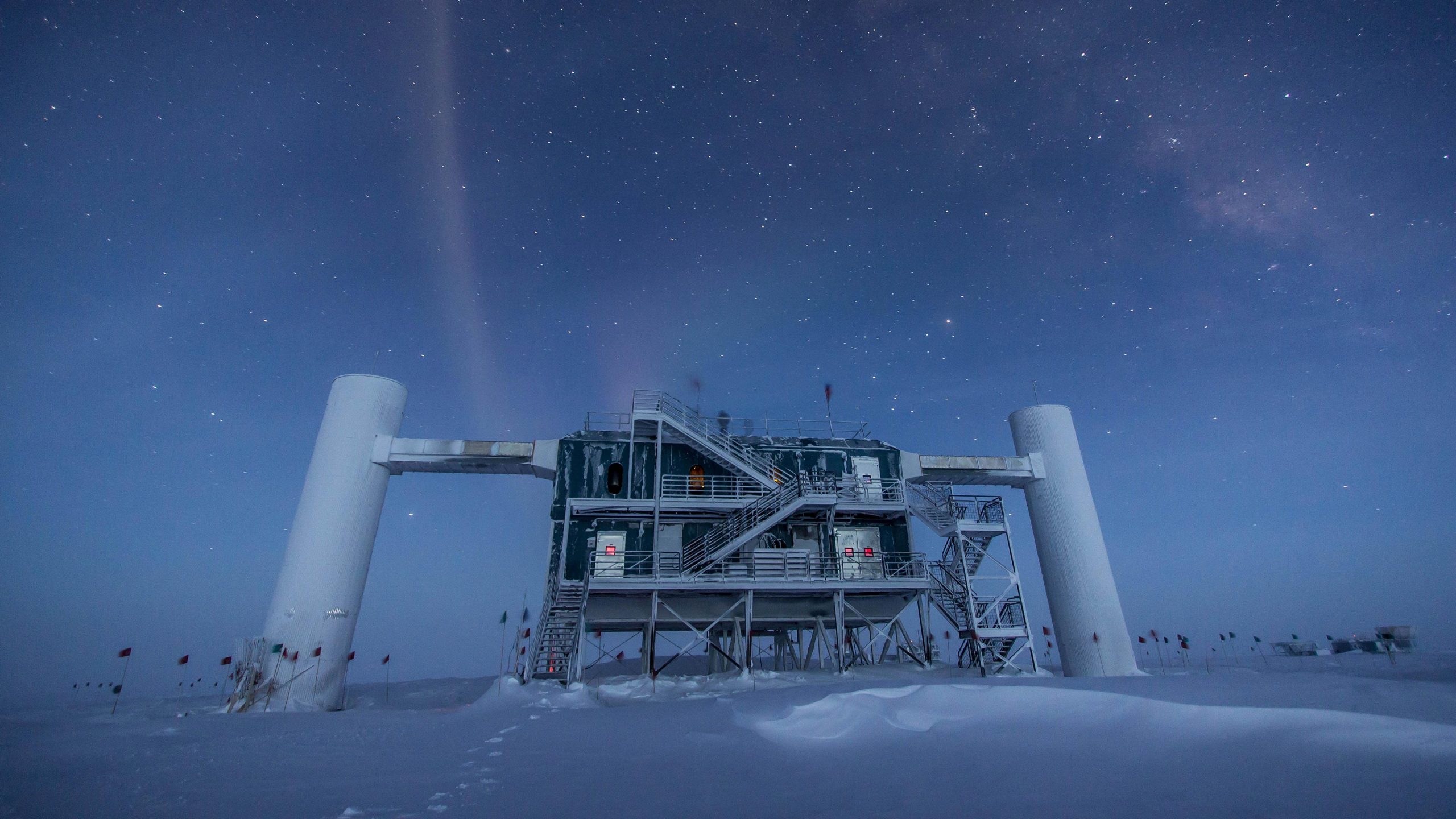
The signals were captured by the IceCube Neutrino Observatory, a massive network of detectors frozen in a cubic kilometer of crystal-clear Antarctic ice. These detectors are designed to spot the rare flashes of light created when neutrinos interact with matter, offering a new way to observe distant cosmic events.
Now, researchers from institutions including UCLA, Osaka University, and Japan’s Kavli Institute for the Physics and Mathematics of the Universe believe the Squid Galaxy may be producing neutrinos in a previously unknown way—one that doesn’t match the standard models.
Gamma Ray Gap Challenges Current Models
Typically, energetic neutrinos from galaxies like NGC 1068 are thought to form when high-speed protons collide with light particles (photons). These violent interactions should also produce strong gamma-ray emissions. But that’s not what scientists found here.
Instead, NGC 1068’s gamma-ray signal was faint and unusually shaped, raising questions about whether the usual proton-photon collisions are happening at all. Existing theories, including those involving the galaxy’s blazing-hot central region called the “corona,” can’t fully explain the strange data.
This has sparked excitement in the astrophysics community, as researchers race to uncover what’s really happening near the heart of this galaxy. If confirmed, the findings could rewrite what we know about the extreme environments around supermassive black holes and how the universe creates some of its most mysterious particles.
A New Route for Neutrino Creation
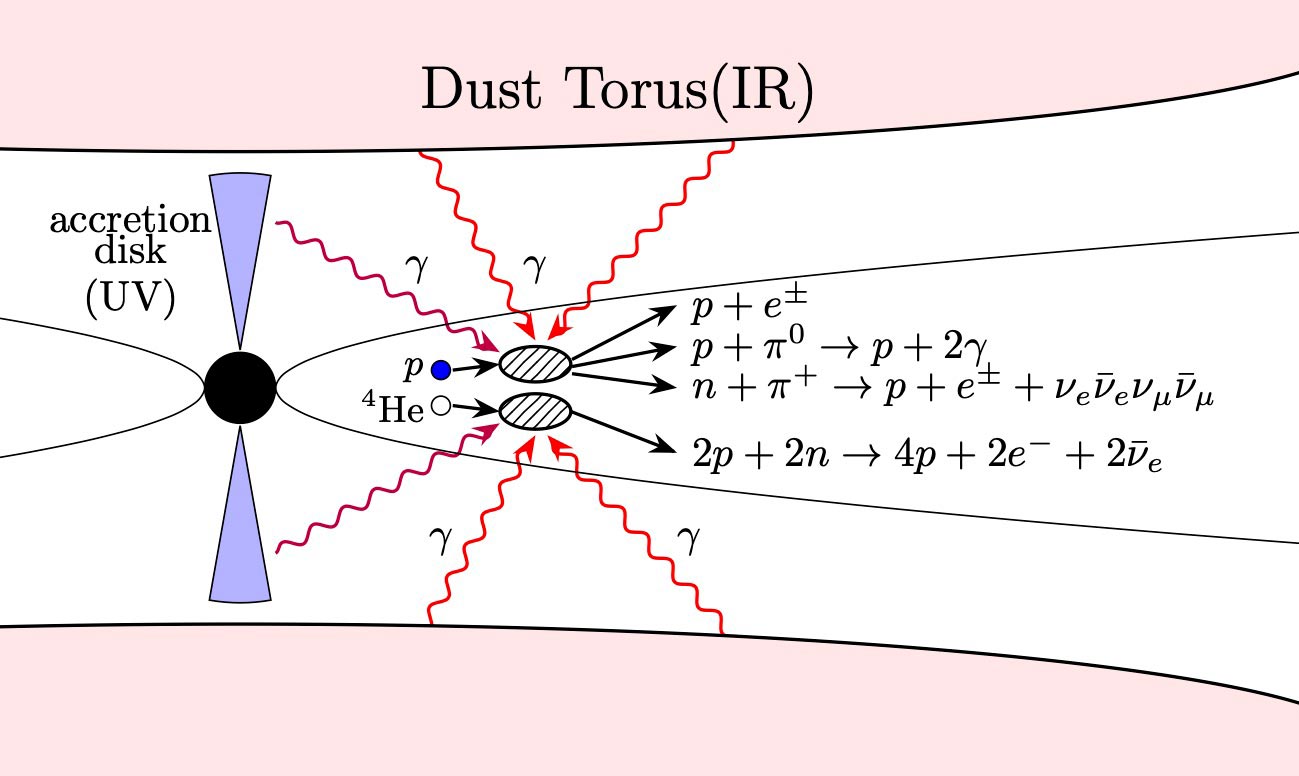
In a paper published in Physical Review Letters, the researchers suggest that the high energy neutrinos from NGC 1068 primarily result from the decay of neutrons when helium nuclei in the galaxy’s jet break apart under intense ultraviolet radiation. When these helium nuclei collide with ultraviolet photons emitted by the galaxy’s central region, they fragment, releasing neutrons that subsequently decay into neutrinos. The energies of the resulting neutrinos match the observations.
Additionally, electrons generated by these nuclear decays interact with surrounding radiation fields, creating gamma rays consistent with the observed lower intensity. This scenario elegantly explains why the neutrino signal dramatically outshines the gamma ray emission and accounts for the distinct energy spectrum observed in both neutrinos and gamma rays.
Peering into Black Hole Jets
The breakthrough helps scientists understand how cosmic jets in active galaxies can emit powerful neutrinos without a corresponding gamma ray glow, shedding new light on the extreme, complex conditions surrounding supermassive black holes, including the one at the center of our own galaxy.
“We don’t know very much about the central, extreme region near the galactic center of NGC1068,” said co-author Alexander Kusenko, Professor of Physics and Astronomy at the University of California, Los Angeles (UCLA) and a Senior Fellow at Kavli IPMU. “If our scenario is confirmed, it tells us something about the environment near the supermassive black hole at the center of that galaxy.”
Furthermore, it confirms the existence of “hidden” astrophysical neutrino sources, whose signals may previously have gone unnoticed due to their faint gamma-ray signatures.
How the IceCube Observatory Hunts Neutrinos
Neutrinos are subatomic particles that interact only very weakly with gravity and can pass through matter. This makes them even harder to detect than other subatomic particles, such as electrons. The IceCube Neutrino Observatory consists of 5,160 sensors buried in clear, compressed Antarctic ice that look for events that could be produced by neutrinos when they pass through the ice, interact with it, and create charged particles.
“We have telescopes that use light to look at stars, but many of these astrophysical systems also emit neutrinos,” said Kusenko. “To see neutrinos, we need a different type of telescope, and that’s the telescope we have at the South Pole.”
Neutrinos are usually produced when accelerated protons interact with photons, emitting gamma radiation of a strength of energy similar to that of the neutrino. Thus, energetic neutrinos are usually paired with energetic gamma rays.
The IceCube neutrino telescope, however, detected very energetic neutrinos coming from NGC 1068 accompanied by a weak gamma ray flux, hinting that the neutrinos may have been produced in a different way.
The new paper proposes that if a helium nucleus accelerates in the jet of a supermassive black hole, it crashes into photons and breaks apart, spilling its two protons and two neutrons into space. The protons can fly away, but the neutrons are unstable and fall apart, or decay, into neutrinos, without producing gamma rays.
“Hydrogen and helium are the two most common elements in space,” said first author and UCLA doctoral student Koichiro Yasuda. “But hydrogen only has a proton and if that proton runs into photons, it will produce both neutrinos and strong gamma rays. But neutrons have an additional way of forming neutrinos that doesn’t produce gamma rays. So helium is the most likely origin of the neutrinos we observe from NGC 1068.”
The scenario sheds light on the extreme environments around the supermassive black holes at the center of many galaxies, including NGC 1068 and our own, where unfathomably immense gravity and energy literally tear atoms apart. Although there’s not necessarily a straight line from understanding the galactic center to improvements in human welfare, knowledge gained through the study of particles like neutrinos, and radiation like gamma rays has a tendency to lead technology down surprising and transformative paths.
“When J.J. Thompson received the 1906 Nobel Prize in physics for the discovery of electrons, he famously gave a toast at a dinner after the ceremony, saying that this was probably the most useless discovery in history,” said Kusenko. “And, of course, every smartphone, every electronic device today, uses the discovery that Thompson made nearly 125 years ago.”
Kusenko also said that particle physics gave birth to the internet, which originated as a network developed by physicists who needed to move large amounts of data between labs. And he pointed out that the discovery of nuclear magnetic resonance seemed obscure at the time but led to the development of magnetic resonance imaging technology, which is now used routinely in medicine.
“We stand at the very beginning of the new field of neutrino astronomy, and the mysterious neutrinos from NGC 1068 is one of the puzzles we have to solve along the way,” said Kusenko. “Investment in science is going to produce something that you may not be able to appreciate now, but could produce something big decades later. It’s a long-term investment, and private companies are reluctant to invest in the kind of research we’re doing. That’s why government funding for science is so important, and that’s why universities are so important.”
Explore Further: IceCube Spots Space’s Strangest Signal: A Neutrino Torrent With No Gamma Flash
Reference: “Neutrinos and Gamma Rays from Beta Decays in an Active Galactic Nucleus NGC 1068 Jet” by Koichiro Yasuda, Nobuyuki Sakai, Yoshiyuki Inoue and Alexander Kusenko, 18 April 2025, Physical Review Letters.
DOI: 10.1103/PhysRevLett.134.151005
Never miss a breakthrough: Join the SciTechDaily newsletter.
Follow us on Google and Google News.
2 Comments
On the other hand…
Aridua to quantum ip to the 4th