
Close Menu
    Facebook X (Twitter) Instagram
    SciTechDaily
    • Biology
    • Chemistry
    • Earth
    • Health
    • Physics
    • Science
    • Space
    • Technology
    Facebook X (Twitter) Pinterest YouTube RSS
    SciTechDaily
    Home»Science»Identifying Microbial Markers in Martian Clay: Subsoil at Earth’s Driest Place May Signal Life on Mars
    Science

    Identifying Microbial Markers in Martian Clay: Subsoil at Earth’s Driest Place May Signal Life on Mars

    By Cornell UniversityNovember 5, 20201 Comment3 Mins Read
    Facebook Twitter Pinterest Telegram LinkedIn WhatsApp Email Reddit
    Share
    Facebook Twitter LinkedIn Pinterest Telegram Email Reddit
    Curiosity's First Scoop of Mars
    The first Martian material collected by the scoop on the robotic arm of NASA’s Mars rover Curiosity. Credit: NASA/JPL-Caltech/MSSS

    Earth’s most arid desert may hold a key to finding life on Mars.

    Diverse microbes discovered in the clay-rich, shallow soil layers in Chile’s dry Atacama Desert suggest that similar deposits below the Martian surface may contain microorganisms, which could be easily found by future rover missions or landing craft.

    Led by Cornell University and Spain’s Centro de Astrobiología, scientists now offer a planetary primer to identifying microbial markers on shallow rover digs in Martian clay, in their work published today (November 5, 2020) in Nature Scientific Reports.

    In that dry environment at Atacama, the scientists found layers of wet clay about a foot below the surface.

    “The clays are inhabited by microorganisms,” said corresponding author Alberto G. Fairén, a visiting scientist in the Department of Astronomy at Cornell University. “Our discovery suggests that something similar may have occurred billions of years ago — or it still may be occurring — on Mars.”

    If microbes existed on Mars in the past, their biomarkers likely would be preserved there, Fairén said. “If microbes still exist today,” he said, “the latest possible Martian life still may be resting there.”
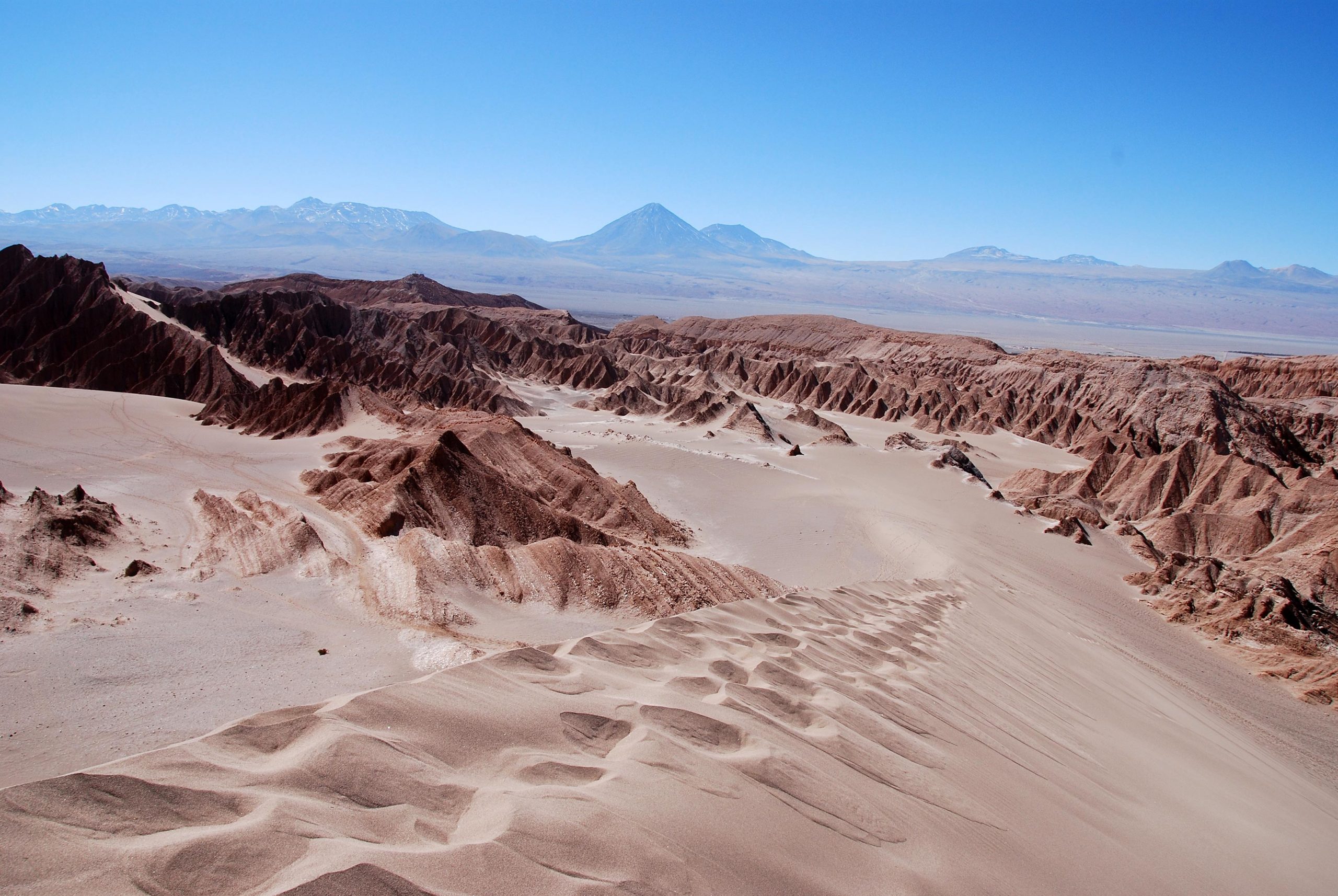
    Chile's Atacama Desert
    Scientists from Cornell and Spain’s Centro de Astrobiología have found that Earth’s most arid desert – Chile’s Atacama Desert, shown above – may hold a key to finding microbial life on Mars.

    The red planet will see rovers cruising across the surface there in the next few years. NASA’s rover Perseverance will land on Mars in February 2021; Europe’s Rosalind Franklin rover will arrive in 2023. Both of those missions will seek microbial biomarkers in the clay below the planet’s surface.

    “This paper helps guide the search,” Fairén said, “to inform where we should look and which instruments to use on a search for life.”

    In the Yungay region of the Atacama desert, the scientists found the clay layer, a previously unreported habitat for microbial life, is inhabited by at least 30 salt-loving microbial species of metabolically active bacteria and archaea (single-cell organisms).

    The researchers’ Atacama discovery reinforces the notion that early Mars may have had a similar subsurface with protected habitable niches, particularly during the first billion years of its history.

    “That’s why clays are important,” he said. “They preserve organic compounds and biomarkers extremely well and they are abundant on Mars.”

    Reference: “Inhabited subsurface wet smectites in the hyperarid core of the Atacama Desert as an analog for the search for life on Mars” by Armando Azua-Bustos, Alberto G. Fairén, Carlos González Silva, Daniel Carrizo, Miguel Ángel Fernández-Martínez, Cristián Arenas-Fajardo, Maite Fernández-Sampedro, Carolina Gil-Lozano, Laura Sánchez-García, Carmen Ascaso, Jacek Wierzchos and Elizabeth B. Rampe, 5 November 2020, Scientific Reports.
    DOI: 10.1038/s41598-020-76302-z

    The paper’s lead author is Armando Azua-Bustos, a researcher on Fairén’s team at the Centro de Astrobiología, Madrid.

    The research was funded by the European Research Council.

    Never miss a breakthrough: Join the SciTechDaily newsletter.
    Follow us on Google and Google News.

    Astrobiology Astronomy Cornell University Geology Mars
    Share. Facebook Twitter Pinterest LinkedIn Email Reddit

    Related Articles

    Ancient Martian Megaflood: Floods of Unimaginable Magnitude Once Washed Through Gale Crater on Mars’ Equator

    Acidic Fluids: Finding Evidence of Life on Mars Just Got Harder

    Depleted Organic Matter in Banded Iron Formations Provides Clues for Extraterrestrial Life Biosignatures

    Martian Meteorite Reveals the Possibility of Life on Mars

    New Guidelines for the Search for Alien Life on Other Planets

    New Technique to Search Space Dust for Molecules Critical for Life

    Martian Meteorite Almost 4 Billion Years Younger Than Previously Thought

    Martian Meteorite Contains Chemical Implicated in the Origin of Life

    ESA’s Mars Express MARSIS Radar Explores Martian Oceans

    1 Comment

    1. ALAN on November 5, 2020 10:36 am

      Thank you

      Reply
    Leave A Reply Cancel Reply

    • Facebook
    • Twitter
    • Pinterest
    • YouTube

    Don't Miss a Discovery

    Subscribe for the Latest in Science & Tech!

    Trending News

    Breakthrough Bowel Cancer Trial Leaves Patients Cancer-Free for Nearly 3 Years

    Natural Compound Shows Powerful Potential Against Rheumatoid Arthritis

    100,000-Year-Old Neanderthal Fossils in Poland Reveal Unexpected Genetic Connections

    Simple “Gut Reset” May Prevent Weight Gain After Ozempic or Wegovy

    2.8 Days to Disaster: Scientists Warn Low Earth Orbit Could Suddenly Collapse

    Common Food Compound Shows Surprising Power Against Superbugs

    5 Simple Ways To Remember More and Forget Less

    The Atomic Gap That Could Cost the Semiconductor Industry Billions

    Follow SciTechDaily
    • Facebook
    • Twitter
    • YouTube
    • Pinterest
    • Newsletter
    • RSS
    SciTech News
    • Biology News
    • Chemistry News
    • Earth News
    • Health News
    • Physics News
    • Science News
    • Space News
    • Technology News
    Recent Posts
    • Bowel and Ovarian Cancers Are Dramatically Rising in Young Adults and Scientists Aren’t Sure Why
    • Alzheimer’s May Begin Decades Earlier Than You Think, New Mayo Clinic Study Finds
    • The Hidden Risk of Taking Breaks From Weight-Loss Drugs Like Ozempic
    • Total Solar Eclipse Made Cities Go Eerily Quiet Beneath the Surface
    • This Common Plant Could Be an Unexpected New Source of Protein
    Copyright © 1998 - 2026 SciTechDaily. All Rights Reserved.
    • Science News
    • About
    • Contact
    • Editorial Board
    • Privacy Policy
    • Terms of Use

    Type above and press Enter to search. Press Esc to cancel.