
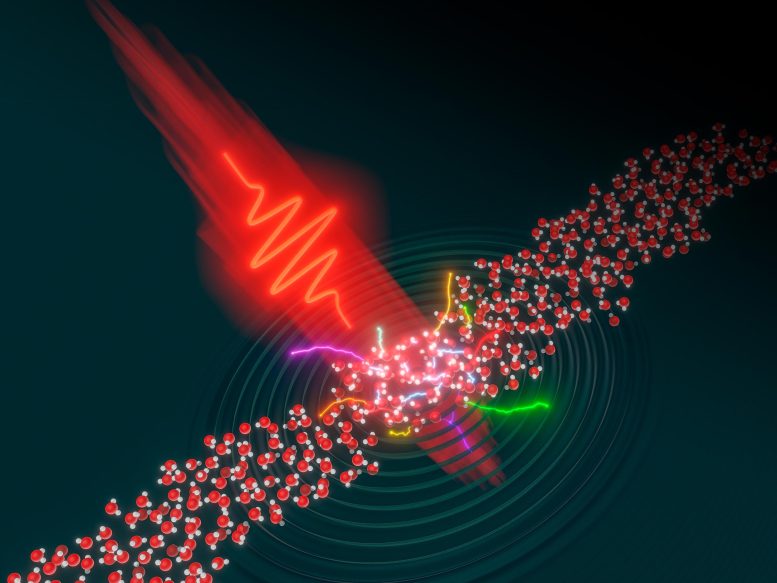
Researchers employed intense laser fields to uncover unique electron dynamics in liquids, providing new insights into the high-harmonic spectrum and revealing the significance of the electron’s mean free path in determining photon energy limits.
The behavior of electrons in liquids plays a big role in many chemical processes that are important for living things and the world in general. For example, slow electrons in liquid have the capacity to cause disruptions in the DNA strand.
But electron movements are extremely hard to capture because they take place within attoseconds: the realm of quintillionths of a second. Since advanced lasers now operate at these timescales, they can offer scientists glimpses of these ultrafast processes via a range of techniques.
An international team of researchers has now demonstrated that it is possible to probe electron dynamics in liquids using intense laser fields and to retrieve the electron’s mean free path — the average distance an electron can travel before colliding with another particle.
“We found that the mechanism by which liquids emit a particular light spectrum, known as the high-harmonic spectrum, is markedly different from the ones in other phases of matter like gases and solids,” said Zhong Yin from Tohoku University’s International Center for Synchrotron Radiation Innovation Smart (SRIS) and co-first author of the paper. “Our findings open the door to a deeper understanding of ultrafast dynamics in liquids.”
Details of the group’s research were published on September 28, 2023, in the journal Nature Physics.
The High-Harmonic Generation Technique
Using intense laser fields to generate high-energy photons, a phenomenon known as high-harmonic generation (HHG), is a widespread technique used in many different areas of science, for instance for probing electronic motion in materials, or tracking chemical reactions in time. HHG has been studied extensively in gases and more recently in crystals, but much less is known about liquids.
The team of researchers, which also included scientists from the Max Planck Institute for the Structure and Dynamics of Matter (MPSD) in Hamburg and ETH Zurich, reported on the unique behavior of liquids when irradiated by intense lasers. Until now, almost nothing is known about these light-induced processes in liquids, which surround us everywhere and are present in every chemical reaction. In contrast, scientists have made significant strides in recent years in exploring the behavior of solids under irradiation.
Therefore, the experimental team at ETH Zurich developed a unique apparatus to specifically study the interaction of liquids with intense lasers. The researchers discovered a distinctive behavior where the maximum photon energy obtained through HHG in liquids was independent of the laser’s wavelength. What, then, was the responsible factor?
Uncovering the Photon Energy Ceiling
Setting out to answer this question, the scientists identified a connection that had not been uncovered so far.
“The distance an electron can travel in the liquid before colliding with another particle is the crucial factor that imposes a ceiling on the photon energy,” said MPSD researcher Nicolas Tancogne-Dejean, a co-author of the study. “We were able to retrieve this quantity — known as the effective electron mean free path — from the experimental data thanks to a specifically developed analytical model which accounts for the scattering of the electrons.”
By combining experimental and theoretical results in their study of HHG in liquids, the scientists not only pinpointed the key factor that determines the maximum photo energy but also provide an intuitive model to elucidate the fundamental mechanism.
“Measuring the effective mean free path of the electrons is very challenging in the low kinetic energy region, as was done in this study, added Yin. “Ultimately, our collaborative effort establishes HHG as a new spectroscopical tool to study liquids and is therefore an important stepping stone in the quest to understand the dynamics of electrons in liquids.”
The research was a continuation of Yin’s previous work.
Reference: “High-harmonic spectroscopy of low-energy electron-scattering dynamics in liquids” by Angana Mondal, Ofer Neufeld, Zhong Yin, Zahra Nourbakhsh, Vít Svoboda, Angel Rubio, Nicolas Tancogne-Dejean and Hans Jakob Wörner, 28 September 2023, Nature Physics.
DOI: 10.1038/s41567-023-02214-0
Never miss a breakthrough: Join the SciTechDaily newsletter.
Follow us on Google and Google News.
3 Comments
The value of one scientific experiment is not achieved by flaunting its publication in a certain journal.
Nature Physics firmly believe that even without understanding how θ & τ were formed, it can be concluded that they are CP violations. Is it scientific?
Nature Physics firmly believe that even if two objects (such as cobalt-60) that rotate in opposite directions are asymmetrical, they are still two objects that mirror each other. Is it scientific?
Nature Physics oppose to discuss the aforementioned topics. Is it honest?
Their absurd theory leads to absurd scientific research behavior, which has been ongoing. Are they respectable?
Some so-called academic journals are neither scientific nor honest.
Leave on stone unturned, true Science.
Correction: Leave no stone unturned.