
Close Menu
    Facebook X (Twitter) Instagram
    SciTechDaily
    • Biology
    • Chemistry
    • Earth
    • Health
    • Physics
    • Science
    • Space
    • Technology
    Facebook X (Twitter) Pinterest YouTube RSS
    SciTechDaily
    Home»Health»In a Pandemic, Migration Away From Dense Cities Is More Effective Than Closing Borders
    Health

    In a Pandemic, Migration Away From Dense Cities Is More Effective Than Closing Borders

    By American Institute of PhysicsNovember 17, 2020No Comments3 Mins Read
    Facebook Twitter Pinterest Telegram LinkedIn WhatsApp Email Reddit
    Share
    Facebook Twitter LinkedIn Pinterest Telegram Email Reddit
    Evolution of Infection as a Function of Asymmetry in Population Distribution
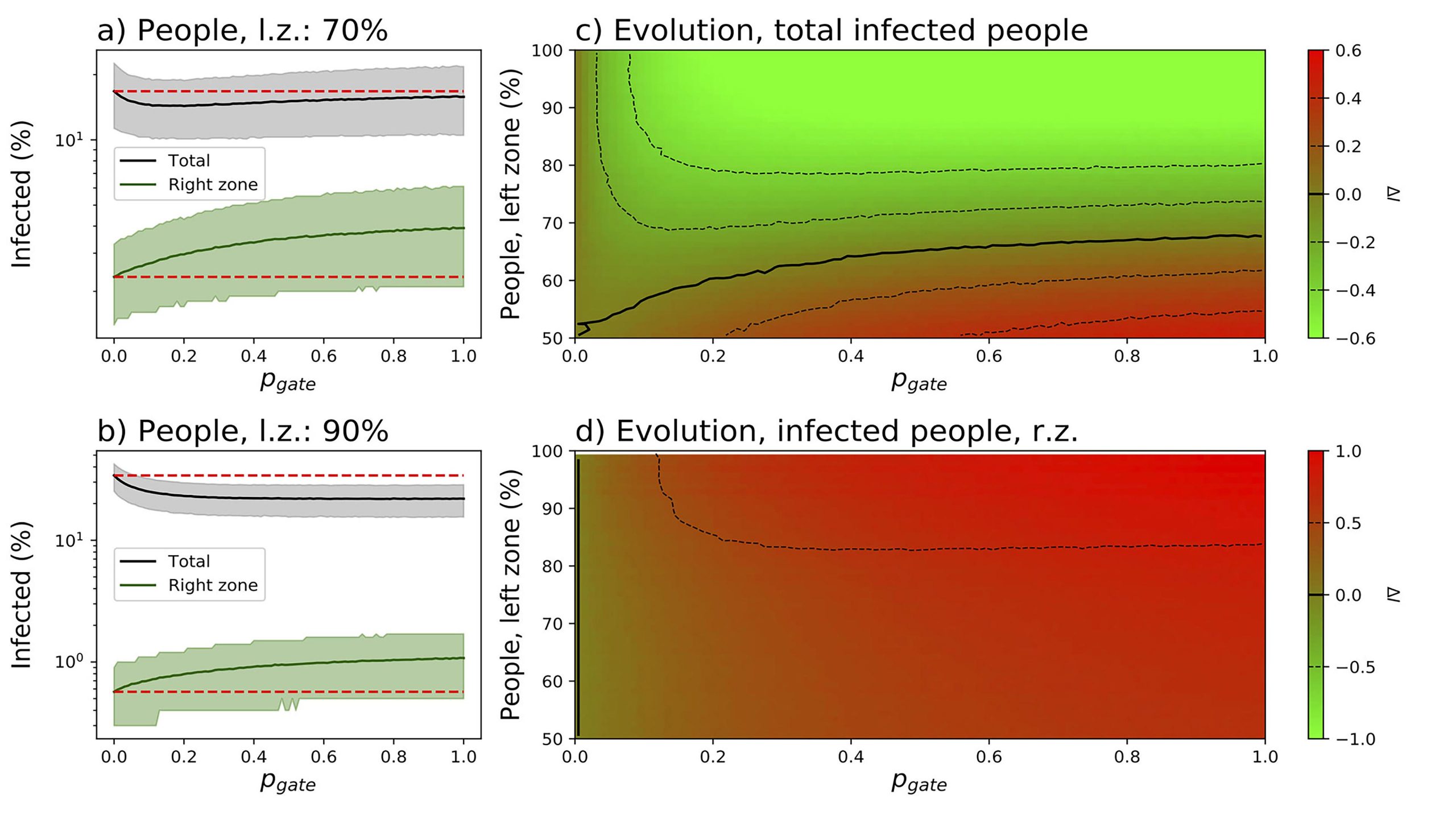
    Evolution of infection in people as a function of asymmetry in population distribution shows that when the border from high-density to low-density areas is closed, total overall disease spread doubles. Credit: Image courtesy of Massimiliano Zanin

    A simulation shows reducing population density in large cities decreases disease spread.

    Pandemics are fueled, in part, by dense populations in large cities where networks of buildings, crowded sidewalks, and public transportation force people into tighter conditions. This contrasts with conditions in rural areas, where there is more space available per person.

    According to common sense, being in less crowded areas during a pandemic is safer. But small town mayors want to keep people safe, too, and migration of people from cities to rural towns brings concerns. During the COVID-19 pandemic, closing national borders and borders between states and regions has been prevalent. But does it really help?

    In a paper published in Chaos, by AIP Publishing, two researchers decided to put this hypothesis to the test and discover if confinement and travel bans are really effective ways to limit the spread of a pandemic disease. Specifically, they focused on the movement of people from larger cities to smaller ones and tested the results of this one-way migration.

    “Instead of taking mobility, or the lack of mobility, for granted, we decided to explore how an altered mobility would affect the spreading,” author Massimiliano Zanin said. “The real answer lies in the sign of the result. People always assume that closing borders is good. We found that it is almost always bad.”

    The model used by the authors is simplified, without many of the details that affect migration patterns and disease spread. But their focus on changes in population density indicates travel bans might be less effective than migration of people to less dense areas. The result was reduced spread of disease.

    Zanin and collaborator David Papo placed a hypothetical group of people in two locations and assumed their travel was in random movement patterns. They used SIR dynamics, which is common in epidemiological studies of disease movement. SIR stands for susceptible, infected, and recovered — classifications used to label groups in a simulation and track disease spread according to their interactions.

    They ran 10,000 iterations of the simulation to determine the resulting disease spread among people in two locations when migration is one way: from dense cities to less dense towns. They also studied the effect of “forced migration,” which moves healthy people out of dense cities at the onset of a pandemic.

    The results showed that while movement from big cities to small towns might be slightly less safe for the people in small towns, overall, for a global pandemic situation, this reduction in the density of highly populated areas is better for the majority of all people.

    “Collaboration between different governments and administrations is an essential ingredient towards controlling a pandemic, and one should consider the possibility of small-scale sacrifices to reach a global benefit,” Zanin said.

    Reference: “Travel restrictions during pandemics: A useful strategy?” by Massimiliano Zanin and David Papo, 17 November 2020, Chaos.
    DOI: 10.1063/5.0028091

    Never miss a breakthrough: Join the SciTechDaily newsletter.
    Follow us on Google and Google News.

    Algorithm American Institute of Physics Infectious Diseases Mathematics Public Health
    Share. Facebook Twitter Pinterest LinkedIn Email Reddit

    Related Articles

    Researchers Say Benefits of AstraZeneca COVID-19 Vaccine Outweigh Its Risks

    Network Model Shows How Combining Mask Wearing, Social Distancing Suppresses COVID-19 Virus Spread

    Time to Rethink COVID Predictions? Pandemic Infection Rates Are Deterministic but Cannot Be Modeled

    Contagion Transmission Model: Estimating Risk of Airborne COVID-19 With Mask Usage, Social Distancing

    Aerosol Microdroplets Not Very Effective at Spreading the COVID-19 Virus

    Scientists Compare How COVID-19 Cough Clouds Travel With and Without Face Masks

    Simple Algebra Enables Faster, Large-Volume COVID-19 Testing

    New Research Shows COVID-19 Herd Immunity Could Be Achieved With Fewer People Being Infected

    New Model Predicts the Peaks of the COVID-19 Pandemic Around the World

    Leave A Reply Cancel Reply

    • Facebook
    • Twitter
    • Pinterest
    • YouTube

    Don't Miss a Discovery

    Subscribe for the Latest in Science & Tech!

    Trending News

    First-of-Its-Kind Discovery: Homer’s Iliad Found Embedded in a 1,600-Year-Old Egyptian Mummy

    Beyond Inflammation: Scientists Uncover New Cause of Persistent Rheumatoid Arthritis

    A Simple Molecule Could Unlock Safer, Easier Weight Loss

    Scientists Just Built a Quantum Battery That Charges Almost Instantly

    Researchers Unveil Groundbreaking Sustainable Solution to Vitamin B12 Deficiency

    Millions of People Have Osteopenia Without Realizing It – Here’s What You Need To Know

    Researchers Discover Boosting a Single Protein Helps the Brain Fight Alzheimer’s

    World-First Study Reveals Human Hearts Can Regenerate After a Heart Attack

    Follow SciTechDaily
    • Facebook
    • Twitter
    • YouTube
    • Pinterest
    • Newsletter
    • RSS
    SciTech News
    • Biology News
    • Chemistry News
    • Earth News
    • Health News
    • Physics News
    • Science News
    • Space News
    • Technology News
    Recent Posts
    • Weight-Loss Drugs Like Ozempic May Come With an Unexpected Cost
    • After Decades, MIT Researchers Capture the First 3D Atomic View of a Mysterious Material
    • Your Favorite Fishing Spot Is Turning Brown – and the Fish Are Changing
    • 380-Million-Year-Old Fish Fossil Reveals Secrets of Life’s First Steps Onto Land
    • Mezcal “Worm” in a Bottle Mystery: DNA Testing Reveals a Surprise
    Copyright © 1998 - 2026 SciTechDaily. All Rights Reserved.
    • Science News
    • About
    • Contact
    • Editorial Board
    • Privacy Policy
    • Terms of Use

    Type above and press Enter to search. Press Esc to cancel.