
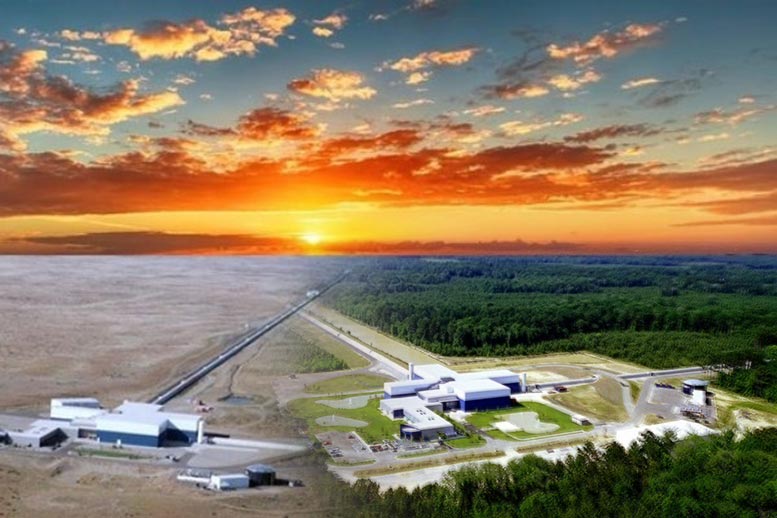
Despite the planet’s seeming standstill, graduate students continue to use LIGO to identify astrophysical events.
When LIGO, the Laser Interferometer Gravitational-Wave Observatory, and its European counterpart, Virgo, detect a gravitational ripple from space, a public alert is sent out. That alert lets researchers know with a decently high confidence that this ripple was probably caused by an exceptional cosmic event, such as the collision of neutron stars or the merging of black holes, somewhere in the universe.
Then starts the scramble. A pair of researchers is assigned to the incoming event, analyzing the data to get a preliminary location in the sky whence the ripple emanated. Telescopes are pointed in that direction, more data is amassed, and the pair of researchers conduct further followup studies to try to determine what kind of event caused the wave.
“I often think of it as if we’re in a dark forest and listening to the ground,” says Eva Huang, a third-year Department of Physics graduate student in Assistant Professor Salvatore Vitale’s lab in the MIT Kavli Institute for Astrophysics and Space Research (MKI). “From the footsteps, we’re trying to guess what kind of animal is passing by.”
The LIGO-Virgo Collaboration keeps a rotation system to determine which researchers get to investigate the latest detection. Sylvia Biscoveanu, a second-year graduate student also in Vitale’s lab, was next on the list when LIGO suspended its third observational run due to COVID-19. If a cosmic event happens in the universe and there’s no one there to detect it, did it even happen?
Data analysis in isolation
When MIT similarly scaled back on-campus research in mid-March due to the coronavirus pandemic, the LIGO team at MKI adapted quickly to the new work-from-home normal. “Our work is physically less dependent on being at MIT,” says Vitale, who is also a member of the LIGO Scientific Collaboration. “Still, there are consequences.”
For Biscoveanu, working from home has entailed being at her computer for at least eight hours a day. “In terms of actually being able to do my research, I haven’t suffered,” she says. What has suffered is her ability to exchange ideas with other members of the LIGO group at MIT. “I had just moved to a bigger office with a bunch of graduate students, and we were really looking forward to being able to talk to each other and ask questions regularly,” says Biscoveanu. “I definitely don’t get as much of that at home.”
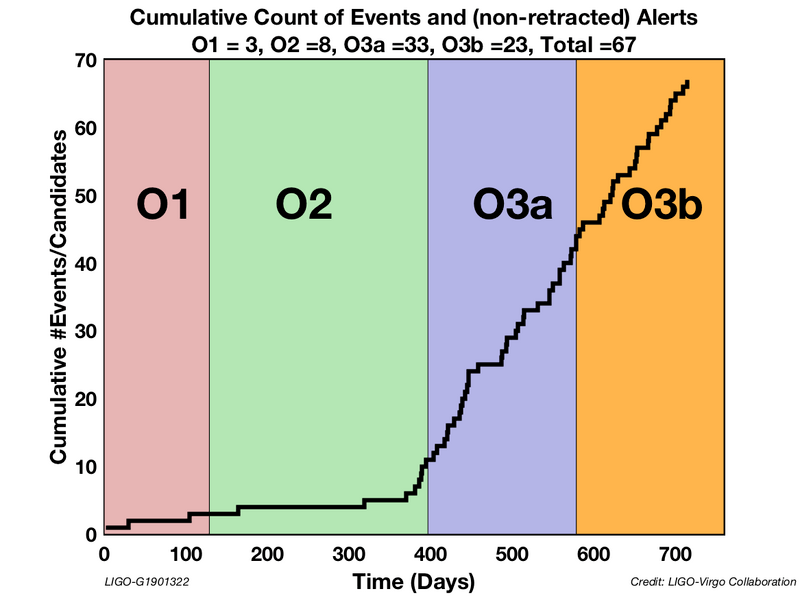
Image courtesy of the LIGO-Virgo Collaboration
Mentorship also looks different when everyone is at home. Vitale has always had an open-door policy with his graduate students. “I do weekly meetings with my students, but on top of that I had close-to-daily interactions with them,” he says. Unless his door was closed, Vitale says, his students could come in and talk anytime. That immediate connection, he has found, is hard to replicate in the digital world.
“The thing I tell my students is that we don’t work in a hut where everyone is making their own project and then it’s done,” says Vitale. “Research is more than the sum of its parts.” One advantage of working in a group is the ability to turn to a colleague to discuss a paper you just read, a problem you’re facing, or a crazy idea you had the night before. That’s harder to do when everyone is stuck in their own hut.
“Now you have to go in the chat room or arrange a telecon if you want to ask a question,” says Ken Ng, a third-year graduate student in the Vitale group. Ng uses gravitational waves to study particle physics, with his work focusing on axions, a proposed elementary particle that is orders of magnitude smaller than the tiniest particle observed. Telecons and Slack, he has found, can be particularly inefficient when you’re trying to quickly sketch out an idea. “I’m actually thinking of buying a whiteboard,” he says.
Space never stops
When the third observation run was suspended a month before it was supposed to end, it had collected 56 gravitational wave candidates. In comparison, the first two runs combined amassed a total of 11 candidates. So even though fresh data isn’t arriving in the lab, the work hasn’t ceased, and LIGO scientists are scrutinizing the data from home. “If the pandemic had happened a few months before, we could have missed half the data,” says Ng, looking on the positive side.
Compared to the other members of the lab, Ng is no pandemic rookie. When the COVID-19 pandemic struck, he thought, “Again?” Ng, who is from Hong Kong, faced the SARS outbreak in 2002 and considers himself the pandemic veteran of the group. That experience has kept him from panicking these days. “I know the importance of social distancing and mask-wearing,” he explains.
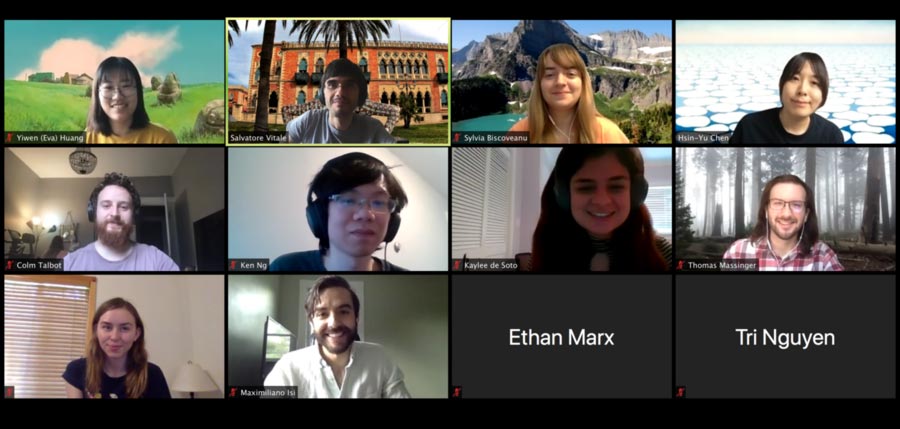
Still, for some in the group, social distancing has led to less productivity and feelings of guilt. “I sometimes feel that, because my work is less impacted, I cannot allow myself to feel frustrated,” says Huang. Her work — analyzing LIGO data to decipher the cosmic events responsible for detected waves — can be done at home, unlike researchers who need to be physically in-lab. Throughout the pandemic, Huang has worked hard to combat the feeling that she needs to earn permission to be self-compassionate. “I can be, and need to be, kind to myself during this time.
All are looking forward to the day when they can come back to campus. Partly, Ng confesses, for the free food. But mostly to continue studying gravitational waves in the same space. “I miss being able to chat randomly when people are in an office,” he says.
Vitale acknowledges that there have been some benefits of working from home. “This has obliged everyone to think a bit harder about how to express what we want to say,” he says. Still, like his students, he also can’t wait to leave his hut and get back to campus. “I think for all of us, it will also just be nice to be back at the office and re-establish a clear separation between our living and our working spaces, that right now are collapsed in the same entity.”
Never miss a breakthrough: Join the SciTechDaily newsletter.
Follow us on Google and Google News.