
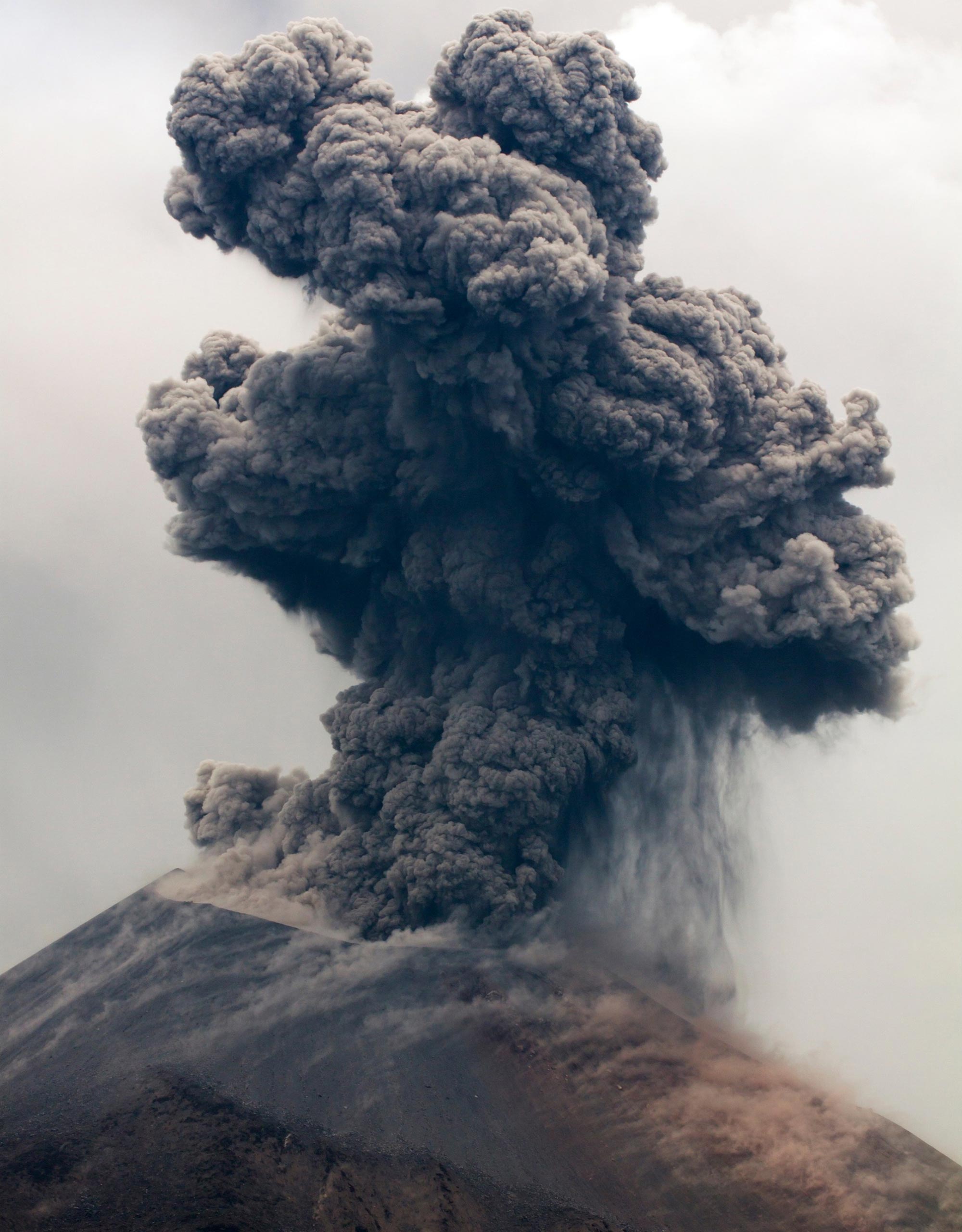
The 2018 collapse of Indonesia’s Anak Krakatau volcano, which triggered a devastating tsunami, resulted from long-term geological processes rather than sudden magmatic changes.
Researchers from the University of Birmingham, the Bandung Institute of Technology, and other institutions found that the explosive eruption following the collapse was likely due to a landslide releasing pressure on the magma system. This discovery challenges current monitoring methods and emphasizes the need for better hazard prediction and management for volcanic islands.
Anak Krakatau’s Collapse
The dramatic collapse of Indonesia’s Anak Krakatau volcano in December 2018 resulted from long-term destabilizing processes, and was not triggered by any distinct changes in the magmatic system that could have been detected by current monitoring techniques, new research has found.
The volcano had been erupting for around six months prior to the collapse, which saw more than two-thirds of its height slide into the sea as the island halved in area. The event triggered a devastating tsunami, which inundated the coastlines of Java and Sumatra and led to the deaths of more than 400 people.
A team led by the University of Birmingham examined volcanic material from nearby islands for clues to determine whether the powerful, explosive eruption observed after the collapse had itself triggered the landslide and tsunami. Their results are published in Earth and Planetary Science Letters.
Analysis of the Collapse and Eruption
Working with researchers at the Bandung Institute of Technology, the University of Oxford, and the British Geological Survey, the team looked at the physical, chemical, and microtextural characteristics of the erupted material. They concluded that the large explosive eruption associated with the collapse was probably caused by the underlying magmatic system becoming destabilized as the landslide got underway.
This means the disaster was less likely to have been caused by magma forcing its way to the surface and triggering the landslide. Current volcano monitoring methods record seismic activity and other signals caused by magma rising through the volcano, but since this event was not triggered from within, it would not have been detected using these techniques.
Challenges in Predicting Volcanic Hazards
Dr. Sebastian Watt, in the University of Birmingham’s School of Geography, Earth and Environmental Sciences, is senior author on the paper. He said: “This type of volcanic hazard is rare, extremely hard to predict, and often devastating. Our findings show that, although there was a dramatic, explosive eruption after the collapse of Anak Krakatau, this was triggered by the landslide releasing pressure on the magma system – like a champagne cork popping.”
The results present a challenge for predicting future hazards at volcanic islands. Dr. Mirzam Abdurrachman, from the Bandung Institute of Technology, explains: “If large volcanic landslides occur as a result of long-term instability, and can take place without any distinctive change in the magmatic activity at the volcano, this means they can happen suddenly and without any clear warning.
“This finding is important for people who live in regions surrounded by active volcanoes and volcanic islands in places such as Indonesia, Philippines, and Japan.”
Long-Term Research and Hazard Mitigation
Lead author, Kyra Cutler, at the University of Oxford said: “Evaluating longer-term growth and deformation patterns of volcanoes will help to provide a better understanding of the likelihood of failure – this is will be particularly relevant for Anak Krakatau as it rebuilds. Identifying susceptible areas, along with efforts to develop non-seismic tsunami detection, will improve overall hazard management strategies for communities who are at risk.”
Insights From Marine Surveys and Future Strategies
Professor David Tappin, (British Geological Survey, University College, London) led the marine surveys that mapped the deposits resulting from the 2018 Anak Krakatau eruption collapse (Hunt et al. 2021). He said: “It is rare that we have the opportunity to study such an eruption and tsunami, with the last event, Ritter Island, over 100 years ago. The results in the paper reveal that the driving mechanism was from long-term destabilization, rather than an instantaneous explosive event. This is a major surprise discovery and will lead to a re-evaluation of how to mitigate the hazard from volcanic failures and their associated tsunamis.”
Reference: “Downward-propagating eruption following vent unloading implies no direct magmatic trigger for the 2018 lateral collapse of Anak Krakatau” by Kyra S. Cutler, Sebastian F. L. Watt, Mike Cassidy, Amber L. Madden-Nadeau, Samantha L. Engwell, Mirzam Abdurrachman, Muhammad E. M. Nurshal, David R. Tappin, Steven N. Carey, Alessandro Novellino, Catherine Hayer, James E. Hunt, Simon J. Day, Stephan T. Grilli, Idham A. Kurniawan and Nugraha Kartadinata, 14 January 2022, Earth and Planetary Science Letters.
DOI: 10.1016/j.epsl.2021.117332
Never miss a breakthrough: Join the SciTechDaily newsletter.
Follow us on Google and Google News.
3 Comments
Today isn’t the day to start posting tsunami and volcano stories that have nothing to do with Tonga.
And that is way
Ñate while I was going to say that I want to go to bed soon 🙂 and then