
Marine microbes survive in low-nutrient oceans by teaming up with ciliated cells that stir water and pull in nutrients.
What’s a hungry marine microbe to do when the pickings are slim? It must capture nutrients – nitrogen, phosphorus, or iron – to survive, yet in vast expanses of the ocean, nutrients are extremely scarce. And the stakes are high: Marine microbial communities drive many of the elemental cycles that sustain all life on Earth.
One ingenious solution to this challenge is reported this week in Proceedings of the National Academy of Sciences. In low-nutrient environments, marine microbes can clump together and hook up with even tinier cells that have vibrating, hairlike appendages (cilia) on their surface. The beating cilia create microcurrents that can pull up to 10 times more nutrients within the microbes’ reach – thereby serving up a meal through cooperative work.
Even if the ocean is wildly turbulent, microbes can piggyback into consortia for division of labor, says senior corresponding author John H. Costello of Providence College and the Marine Biological Laboratory (MBL), Woods Hole, where much of the research was conducted.
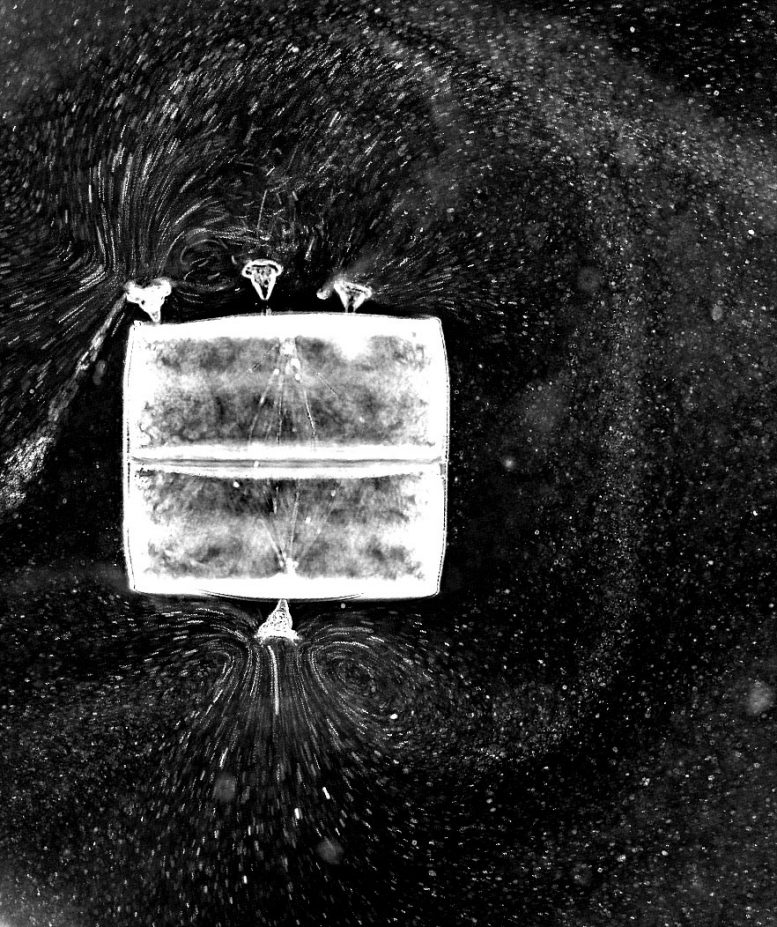
Microcurrents created by ciliate epibionts (Pseudovorticella coscinodisci) bring fluid and nutrients to its diatom host (Coscinodiscus wailesii). Credit: Kanso et al, PNAS, 2021.
“For all conditions but the most radically extreme mixing, these microbial cells live in fluid spaces that are smaller than the eddies caused by ocean mixing,” Costello says. “In their world, the surrounding fluid is always viscous and they do not experience turbulent eddies as humans feel them.”
The team used a technology called Particle Image Velocimetry (PIV) to measure the direction and magnitude of fluid flows around a photosynthetic marine diatom, Coscinodiscus wailesii, with and without an attached ciliate “partner,” Pseudovorticella coscinodisci. They found that fluid flows generated by ciliary beating can increase nutrient flux to the diatom’s cell surface 4-10 times greater than fluxes to the diatom alone.
This cooperative solution is one way microbes can cope in low-nutrient environments. Another previously known tactic for individual cells is sinking to greater depths, which creates relative motion between the cell and surrounding water and increases its exposure to higher nutrient concentrations.
Rotation of Coscinodiscus wailesii diatom host with multiple attached Pseudovorticella coscinodisci ciliate epibionts. Unbalanced forces generated by ciliates result in rotational motion of consortia. Credit: Kanso et al, PNAS, 2021
“Sinking might work well in low-nutrient conditions where mixing will recirculate the cells back up from the depths to the sunlit layers,” Costello says. “That way, the risk to the diatom of sinking might be countered by the probability of being returned to high-light environments. But in low-mixing conditions, forming consortia with ciliates could be a more favorable solution to low nutrient availability.”
Diatoms are among the most important groups of single-celled photosynthesizers for removing carbon dioxide from the atmosphere. Thus, the study helps to illuminate ocean-atmospheric exchanges that have become increasingly important for understanding climate change.
“We have described a collaborative solution – consortium formation – that has evolved on the microscopic scale to allow this large diatom species to successfully persist in low-nutrient waters that would otherwise appear to restrict its success,” Costello says.
Reference: “Teamwork in the viscous oceanic microscale” by Eva A. Kanso, Rubens M. Lopes, J. Rudi Strickler, John O. Dabiri and John H. Costello, 16 July 2021, Proceedings of the National Academy of Sciences.
DOI: 10.1073/pnas.2018193118
Eve Kanso, the paper’s lead author, is at University of Southern California. Costello conducts research at the Marine Biological Laboratory as a Whitman Center scientist. Other co-authors include scientists from University of São Paulo, Instituto Oceanográfico; University of Wisconsin-Milwaukee; University of Texas at Austin; and California Institute of Technology.
Never miss a breakthrough: Join the SciTechDaily newsletter.
Follow us on Google and Google News.