
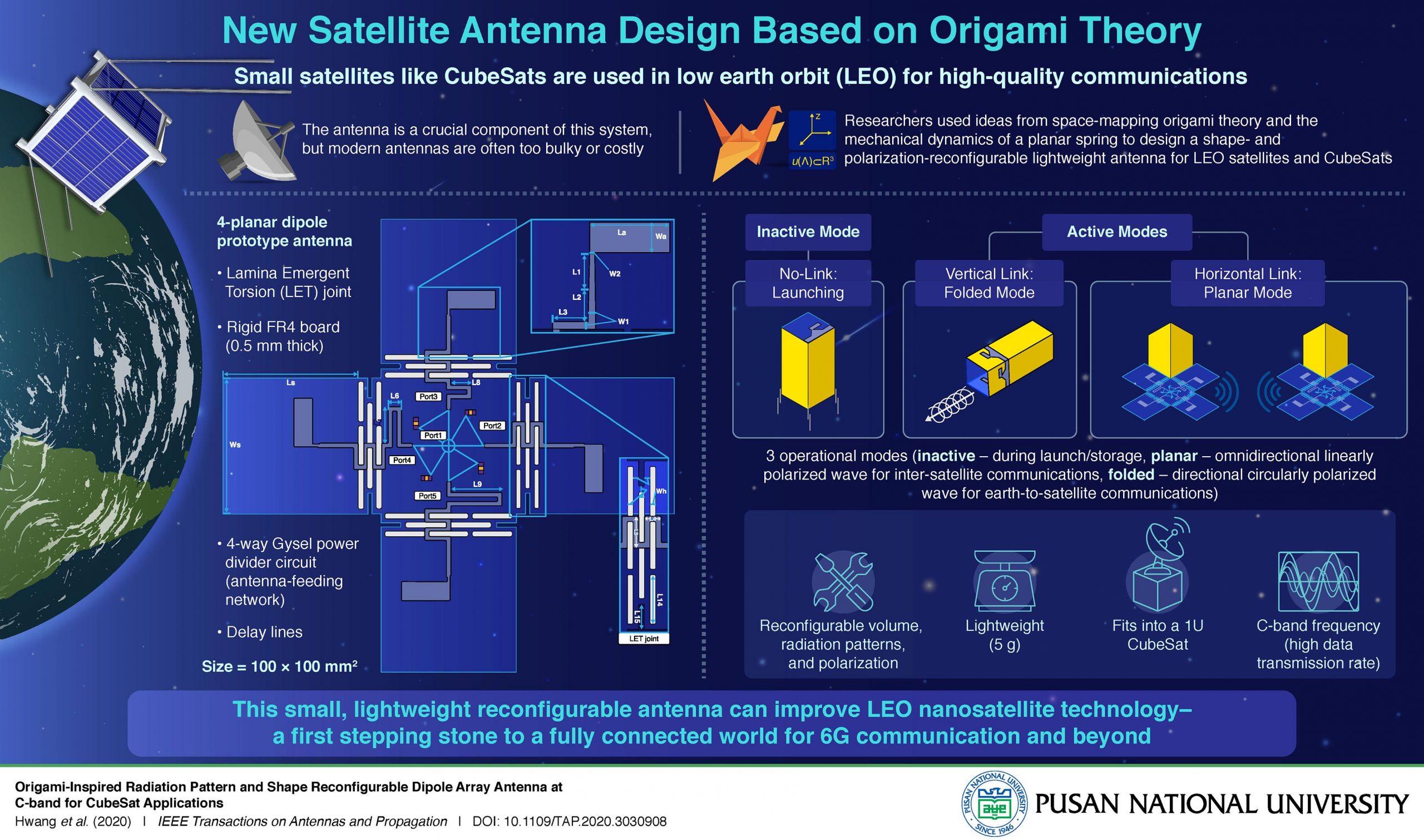
A multidisciplinary team engineered a small, light, and low-cost deployable antenna for nano- and micro-satellite communications.
In a brand-new study, scientists from Korea and the USA have revealed a novel antenna design for use in CubeSat nanosatellites using state-of-the-art communications systems like 6G communications. Using theoretical knowledge based on origami theory, mechanical dynamics, and antenna array principles, the researchers built a small, lightweight, and reconfigurable antenna for CubeSat depending on operational mode selected. This could potentially mark the beginning of a new era in satellite communications!
Modern telecommunication systems rely on satellites to relay signals across the globe quickly and reliably, enabling users to send messages across the world in an instant, watch live television, or – more recently – hold conference calls with global partners right from the kitchen table!
Communications satellites use high-frequency radio waves to transmit data, with antennas acting as a two-way interface, converting electric current provided by the transmitter into radio waves, and vice versa when paired with a receiver. Antennas are therefore vital pieces of equipment, without which satellites and ground receivers would be practically useless.
However, despite advances in modern satellite design and performance, antenna technology remains a limiting factor for next-generation telecommunications such as 6G. Engineers struggle to miniaturize antennas for nanosatellites without compromising on their cost or performance. For instance, nanosatellites like CubeSats can be as small as a 10 cm3 cube, but manufacturing a communication antenna small enough to be stored inside it during launch and flight is expensive and technologically challenging.
“Many high-performance antennas reported for CubeSat systems are deployable, foldable, or inflatable,” explains Dr. Sangkil Kim from Pusan National University in South Korea.
Origami-Inspired Innovation: A Foldable Antenna Design
Recently, Dr. Kim and his colleagues at Pusan National University and the University of Alabama, USA, developed a new deployable antenna for CubeSats used in low-earth orbit (LEO). Interestingly, their design was inspired by the mathematics of “origami”, the Japanese art of paper folding—specifically a field called spatial mapping—which enabled them to decide on the best geometry for a foldable, deployable antenna. With the design on paper, they set out to manufacture the antenna and test it.
With remarkable dimensions of 32.5 mm3 when folded and weighing merely 5 grams, the prototype antenna fits snugly within a CubeSat. The researchers used an inexpensive material to make the bulk of the antenna, using special joints to fold the square boards into a cube, which can easily be stored during launch and flight. Once in orbit, the antenna can be deployed outside of the CubeSat, ready to receive and transmit data.
Prof. Kim and his team went one step further and set up different deployment modes, depending on whether satellites needed to communicate with each other or with Earth. “The volume, radiation patterns, and polarizations of the antenna are reconfigurable according to the required operation mode,” Dr. Kim explains. This configuration enabled the researchers to optimize the antenna’s performance for each type of communication.
With such promising results, the scientists hope their design will inspire future deployable designs for nanosatellite antenna technology and pave the way for next-generation communication systems, such as 6G. Not only will their prototype reduce the cost of future nanosatellites and improve their overall performance, but it can also be scaled up to larger satellites in geostationary orbit and other communication platforms on Earth.
Reference: “Origami-Inspired Radiation Pattern and Shape Reconfigurable Dipole Array Antenna at C-band for CubeSat Applications” by Myeongha Hwang, Gyoungdeuk Kim, Sangkil Kim and Nathan Seongheon Jeong, 20 October 2020, IEEE Transactions on Antennas and Propagation.
DOI: 10.1109/TAP.2020.3030908
Never miss a breakthrough: Join the SciTechDaily newsletter.
Follow us on Google and Google News.