
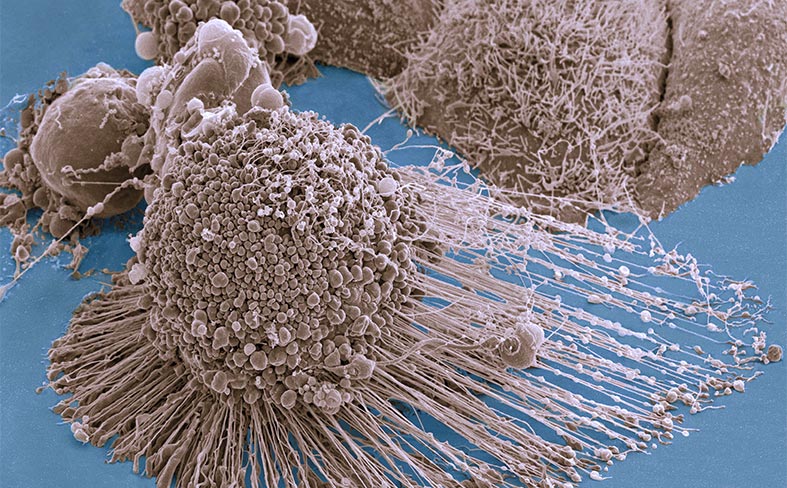
Cancer cells rewire their metabolism to compensate for a halt in fat production by importing more fat molecules from their environment.
Knowing what cancer will do next could lessen the likelihood of it becoming resistant to treatment. A new U of T study investigates how cancer adapts its metabolism to potentially overcome therapies still in development.
“Several clinical trials have failed because metabolism is such an adaptive process by which cancer cells gain drug resistance,” says Michael Aregger, a co-lead author and Research Associate working with Jason Moffat, Professor of molecular genetics in the Donnelly Centre for Cellular and Biomolecular Research, who co-led the work. “If you know how cells are able to adapt to perturbations, maybe we can target them more specifically to avoid resistance from developing.”
“If you know how cells are able to adapt to perturbations, maybe we can target them more specifically to avoid resistance from developing” Michael Aregger, Research Associate
The research was also led by Brenda Andrews and Charles Boone, University Professor and Professor of molecular genetics at the Donnelly Centre, respectively, and Chad Myers, a Professor of computer science at the University of Minnesota-Twin Cities.
The study, published this week in the journal Nature Metabolism, is the first to investigate global changes in cancerous cells as they adapt to a shortfall of critical nutrients such as fat molecules, or lipids, which make up the cell’s outer envelope.
When cancer cells are unable to make their own lipids, they gobble them up from their environment to ensure a steady supply of these essential building blocks, the study found. Lipids also serve as fuel and chemical signals for communication between cells, among other roles.
The switch in metabolism could be bad news for drugmakers seeking to target cancer by reducing its lipid reserves. In particular, drugs that inhibit an enzyme called FASN, for fatty acid synthase, involved in an early step of lipid synthesis, are being explored in patient trials. Fatty acids are precursors of larger lipid molecules and their production is increased in many cancers thanks to elevated FASN levels, which are also associated with poor patient prognosis.
The U of T study suggests that the effectiveness of FASN inhibitors could be short-lived owing to cancer’s ability to find another way to procure lipids.
“Because FASN is upregulated in many cancers, fatty acid synthesis is one of the most promising metabolic pathways to target” says Keith Lawson, a co-lead author and PhD student in Moffat’s lab enrolled in the Surgeon-Scientist Program at the Faculty of Medicine. “Given that we know there is a lot of plasticity in metabolic processes, we wanted to identify and predict ways in which cancer cells can potentially overcome the inhibition of lipid synthesis.”
To block fatty acid synthesis, the researchers employed a human cell line from which the FASN coding gene was removed. Using the genome editing tool CRISPR, they deleted from these cells all ~18,000 or so human genes, one by one, to find those that can compensate for the halt in lipid production. Such functional relationships are also referred to as ‘genetic interactions’.
Data analysis, performed by Maximilian Billmann, a co-lead author and a postdoctoral fellow in Myers’ lab at Minnesota-Twin Cities, revealed hundreds of genes that become essential when cells are starved of fat. Their protein products clustered into well-known metabolic pathways through which cells hoover up dietary cholesterol and other lipids from their surroundings.
Cells’ intake of cholesterol has become textbook knowledge since it was discovered half a century ago, winning a Nobel Prize and inspiring the blockbuster drug statin and many others. But the new study found that one component of this process remained overlooked all this time.
The gene encoding it was only known as C12orf49, named after its location on chromosome 12. The researchers re-named the gene LUR1, for lipid uptake regulator 1, and showed that it helps switch on a set of genes directly involved in lipid import.
“This was a big surprise to us that we were able to identify a new component of the process we thought we knew everything about,” says Aregger. “It really highlights the power of our global genetic interaction approach that allowed us to identify a new player in lipid uptake in a completely unbiased way.”
By a remarkable coincidence, two groups working independently in New York and Amsterdam also linked C12orf49 to lipid metabolism, lending further support for the gene’s role in this process. The New York team published their findings in the same journal issue as Moffat and colleagues.
Inhibiting LUR1, or other components of lipid import, along with FASN could lead to more effective cancer treatments. Such combination therapies are thought to be less susceptible to emerging drug resistance because the cells would have to simultaneously overcome two obstacles—blocked lipid production and import—which has a lower probability of occurring.
“Therapeutic context that comes out of our work is that you should be targeting lipid uptake in addition to targeting lipid synthesis and our work highlights some specific genes that could be candidates,” says Lawson.
Reference: “Systematic mapping of genetic interactions for de novo fatty acid synthesis identifies C12orf49 as a regulator of lipid metabolism” by Michael Aregger, Keith A. Lawson, Maximillian Billmann, Michael Costanzo, Amy H. Y. Tong, Katherine Chan, Mahfuzur Rahman, Kevin R. Brown, Catherine Ross, Matej Usaj, Lucy Nedyalkova, Olga Sizova, Andrea Habsid, Judy Pawling, Zhen-Yuan Lin, Hala Abdouni, Cassandra J. Wong, Alexander Weiss, Patricia Mero, James W. Dennis, Anne-Claude Gingras, Chad L. Myers, Brenda J. Andrews, Charles Boone and Jason Moffat, 1 June 2020, Nature Metabolism.
DOI: 10.1038/s42255-020-0211-z
The research was supported by the Canadian Institutes for Health Research, Ontario Research Fund, Canada Research Chairs Program and the U.S. National Institutes of Health.
Never miss a breakthrough: Join the SciTechDaily newsletter.
Follow us on Google and Google News.
2 Comments
Cancer is the worst disease for loved ones. My mother received such a diagnosis when she was 48 years old. I tried to alleviate her condition as much as I could. I was looking for alternative options. I made a hot bath with CBD oil for her – https://purekana.com/products/eucalyptus-cbd-bath-bomb/ This helped her relax and fall asleep without daily painkillers.
Hey Very nice site Thank For sharing Information
WHY CBDFX? Our CBD oil is extracted from plants grown organically in United States, and contains NO toxic pesticide residues or other harmful chemicals. Our CBD products are carefully tested for purity and quality by third-party lab facilities (see lab report below).
https://naturalsamerica.com/product-category/cbdoilsandtinctures/