
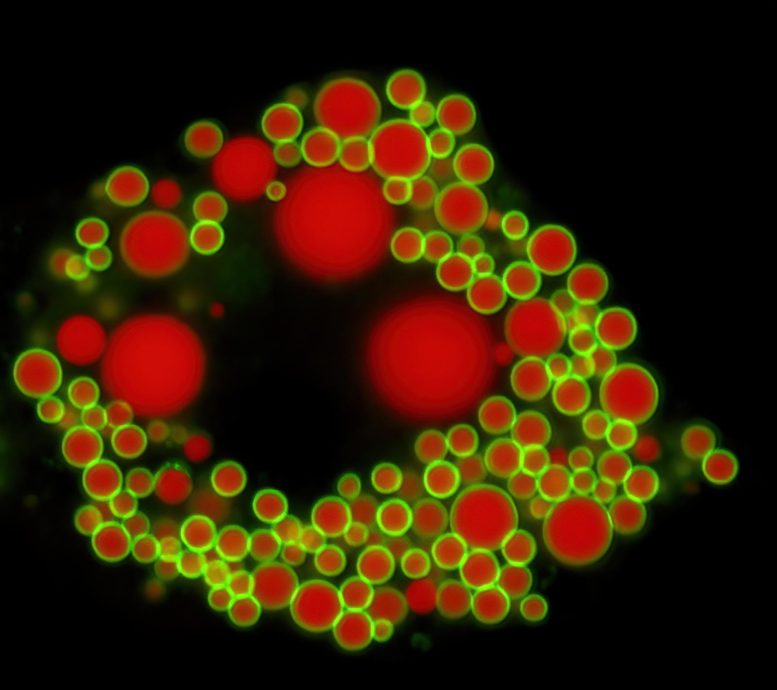
The Study Offers the First Precise Understanding of Crucial Remodeling Processes in Adipose Tissue
Fat cells utilize fat molecules as a means of energy storage. These molecules are comprised of three fatty acids attached to a glycerol backbone, and are commonly referred to as triglycerides. It has been long believed that these molecules undergo constant change during storage, being regularly broken down and reconstructed – a process known as “triglyceride cycling.” But is this assumption true, and if so, what is the purpose of this process?
“Until now, there has been no real answer to these questions,” explains Prof. Dr. Christoph Thiele of the LIMES Institute at the University of Bonn. “It’s true that there has been indirect evidence of this permanent reconstruction for the past 50 years. However, direct evidence of this has so far been lacking.”
The problem: To prove that triglycerides are broken down, and fatty acids modified and reincorporated into new molecules, one would need to track their transformation as they travel through the body. Yet there are thousands of different forms of triglycerides in each cell. Keeping track of individual fatty acids is therefore extremely difficult.
Label Makes Fatty Acids Unmistakable
“However, we have developed a method that allows us to attach a special label to fatty acids, making them unmistakable,” says Thiele. His research group labeled various fatty acids in this way and added them in a nutrient medium to mouse fat cells. The mouse cells then incorporated the labeled molecules into triglycerides.
“We were able to show that these triglycerides do not remain unchanged, but are continuously degraded and remodeled: Each fatty acid is split off about twice a day and reattached to another fat molecule,” the researcher explains.
But why is that? After all, this conversion costs energy, which is released as waste heat – what does the cell get out of it? Until now, it was thought that the cell needed this process to balance energy storage and supply. Or perhaps it is simply a way for the body to generate heat.
“Our results now point to a completely different explanation,” Thiele explains. “It’s possible that in the course of this process, the fats are converted to what the body needs.”
Poorly utilizable fatty acids would consequently be refined into higher-quality variants and stored in this form until they are needed.
Fatty acids consist largely of carbon atoms, which hang one behind the other like the carriages of a train. Their length can be very different: Some consist of only ten carbon atoms, others of 16 or even more. In their study, the researchers produced three different fatty acids and labeled them. One of them was eleven, the second 16, and the third 18 carbon atoms long.
“These chain lengths are typically found in food as well,” Thiele explains.
Short Fatty Acids Are Eliminated, Long Ones “Improved”
Labeling allowed the researchers to track exactly what happens to the fatty acids of different lengths in the cell. This showed that the fatty acids consisting of eleven carbon atoms were initially incorporated into triglycerides. After a short time, however, they were split off again and channeled out of the cell. After two days, they were no longer detectable. “Such shorter fatty acids are poorly usable by cells and can even damage them,” says Thiele, who is also a member of the Cluster of Excellence ImmunoSensation2. “Therefore, they are disposed of quickly.”
In contrast, the 16- and 18-atom fatty acids remained in the cell, although not in their original fat molecules. They were also gradually chemically modified, for example by additional carbon atoms being inserted. In the original fatty acids, the carbon atoms were moreover linked with single bonds – roughly like a human chain in which neighbors join hands. Over time, this sometimes developed into double bonds – as if revelers at a party were doing a conga. The fatty acids that are formed in this process are called unsaturated. They are better utilizable for the body.
“Overall, in this way the cells produce fatty acids that are more beneficial to the organism than those that we had originally supplied with the nutrient solution,” Thiele emphasizes. In the long term, this results for instance in the formation of oleic acid, a component of high-quality olive oil, from palmitate, such as that contained in palm fat. However, the cell cannot change the fatty acids as long as they are inside the fat molecule. They must first be split off, then modified, and finally tacked back on. Thiele: “Without triglyceride cycling, there is also no fatty acid modification.”
Adipose tissue can therefore improve triglycerides. If we eat and store food with unfavorable fatty acids, they do not have to be released in that state again when we are hungry. What we get back contains fewer “short” fatty acids, more oleic acid (instead of palmitate), and more of the important arachidonic acid (instead of linoleic acid). “Nevertheless, we should take care in our diet to consume high-quality dietary fats as much as possible,” the researcher stresses.
Because the refinement never works 100 percent. In addition, some of the fatty acids are not stored but used directly in the body. In the next step, the researchers now want to test whether the same processes occur in human adipose tissue as in individual mouse fat cells in the test tube. They also want to find out which enzymes make cycling work.
Reference: “Triglyceride cycling enables modification of stored fatty acids” by Klaus Wunderling, Jelena Zurkovic, Fabian Zink, Lars Kuerschner and Christoph Thiele, 3 April 2023, Nature Metabolism.
DOI: 10.1038/s42255-023-00769-z
The study was funded by the German Research Foundation (DFG).
Never miss a breakthrough: Join the SciTechDaily newsletter.
Follow us on Google and Google News.