
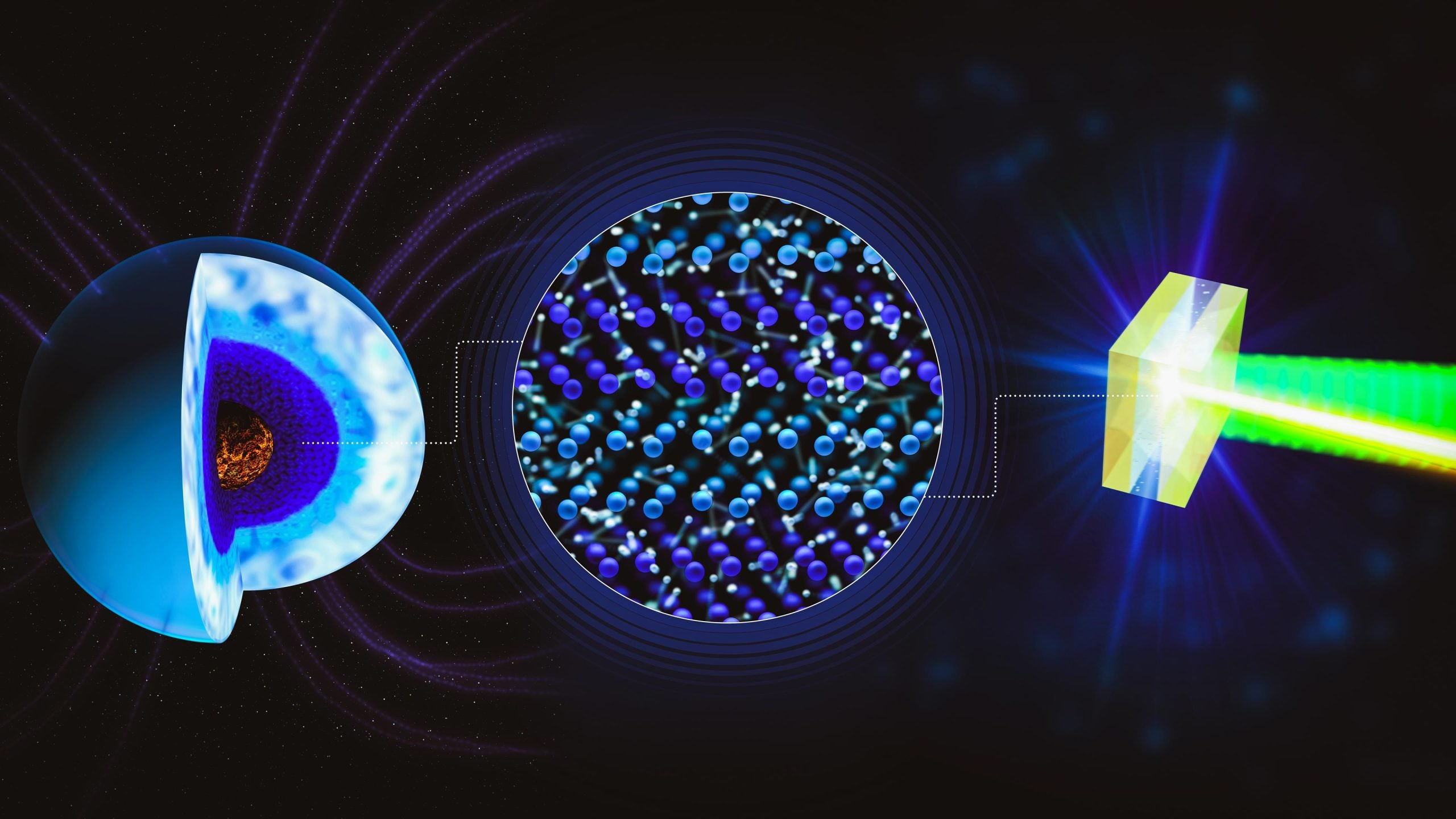
Under extreme planetary conditions, water turns into a strange, electricity-conducting solid hidden deep inside giant planets.
Superionic water forms only under some of the most intense conditions found in nature, with temperatures reaching several thousand degrees Celsius and pressures climbing to millions of atmospheres. Under these extremes, water enters an unusual state where oxygen atoms lock into a solid framework while hydrogen ions move freely through the structure.
Why Superionic Water Matters for Giant Planets
Because this phase allows electrical current to flow so efficiently, scientists link it to the unusual magnetic fields observed around ice giant planets. Uranus and Neptune are believed to contain enormous amounts of water deep within their interiors, raising the possibility that superionic water may be the most widespread form of water in the solar system.
A Longstanding Mystery About Atomic Structure
Superionic water has been created in laboratory experiments before, but its internal arrangement remained uncertain. Earlier studies proposed that the oxygen atoms might organize themselves into one of two cubic structures. These included a body-centered cubic pattern, with an atom located at the center of each cube, or a face-centered cubic pattern, with atoms positioned on the cube’s faces.
New Experiments Reveal a More Complicated Picture
The latest research shows that the reality is far more complex. Instead of forming a single orderly pattern, superionic water contains a mix of face-centered cubic regions and hexagonal close-packed layers. In the hexagonal regions, atoms stack tightly in repeating six-sided patterns. When these different arrangements overlap, they produce widespread structural irregularities. Rather than a clean, repeating lattice, the oxygen atoms form a hybrid and disordered sequence that can only be detected using extremely precise measurements from advanced X-ray lasers.
Recreating Planetary Conditions in the Laboratory
To uncover these details, researchers carried out two major experiments. One took place at the Matter in Extreme Conditions (MEC) instrument at LCLS in the US, and the other was conducted at the HED-HIBEF instrument at European XFEL. These facilities allowed scientists to compress water beyond 1.5 million atmospheres and heat it to several thousand degrees Celsius, while capturing snapshots of its atomic structure within trillionths of a second.
What This Discovery Reveals About Water and Planets
The findings closely match results from the most advanced computer simulations and show that superionic water can adopt multiple structural forms. This behavior mirrors that of ordinary ice, which is known to exist in many crystal structures depending on temperature and pressure. The work highlights that water—despite its apparent simplicity—continues to exhibit surprising and complex behavior under extreme conditions. The results also provide important limits for improving models of the internal structure and evolution of ice giant planets, which are thought to be common throughout the universe.
The project was supported through a joint initiative between the German Research Foundation (DFG) and the French research funding agency ANR. More than 60 scientists from Europe and the US contributed to the experiments and analysis.
Reference: “Observation of a mixed close-packed structure in superionic water” by L. Andriambariarijaona, M. G. Stevenson, M. Bethkenhagen, L. Lecherbourg, F. Lefèvre, T. Vinci, K. Appel, C. Baehtz, A. Benuzzi-Mounaix, A. Bergermann, D. Bespalov, E. Brambrink, T. E. Cowan, E. Cunningham, A. Descamps, S. Di Dio Cafiso, G. Dyer, L. B. Fletcher, M. French, M. Frost, E. Galtier, A. E. Gleason, S. H. Glenzer, G. D. Glenn, Y. Guarnelli, N. J. Hartley, Z. He, M.-L. Herbert, J.-A. Hernandez, B. Heuser, H. Höppner, O. S. Humphries, R. Husband, D. Khaghani, Z. Konôpková, J. Kuhlke, A. Laso Garcia, H. J. Lee, B. Lindqvist, J. Lütgert, W. Lynn, M. Masruri, P. May, E. E. McBride, B. Nagler, M. Nakatsutsumi, J.-P. Naedler, B. K. Ofori-Okai, S. Pandolfi, A. Pelka, T. R. Preston, C. Qu, L. Randolph, D. Ranjan, R. Redmer, J. Rips, C. Schoenwaelder, S. Schumacher, A. K. Schuster, J.-P. Schwinkendorf, C. Strohm, M. Tang, T. Toncian, K. Voigt, J. Vorberger, U. Zastrau, D. Kraus and A. Ravasio, 7 December 2025, Nature Communications.
DOI: 10.1038/s41467-025-67063-2
The project was supported as part of a joint initiative between the German Research Foundation (DFG) and the French research funding agency ANR. More than 60 scientists from Europe and the US were involved in the experiments and evaluation.
Never miss a breakthrough: Join the SciTechDaily newsletter.
Follow us on Google and Google News.
2 Comments
A Longstanding Mystery About Atomic Structure. Under extreme planetary conditions, water turns into a strange, electricity-conducting solid hidden deep inside giant planets.
WHY?
The pseudo scientific theories in physics today are leading researchers’ cognition astray.
Example 1: There are even more ridiculous facts and glorious achievements than what you said. For example,two sets of cobalt-60 are manually rotated in opposite directions, and even without detection, people around the world know that they will not be symmetrical because these two objects are not mirror images of each other at all. However, a group of so-called physicists and so-called academic publications do not believe it. They conducted experiments and the results were indeed asymmetric, but they still firmly believed that these two objects were mirror images of each other, and the asymmetry was due to a violation of the previous natural laws (CP violation). In the history of science, there can never be a dirtier and uglier operation and explanation than this. These people and the so-called academic publications they manipulate no longer know what shame is.
https://scitechdaily.com/what-happens-when-light-gains-extra-dimensions/#comment-947619.
Example 2: Please see how the so-called “mystery of θ – τ” is explained: θ and τ are completely identical in all measurable physical properties such as mass, lifetime, charge, spin, etc. However, experimental observations have shown that the θ meson decays into two π mesons, while the τ meson decays into three π mesons, making it difficult for physicists to explain why they are so similar. Physicist Martin Block proposed a highly challenging idea: θ and τ are the same particle, but in weak interactions, parity is not conserved. An easy to understand explanation is the following analogy:: There are two boxes of apples with identical weight, color, and taste. However, when one box is opened, there are two apples, while when the other box is opened, there are three apples. This confuses the old farmer who buys apples. He circled around the orchard and came up with a highly challenging idea: these two boxes of apples are not from the same tree, so they are the same.
—— Excerpted from https://scitechdaily.com/what-happens-when-light-gains-extra-dimensions/#comment-947686.