
Close Menu
    Facebook X (Twitter) Instagram
    SciTechDaily
    • Biology
    • Chemistry
    • Earth
    • Health
    • Physics
    • Science
    • Space
    • Technology
    Facebook X (Twitter) Pinterest YouTube RSS
    SciTechDaily
    Home»Physics»Mesmerizing: Watch Water Droplets Merge on the International Space Station
    Physics

    Mesmerizing: Watch Water Droplets Merge on the International Space Station

    By American Institute of PhysicsDecember 27, 20223 Comments3 Mins Read
    Facebook Twitter Pinterest Telegram LinkedIn WhatsApp Email Reddit
    Share
    Facebook Twitter LinkedIn Pinterest Telegram Email Reddit
    Water Droplets Merge in Space
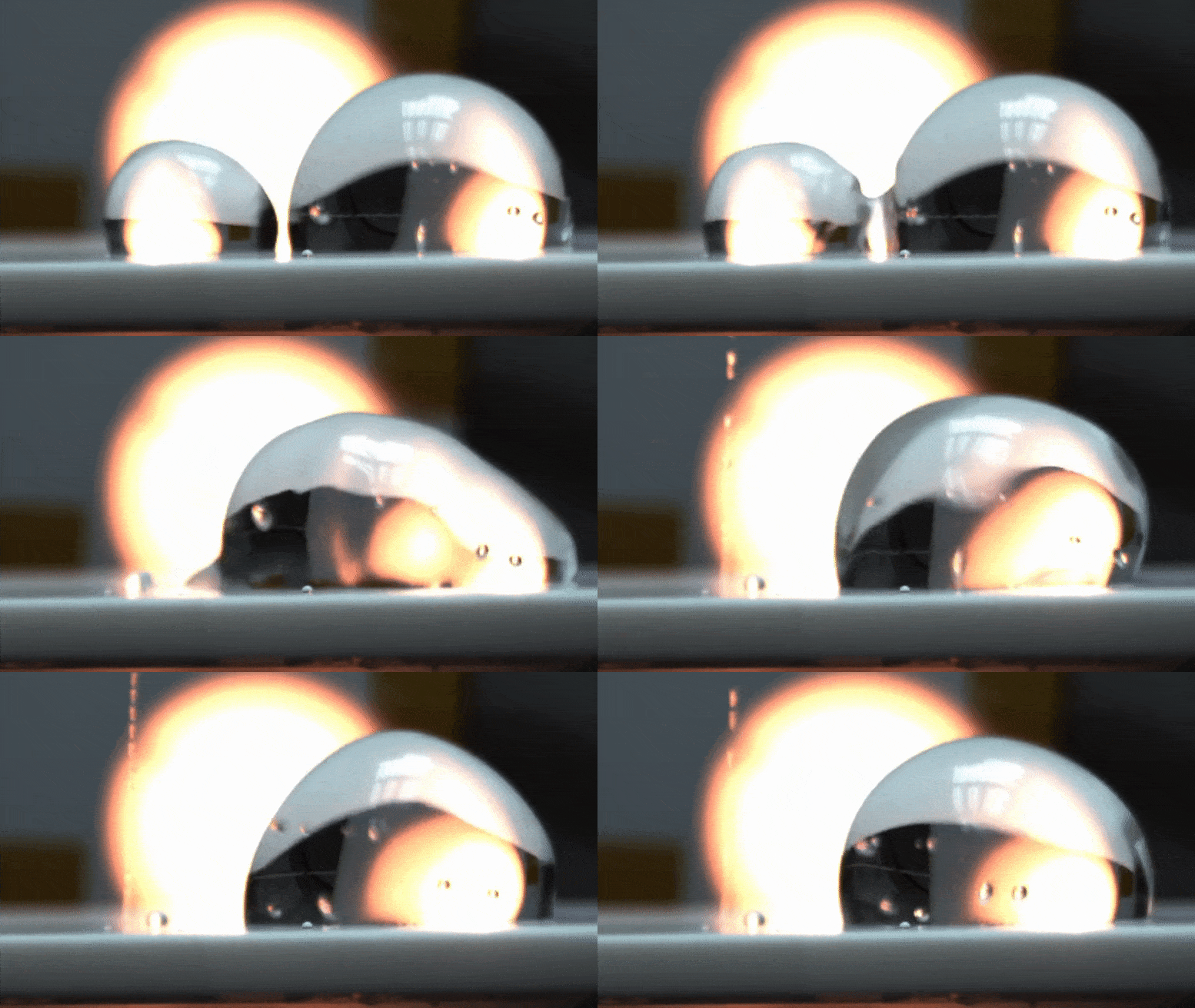
    Droplets (on the centimeter scale) merge during an experiment on the International Space Station. Credit: Josh McCraney

    Scientists designed and analyzed water droplet experiments that were conducted on the International Space Station.

    Understanding how water droplets spread and coalesce is essential for scenarios in everyday life, such as raindrops falling off cars, planes, and roofs, and for applications in energy generation, aerospace engineering, and microscale cell adhesion. However, these phenomena are difficult to model and challenging to observe experimentally.

    In Physics of Fluids, by AIP Publishing, researchers from Cornell University and Clemson University designed and analyzed droplet experiments that were done on the International Space Station (ISS).

    Droplets usually appear as small spherical caps of water because their surface tension exceeds gravity.

    “If the drops get much larger, they begin to lose their spherical shape, and gravity squishes them into something more like puddles,” said author Josh McCraney of Cornell University. “If we want to analyze drops on Earth, we need to do it at a very small scale.”

    Advantages of Conducting Experiments in Space

    But at small scales, droplets dynamics are too fast to observe. Hence, the ISS. The lower gravity in space means the team could investigate larger droplets, moving from a couple millimeters in diameter to 10 times that length.


    Droplets (on the centimeter scale) merge during an experiment on the International Space Station. Credit: Josh McCraney

    The researchers sent four different surfaces with various roughness properties to the ISS, where they were mounted to a lab table. Cameras recorded the droplets as they spread and merged.

    “NASA astronauts Kathleen Rubins and Michael Hopkins would deposit a single drop of desired size at a central location on the surface. This drop is near, but not touching, a small porthole pre-drilled into the surface,” said McCraney. “The astronaut then injected water through the porthole, which collects and essentially grows an adjacent drop. Injection continues until the two drops touch, at which point they coalesce.”

    Testing the Davis-Hocking Model

    The experiments aimed to test the Davis-Hocking model, a simple way to simulate droplets. If a droplet of water sits on a surface, part of it touches the air and creates an interface, while the section in contact with the surface forms an edge or contact line. The Davis-Hocking model describes the equation for the contact line. The experimental results confirmed and expanded the parameter space of the Davis-Hocking model.

    As the original principal investigator of the project, the late professor Paul Steen of Cornell University had written grants, traveled to collaborators worldwide, trained doctoral students, and meticulously analyzed related terrestrial studies, all with the desire to see his work successfully conducted aboard the ISS. Tragically, Steen died only months before his experiments launched.

    “While it’s tragic he isn’t here to see the results, we hope this work makes him and his family proud,” said McCraney.

    Reference: “Coalescence-induced droplet spreading: Experiments aboard the International Space Station” by J. McCraney, J. Ludwicki, J. Bostwick, S. Daniel and P. Steen, 13 December 2022, Physics of Fluids.
    DOI: 10.1063/5.0125279

    Never miss a breakthrough: Join the SciTechDaily newsletter.
    Follow us on Google and Google News.

    American Institute of Physics Fluid Dynamics Fluid Mechanics Space Station Water
    Share. Facebook Twitter Pinterest LinkedIn Email Reddit

    Related Articles

    The Science Behind Skipping Stones: Gateway to Marine Engineering Advances

    Sizzling Sound of Deep-Frying Reveals Complex Physics of Vapor Cavities

    Simulations Reveal Fundamental Insights on Janus Particles

    Owl Wing Design With Serrated Edges Reduces Aircraft, Wind Turbine Noise Pollution

    Using Ice To Boil Water: Heat Transfer Discovery Expands on 18th Century Physics Principle

    Complex Fluid Dynamics May Explain Hydroplaning Phenomenon

    Yikes! Flushing Toilets Create Long-Lasting Clouds of Virus-Containing Particles

    Laser Doppler Velocimetry Delivers New Insights Into Mysterious Fluid Motions

    Galileo’s Jupiter Entry Probe Vaporized – New Gaps Revealed in Heat Shield Modeling

    3 Comments

    1. Corby on December 27, 2022 2:28 pm

      But why is it so mesmerizing ?…

      Reply
    2. Mickey on December 29, 2022 12:35 pm

      Looks like the larger droplet reaches out and “eats” the smaller droplet.

      Reply
    3. xABBAAA on January 21, 2023 1:06 am

      … the big one is eating the smaller one…

      Reply
    Leave A Reply Cancel Reply

    • Facebook
    • Twitter
    • Pinterest
    • YouTube

    Don't Miss a Discovery

    Subscribe for the Latest in Science & Tech!

    Trending News

    Scientists Uncover Potential Brain Risks of Popular Fish Oil Supplements

    Scientists Discover a Surprising Way To Make Bread Healthier and More Nutritious

    After 60 Years, Scientists Uncover Unexpected Brain Effects of Popular Diabetes Drug Metformin

    New Research Uncovers Hidden Side Effects of Popular Weight-Loss Drugs

    Scientists Rethink Extreme Warming After Surprising Ocean Discovery

    Landmark Study Links Never Marrying to Significantly Higher Cancer Risk

    Researchers Discover Unknown Beetle Species Just Steps From Their Lab

    Largest-Ever Study Finds Medicinal Cannabis Ineffective for Anxiety, Depression, PTSD

    Follow SciTechDaily
    • Facebook
    • Twitter
    • YouTube
    • Pinterest
    • Newsletter
    • RSS
    SciTech News
    • Biology News
    • Chemistry News
    • Earth News
    • Health News
    • Physics News
    • Science News
    • Space News
    • Technology News
    Recent Posts
    • Students Build Dark Matter Detector and Set New Experimental Limits
    • Scientists Discover Caffeine Can Repair Key Memory Circuits After Sleep Loss
    • Strange 65-Foot Dinosaur Discovered in Argentina
    • Researchers Uncover Source of Strange Deformation in Earth’s Largest Continental Rift
    • Scientists Solve Mystery of Where the Colorado River Vanished Millions of Years Ago
    Copyright © 1998 - 2026 SciTechDaily. All Rights Reserved.
    • Science News
    • About
    • Contact
    • Editorial Board
    • Privacy Policy
    • Terms of Use

    Type above and press Enter to search. Press Esc to cancel.