
Close Menu
    Facebook X (Twitter) Instagram
    SciTechDaily
    • Biology
    • Chemistry
    • Earth
    • Health
    • Physics
    • Science
    • Space
    • Technology
    Facebook X (Twitter) Pinterest YouTube RSS
    SciTechDaily
    Home»Earth»Is the Brunt Ice Shelf in Antarctica on the Brink?
    Earth

    Is the Brunt Ice Shelf in Antarctica on the Brink?

    By European Space Agency (ESA)February 19, 20214 Comments5 Mins Read
    Facebook Twitter Pinterest Telegram LinkedIn WhatsApp Email Reddit
    Share
    Facebook Twitter LinkedIn Pinterest Telegram Email Reddit
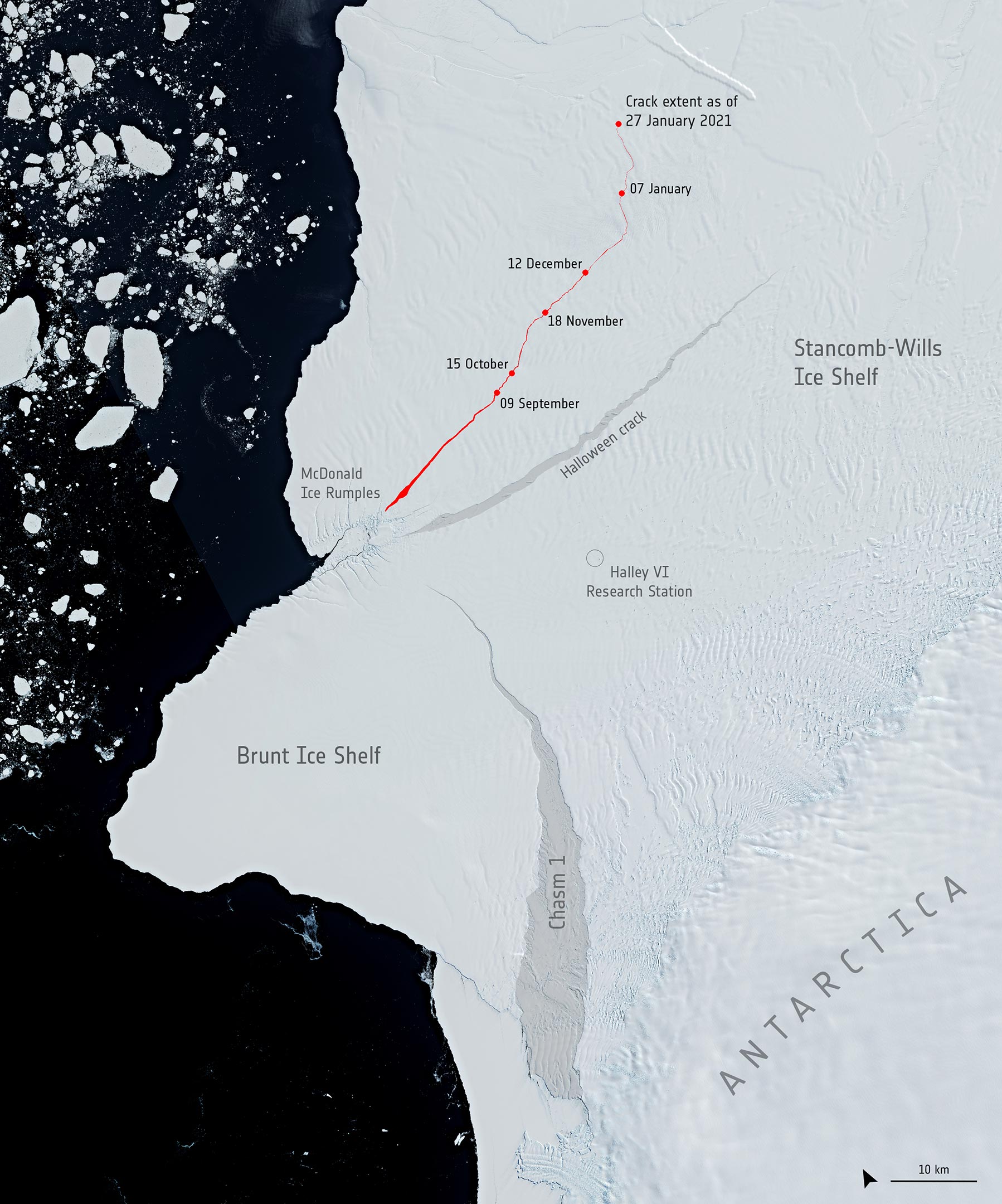
    Brunt Ice Shelf New Crack
    A new crack has been spotted in the portion of the floating ice shelf north of the McDonald Ice Rumples, which may prompt the calving of multiple bergs. The extent of this new crack can be seen at the top of the image. The temporal change locations of the new crack come from visual interpretation of Copernicus Sentinel-1 and Sentinel-2 images. The lengthening of the other two main cracks in the ice shelf, separated only by a few kilometers, have been closely monitored by satellite imagery. Chasm 1, the large crack running northwards has been set in place for more than 25 years, while the Halloween crack was first spotted on 31 October 2016. Credit: Contains modified Copernicus Sentinel data (2021), CC BY-SA 3.0 IGO

    Antarctica’s Brunt Ice Shelf may soon calve one or more large icebergs, as satellite data shows rapid crack growth and ice movement of up to 5 meters daily.

    In early 2019, all eyes were fixed on the Brunt Ice Shelf in Antarctica, where a massive iceberg, around the size of Greater London, appeared poised to break off. Almost two years later, the berg is desperately clinging on, although current data indicate calving is imminent. A new crack, spotted in images captured by the Copernicus Sentinel missions, now suggests the potential for calving of multiple bergs.

    For years, glaciologists have been tracking a number of cracks in the Brunt Ice Shelf, which borders the Coats Land coast in the Weddell Sea sector of Antarctica. The lengthening of two main cracks in the ice shelf, separated only by a few kilometers, has been closely monitored by satellite imagery. Chasm 1, the large crack running northwards from the southernmost part of Brunt, has been set in place for more than 25 years, while the Halloween crack was first spotted on October 31, 2016.

    A more recent, unnamed crack was first noticed in observations from the Copernicus Sentinel-1 mission in late 2019, recently extending by more than 20 km (12 mi) in length. Satellite data has also been used to track the movement and measure the resulting strain in the ice shelf. The map below shows the ice surface velocity on the Brunt and Stancomb-Wills Ice Shelf complex, derived by comparing two Sentinel-1 acquisitions captured on January 5 and January 17, 2021.
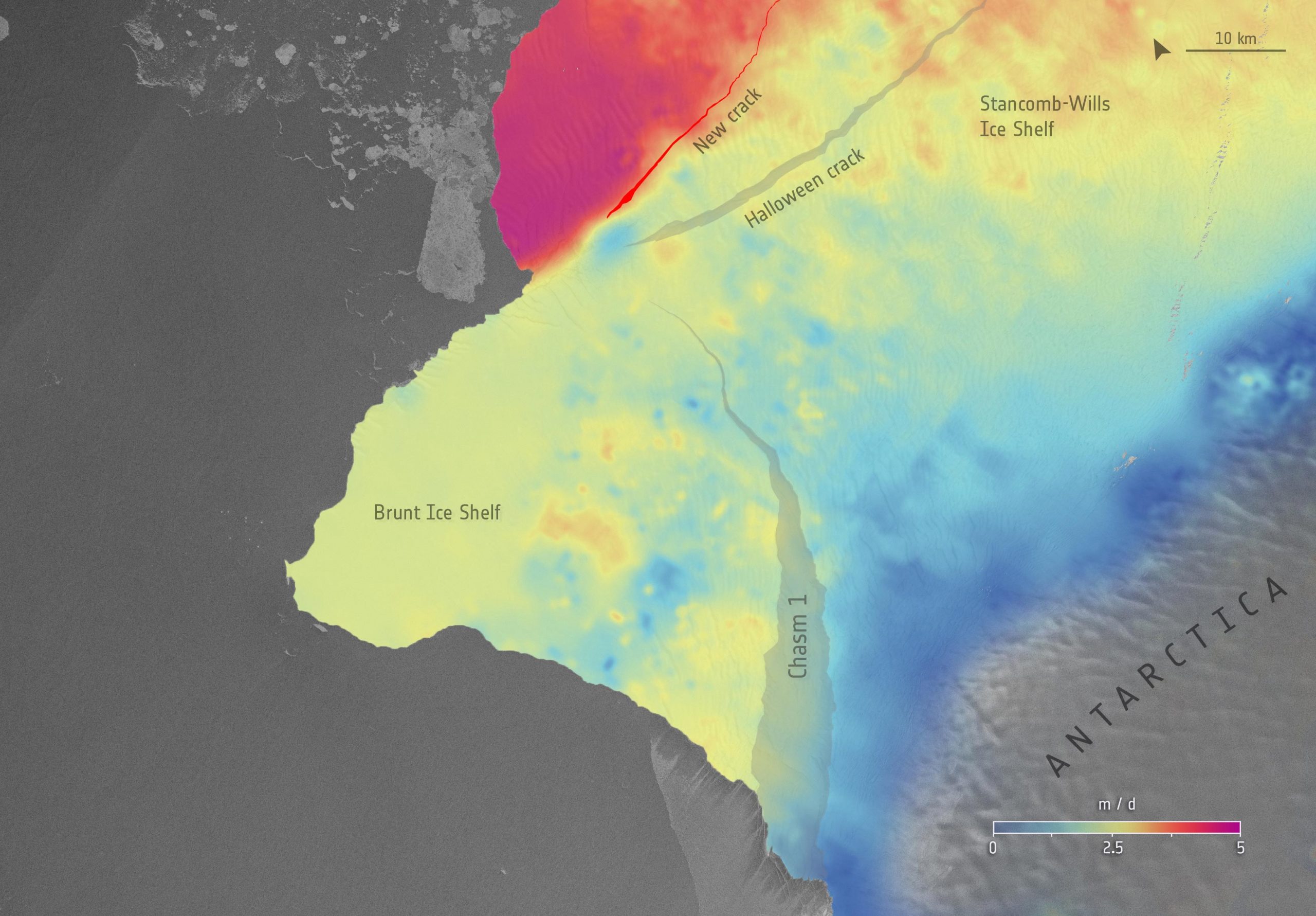
    Brunt and Stancomb Wills Ice Shelf Ice Velocity Map
    Satellite data has been used to measure the surface movement of the ice shelf. The map shows the ice surface velocity on the Brunt Ice Shelf, derived by comparing two Copernicus Sentinel-1 acquisitions captured on January 5 and January 17, 2021. The surface velocity data suggest the upper red area, northwest of the new crack, to be the most unstable, with an approximate movement of almost 5 m per day. The central portion has an average velocity ranging from 2 to 2.5 m per day, while the lower area (visible in blue) suggests a more stable zone of the ice shelf in the vicinity of the coastal grounded ice. Credit: Contains modified Copernicus Sentinel data (2021), CC BY-SA 3.0 IGO

    Satellite Data Reveals Ice Shelf Dynamics

    The data indicate the region of the floating ice shelf, to the north of the new crack, to be the most unstable, with an approximate movement of almost 5 m (16 ft) per day. The central portion has an average velocity ranging from 2 to 2.5 m (6.6 to 8.2 ft) per day, while the lower area (visible in blue) suggests a more stable zone of the ice shelf.

    “Though appearing poised to calve in 2019, the south westernmost region of the Brunt Ice Shelf tenaciously resisted separation,” noted ESA’s Mark Drinkwater. “Since then, Sentinel-1 data indicate the nose of the ice shelf to be pivoting clockwise around the McDonald Ice Rumples region in which point the shelf ice is grounded on shallow underwater topography.”

    “Meanwhile, the strong gradient in ice velocity towards the faster moving Stancomb-Wills ice stream, and ice shelf in the north, has activated a new rift which now threatens the release of a second large iceberg.”
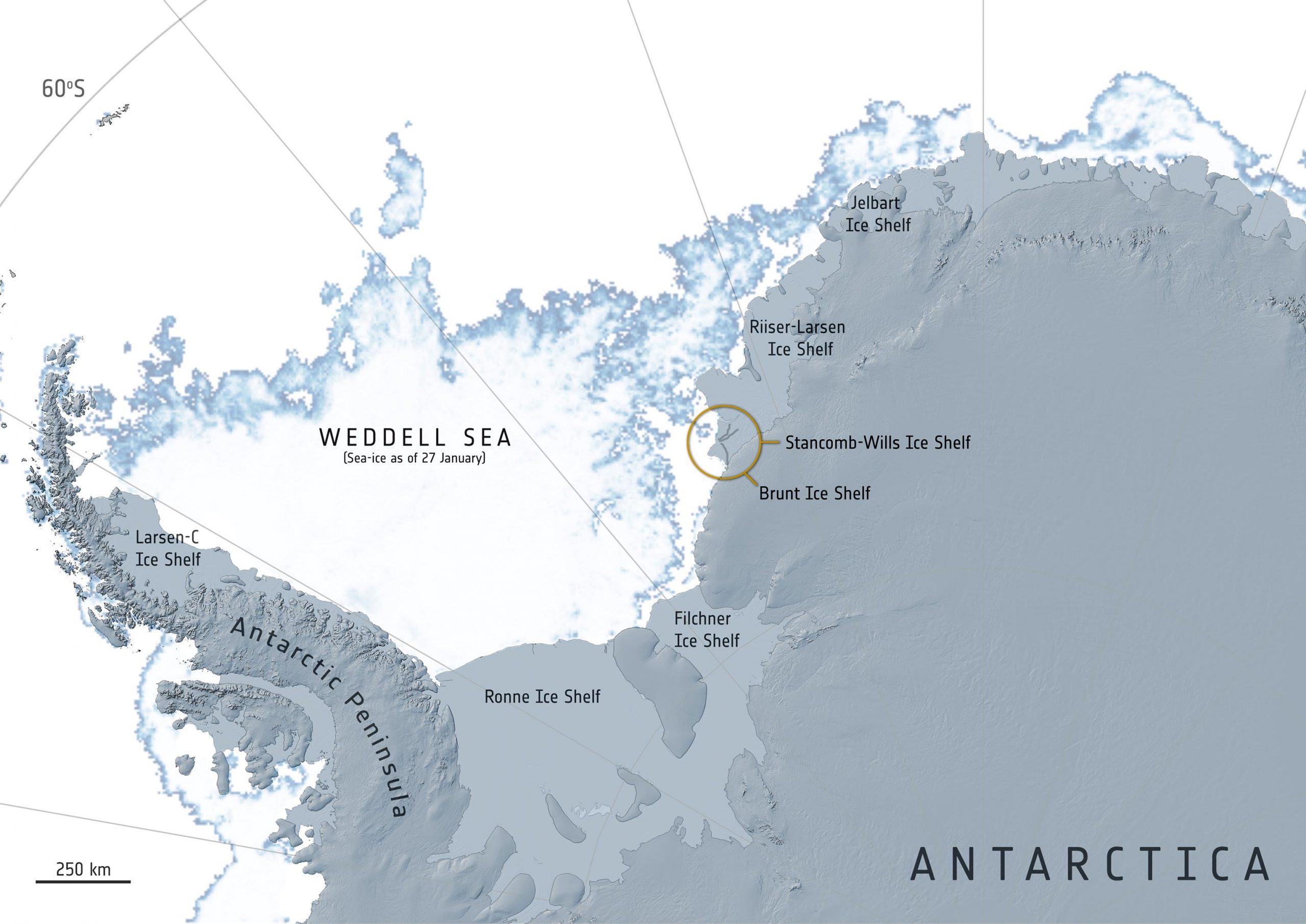
    Location of Brunt Ice Shelf
    Location of the Brunt Ice Shelf. The Brunt Ice Shelf borders the Coats Land coast in the Weddell Sea sector of Antarctica. Credit: ESA (Data sources: JAXA/University of Bremen/BAS)

    Routine monitoring from satellites offers unprecedented views of events happening in remote regions, and show how ice shelves are responding to changes in ice dynamics, air and ocean temperatures. During the dark winter months in Antarctica, radar images are indispensable because, apart from the region being remote, radar continues to deliver images regardless of the dark weather.

    Mark Drinkwater continued, “With today’s Copernicus monitoring system, we are far better equipped not only to observe events in remote places like Antarctica in near real time, but more importantly, to turn this scientific data into theoretical understanding of complex ice fracture processes.”

    History shows that the last major event took on the Brunt Ice Shelf took place in 1971, when a portion of ice calved north of the area known as the McDonald Ice Rumples in what appears to be replicated by today’s Halloween Crack.

    With the ice shelf deemed unsafe due to the encroaching cracks in 2017, the British Antarctic Survey closed up their Halley VI research station, and re-positioned south of Halloween Crack to a more secure location. Operational since 2012, Halley VI is made up of eight interlinked pods built on skis. This allows the pods to be easily moved in case of unstable ice and cracks on the ice shelf.

    Never miss a breakthrough: Join the SciTechDaily newsletter.
    Follow us on Google and Google News.

    Antarctica European Space Agency
    Share. Facebook Twitter Pinterest LinkedIn Email Reddit

    Related Articles

    Massive Iceberg – 10 Times the Size of San Francisco – Breaks Off Brunt Ice Shelf in Antarctica

    Ozone Hole Over the Antarctic Is One of the Largest and Deepest in Recent Years

    Disintegration Fears Grow As Worsening Rifts and Fractures Spotted at Two of Antarctica’s Most Important Glaciers

    “Worst-Case Climate Scenario” – Ice Sheets in Greenland and Antarctica Loss Rates Rapidly Increasing

    After Four Months of Darkness, the Sun Finally Rises at Concordia Research Station

    Worst-Case Climate Change Scenario: Greenland and Antarctica Losing Ice 6x Faster Than Expected

    Massive Iceberg 5 Times Larger Than Manhattan Shatters Into Pieces – Satellite Video

    CryoSat Discovers Antarctica’s Biggest Glacier’s Ice Loss Pattern Is Evolving

    GOCE Gravity Mapper Reveals What’s Going on Deep Below Antarctica

    4 Comments

    1. Clyde Spencer on February 19, 2021 8:20 am

      “Dark weather?” That is an unusual expression!

      Reply
    2. Caesar on February 19, 2021 8:22 pm

      I can only hope . #Learntoswim

      Reply
    3. Bill on February 23, 2021 12:30 pm

      Find this article on Antarctica ice shelf of interest, but weak, as the earth and all its complexities over billions of years is not calculable for specific outcomes, as rising oceans or or global climate shift. It appears that climate variability is more the norm than the exception. However appreciate the scientific endeavor for a more comprehensive understanding

      Reply
    4. Brandon on March 8, 2021 6:29 am

      Ice brake up sized 0f Germany off antarctic global warming

      Reply
    Leave A Reply Cancel Reply

    • Facebook
    • Twitter
    • Pinterest
    • YouTube

    Don't Miss a Discovery

    Subscribe for the Latest in Science & Tech!

    Trending News

    Largest-Ever Study Finds Medicinal Cannabis Ineffective for Anxiety, Depression, PTSD

    250-Million-Year-Old Egg Solves One of Evolution’s Biggest Mysteries

    Living With Roommates Might Be Changing Your Gut Microbiome Without You Knowing

    Century-Old Cleaning Chemical Linked to 500% Increased Risk of Parkinson’s Disease

    What if Your Memories Never Happened? Physicists Take a New Look at the Boltzmann Brain Paradox

    One of the Universe’s Largest Stars May Be Getting Ready To Explode

    Scientists Discover Enzyme That Could Supercharge Ozempic-Like Weight Loss Drugs

    Popular Sweetener Linked to DNA Damage – “It’s Something You Should Not Be Eating”

    Follow SciTechDaily
    • Facebook
    • Twitter
    • YouTube
    • Pinterest
    • Newsletter
    • RSS
    SciTech News
    • Biology News
    • Chemistry News
    • Earth News
    • Health News
    • Physics News
    • Science News
    • Space News
    • Technology News
    Recent Posts
    • A Simpler Path to Super-Resolution: Scientists Reinvent Microscopy
    • Scientists Uncover Hidden Genetic Cause of Diabetes in Babies
    • Amazonian Chocolate Could Become the Next Superfood, Scientists Say
    • Challenging the Narrative: New Study Shows U.S. Life Expectancy Is Rising Across All States
    • Mystery Illness Kills 5 in Burundi As Doctors Scramble for Answers
    Copyright © 1998 - 2026 SciTechDaily. All Rights Reserved.
    • Science News
    • About
    • Contact
    • Editorial Board
    • Privacy Policy
    • Terms of Use

    Type above and press Enter to search. Press Esc to cancel.