
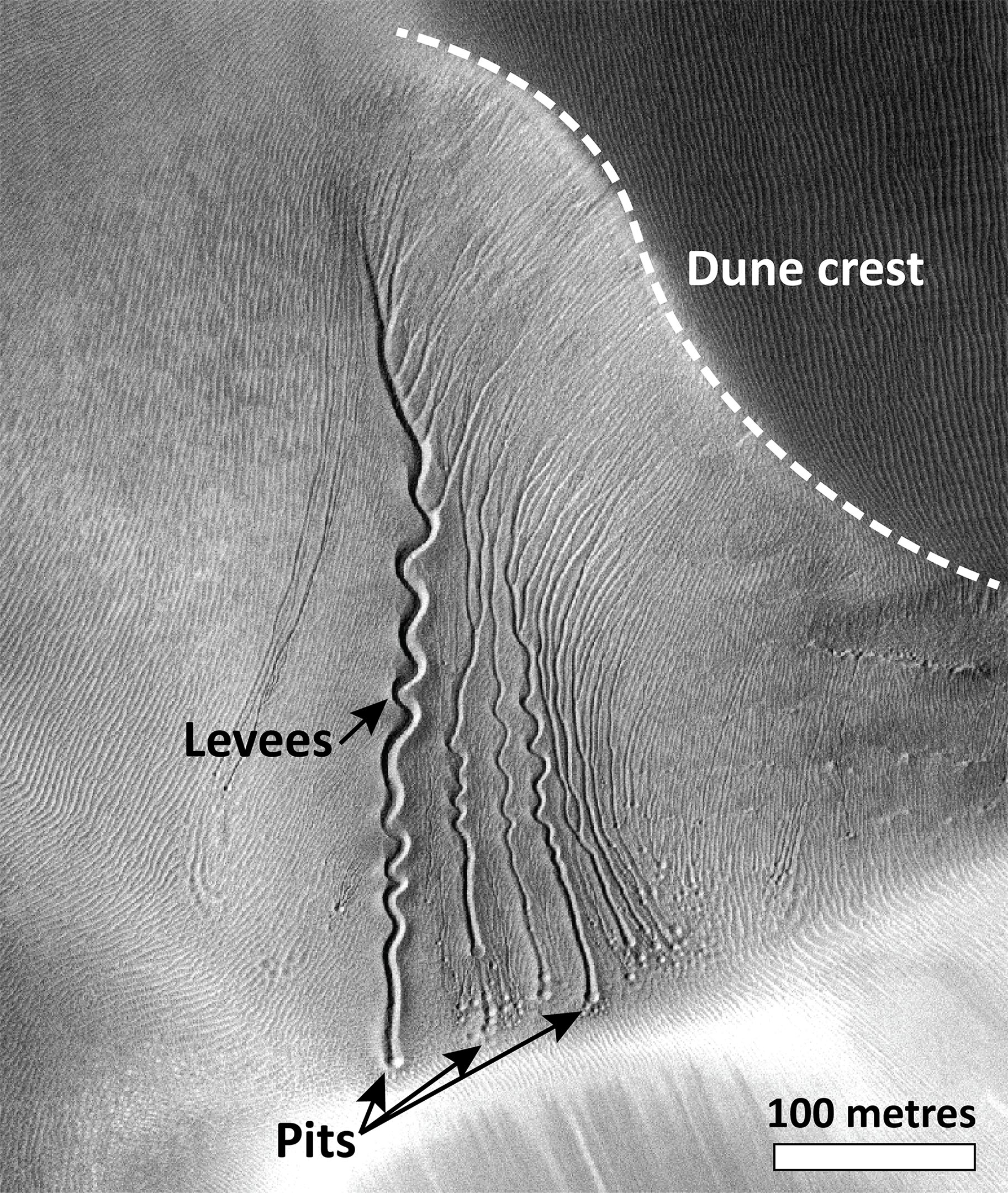
Blocks of frozen carbon dioxide sliding down Martian dunes may have carved the planet’s strange gullies, mimicking the work of living creatures.
In lab experiments, scientists recreated this process, showing how sublimating CO2 ice can blast and burrow through sand, forming deep trenches that match those seen on Mars. The findings reveal a powerful geological force that operates in a way never observed on Earth.
Did Life Shape Mars’ Mysterious Gullies?
Could Mars have once hosted life? So far, scientists have found no proof. Still, some features on the planet’s surface might look as if living organisms helped shape them. One such mystery is the network of strange gullies carved into Martian dunes. Earth scientist Dr. Lonneke Roelofs from Utrecht University set out to understand how these formations came to be.
In a laboratory setup, she watched blocks of frozen carbon dioxide (CO2 ice) dig into the sand on their own. “It felt like I was watching the sandworms in the film Dune,” she said. Her research has been published in Geophysical Research Letters.
For years, scientists suspected that CO2 ice might play a role in creating these gullies. Roelofs confirmed this idea through experiments that showed CO2 ice blocks actually burrowing into sand under Martian-like conditions. It is a process that does not occur naturally on Earth and had never been observed before.
Sublimation: The Explosive Force Beneath Martian Dunes
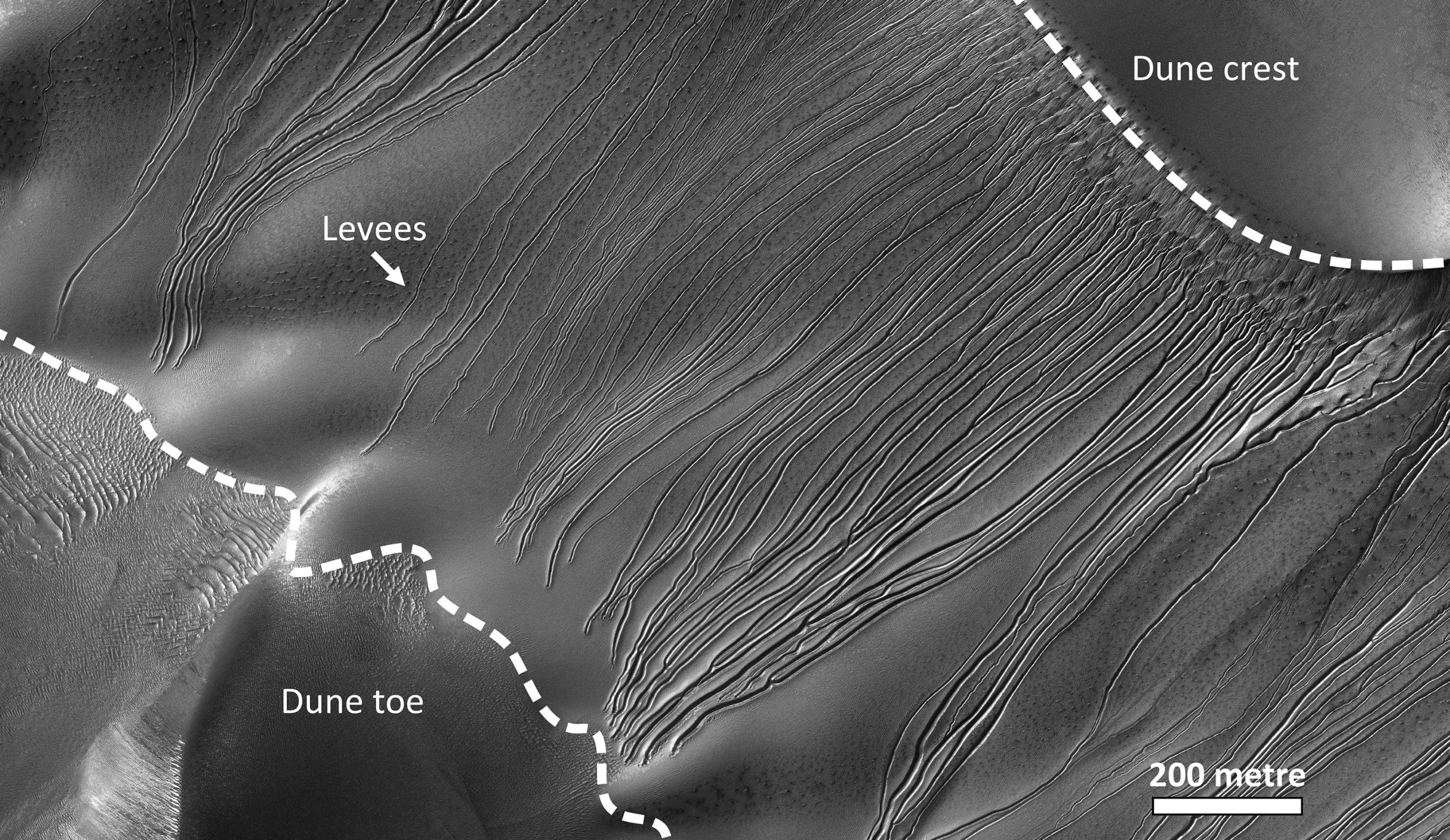
During the Martian winter, when temperatures drop to about minus 120 degrees Celsius, frost builds up on the planet’s dunes. As the season ends, sunlight warms the slopes, and chunks of ice—sometimes up to a metre long—break loose. Because Mars has a thin atmosphere and a sharp temperature contrast between the cold ice and warm sand, the underside of the ice rapidly turns into gas. This transformation, known as sublimation, causes pressure to build up as the gas expands to occupy much more space than the solid ice. The result is a kind of mini explosion.
“In our simulation, I saw how this high gas pressure blasts away the sand around the block in all directions,” says Roelofs. As a result, the block digs itself into the slope and becomes trapped in a hollow surrounded by small ridges of settled sand. “However, the sublimation process continues, and so the sand keeps on being blasted in all directions.” As the ice keeps vaporizing, it slowly slides downhill, carving a long, narrow trench bordered by small ridges. The shape and structure of these experimental gullies are nearly identical to those seen on Mars.
Tracing Mars’ Landscape Evolution
Lonneke Roelofs investigates the processes that form the landscape on the planet Mars. For example, last year she published her research into the sublimation of CO2 ice as a driver of Martian debris flows. These flows cut deep gullies on crater walls.
“But the gullies from this research looked different,” explains Roelofs. “Therefore, a different process was behind this, but which? That is what I set out to discover.”
Inside the Mars Chamber: Recreating Alien Terrain on Earth
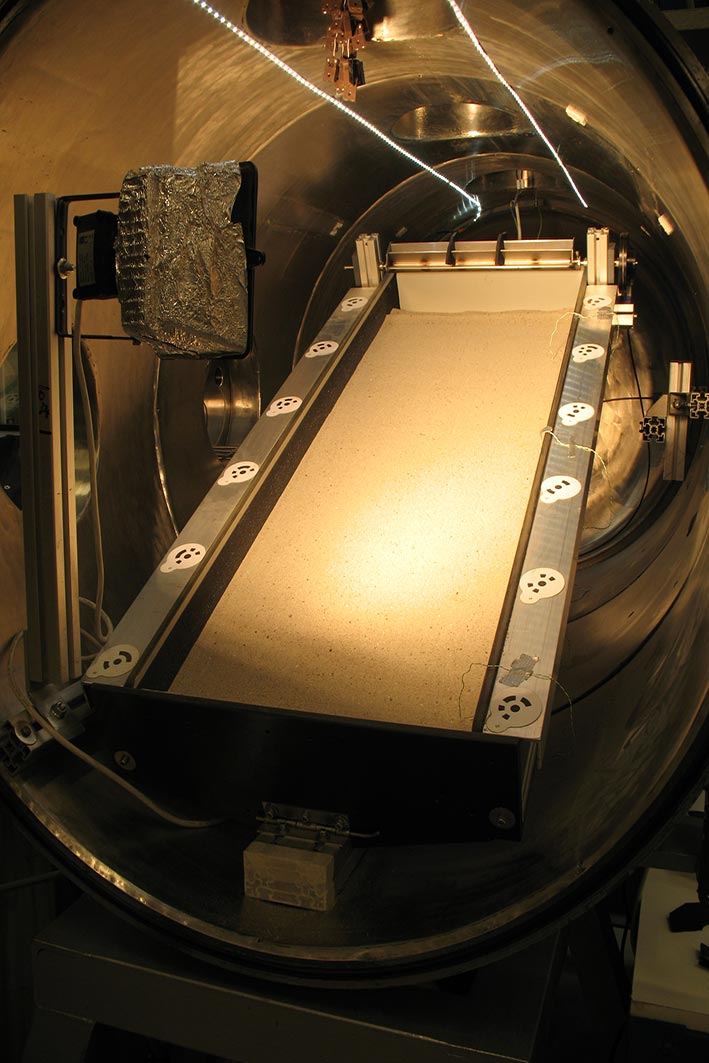
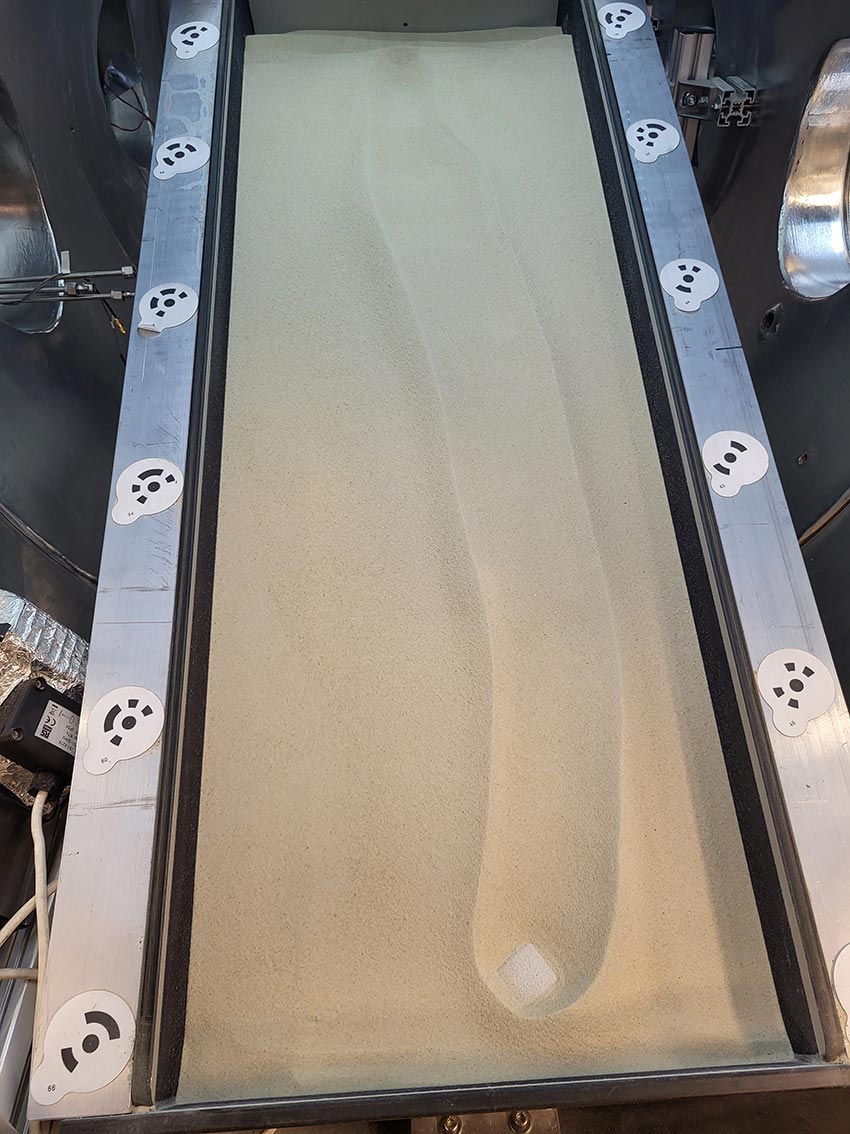
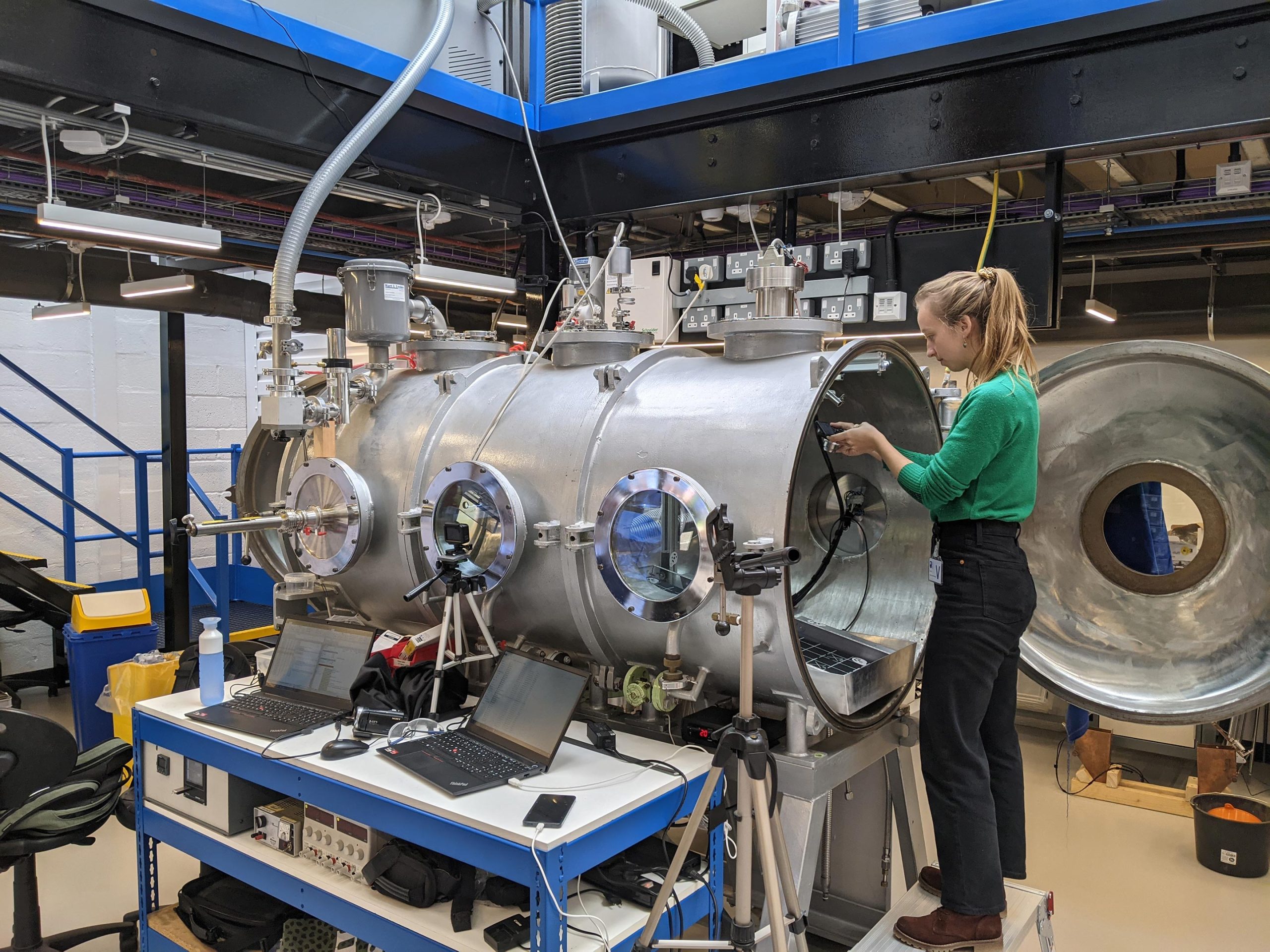
Together with master student Simone Visschers, she traveled to the English city of Milton Keynes to solve the mystery behind these unusual sand gullies. The Open University has a ‘Mars chamber’: a facility for simulating Martian conditions. Financial support from the British Society of Geomorphology made the visit possible. ”We tried out various things by simulating a dune slope at different angles of steepness. We let a block of CO2 ice fall from the top of the slope and observed what happened”, states the researcher. “After finding the right slope, we finally saw results. The CO2 ice block began to dig into the slope and move downwards just like a burrowing mole or the sandworms from Dune. It looked very strange!”
From Frozen Blocks to Sculpted Gullies
But how exactly do these blocks of ice form? “The CO2 ice blocks form on the desert dunes halfway down the southern hemisphere of Mars. During the winter, a layer of CO2 ice forms over the entire surface of the dune field, sometimes up to a thickness of 70 cm! In spring, this ice begins to warm up and sublimate. The last remnants of this ice are located on the shaded side of the dune tops, and that is where the blocks break off from once the temperature is high enough. Once the blocks reach the bottom of the slope and stop moving, the ice continues to sublimate until all the CO2 has evaporated. What remains is a hollow in the sand at the bottom of the dune.”
Why Mars Captures Our Imagination
Why does this planet fascinate people so much? “Mars is our nearest neighbor. It is the only rocky planet close to the ‘green zone’ of our solar system. This zone lies exactly far enough from the Sun to make the presence of liquid water possible, which is a prerequisite for life. Questions about the origin of life, and possible extra-terrestrial life, could therefore be solved here”, says Roelofs. “Also, conducting research into the formation of landscape structures of other planets is a way of stepping outside the frameworks used to think about the Earth. This allows you to pose slightly different questions, which in turn can deliver new insights for processes here on our planet.”
Reference: “Sliding and Burrowing Blocks of CO2 Create Sinuous “Linear Dune Gullies” on Martian Dunes by Explosive Sublimation-Induced Particle Transport” by Lonneke Roelofs, Simone R. Visschers, Susan J. Conway, Tjalling de Haas, Maarten G. Kleinhans, Sylvain Douté, Kelly Pasquon, Matthew E. Sylvest and Manish R. Patel, 8 October 2025, Geophysical Research Letters.
DOI: 10.1029/2024GL112860
Never miss a breakthrough: Join the SciTechDaily newsletter.
Follow us on Google and Google News.