
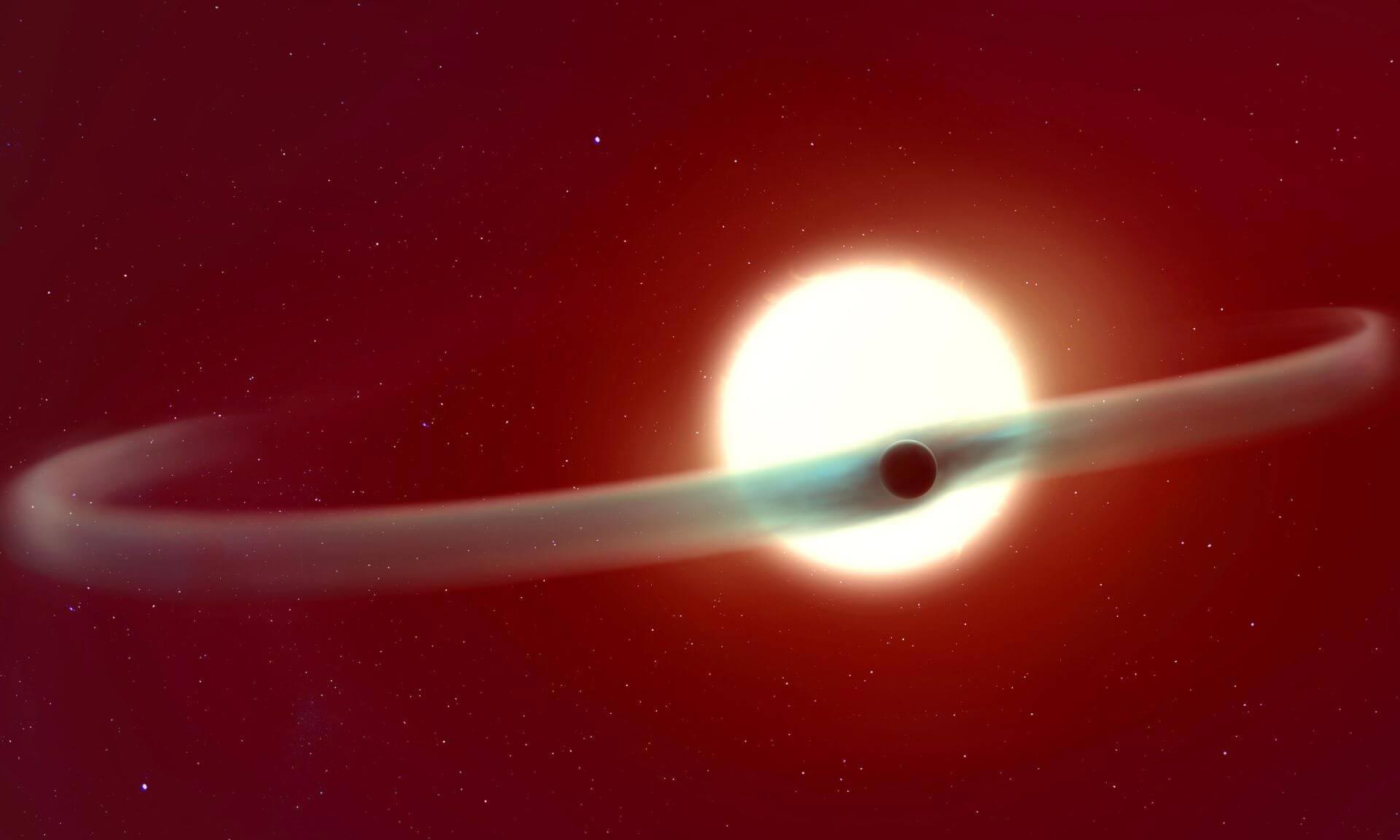
A sizzling exoplanet caught by the James Webb Space Telescope is shedding its atmosphere and leaving behind two gigantic helium tails.
Astronomers from the University of Geneva (UNIGE), the National Centre of Competence in Research PlanetS, and the Trottier Institute for Research on Exoplanets (IREx) at the University of Montreal (UdeM) have made an unprecedented discovery with the James Webb Space Telescope (JWST). For the first time, scientists were able to observe gas escaping from an exoplanet’s atmosphere continuously over an entire orbit around its star.
The observations revealed a striking and unexpected sight. The gas giant WASP-121b is surrounded by two enormous streams of helium that stretch across more than half of its orbit. When combined with detailed numerical models developed at UNIGE, the data provide the most complete picture ever assembled of atmospheric escape, a process that can dramatically reshape a planet over time. The findings are published in Nature Communications.
An Ultra Hot Jupiter Under Extreme Stellar Heat
WASP-121b belongs to a group of planets known as ultra-hot Jupiters. These massive gas giants orbit extremely close to their stars, and WASP-121b completes one full orbit in just 30 hours. Its nearby star bombards the planet with intense radiation, heating the atmosphere to several thousand degrees.
At these temperatures, lighter elements such as hydrogen and helium can escape the planet’s gravitational pull and drift into space. Over millions of years, this steady loss of gas can significantly alter the planet’s size, chemical makeup, and long-term development.
Why Previous Observations Fell Short
Before this study, scientists could only capture short snapshots of atmospheric escape during planetary transits – the brief periods when a planet passes directly in front of its star. These limited observations lasted only a few hours and offered an incomplete view of how atmospheric flows behave.
Without continuous coverage, researchers could not determine how far the escaping gases extended or how their structure changed throughout the planet’s orbit.
A Full Orbit Observed With NIRISS
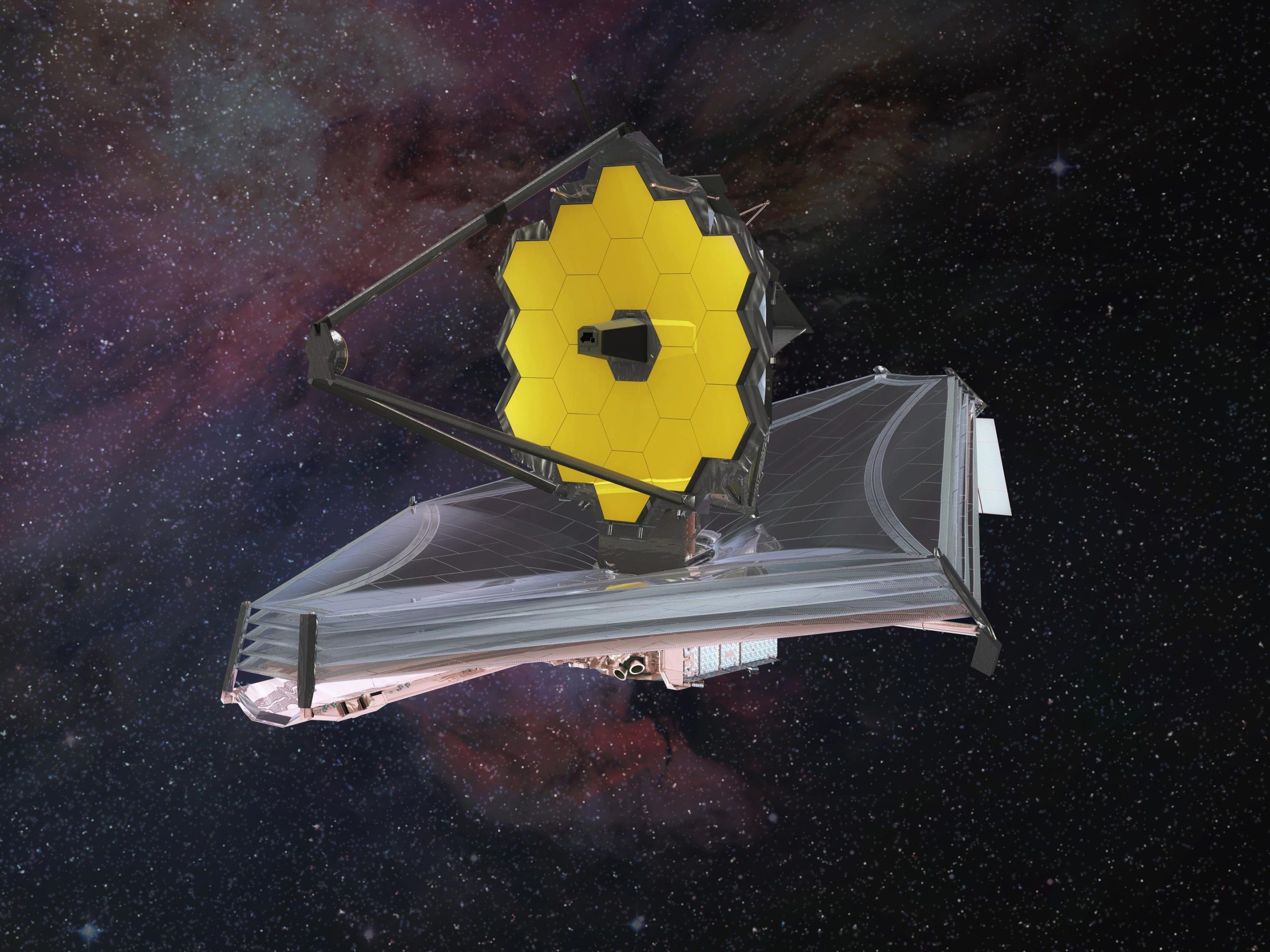
To overcome this limitation, astronomers used the Near-Infrared Spectrograph (NIRISS) aboard the James Webb Space Telescope to observe WASP-121b for nearly 37 uninterrupted hours. This observation covered more than one complete orbit, making it the most extensive continuous study of helium ever conducted on a planet.
The prolonged monitoring allowed scientists to track atmospheric escape in unprecedented detail.
Two Enormous Helium Tails Revealed
By measuring how helium absorbs infrared light, the team discovered that gas surrounding WASP-121b extends far beyond the planet itself. The helium signal remains detectable for more than half of the planet’s orbit, representing the longest continuous detection of atmospheric escape ever recorded.
Even more surprising, the helium forms two separate tails. One trails behind the planet, pushed backward by radiation and stellar winds. The other curves ahead of the planet, likely drawn forward by the star’s gravitational pull. Together, these flowing structures span a distance exceeding 100 times the planet’s diameter, or more than three times the distance between the planet and its star.
“We were incredibly surprised to see how long the helium escape lasted,” explains Romain Allart, a postdoctoral researcher at the University of Montreal, former doctoral student at the University of Geneva, and lead author of the paper. “This discovery reveals the complexity of the physical processes that sculpt exoplanetary atmospheres and their interaction with their stellar environment. We are only beginning to discover the true complexity of these worlds.”
Limits of Current Atmospheric Models
The Department of Astronomy at the University of Geneva (UNIGE) has long played a leading role in atmospheric escape research. Numerical models developed there were essential for interpreting the first helium observations made with the JWST.
While these models can successfully describe simple, comet-like gas tails, they struggle to recreate the double-tailed structure seen around WASP-121b. “This discovery indicates that the structure of these flows results from both gravity and stellar winds, making a new generation of 3D simulations essential for analyzing their physics,” explains Yann Carteret, a doctoral student in the Department of Astronomy at the Faculty of Science of UNIGE and co-author of the study.
What This Means for Future Exoplanet Studies
Helium has emerged as one of the most powerful tools for tracking atmospheric escape, and the JWST’s sensitivity now allows scientists to detect it over greater distances and longer time periods than ever before. Upcoming observations will help determine whether the double-tailed structure seen around WASP-121b is unusual or common among hot exoplanets.
Researchers will also need to refine existing theories to better explain how gravity, radiation, and stellar winds work together to shape escaping atmospheres.
“Very often, new observations reveal the limitations of our numerical models and push us to explore new physical mechanisms to further our understanding of these distant worlds,” concludes Vincent Bourrier, lecturer and researcher in the Department of Astronomy at the Faculty of Science of the University of Geneva and co-author of the study.
Reference: “A complex structure of escaping helium spanning more than half the orbit of the ultra-hot Jupiter WASP-121 b” by Romain Allart, Louis-Philippe Coulombe, Yann Carteret, Jared Splinter, Lisa Dang, Vincent Bourrier, David Lafrenière, Loïc Albert, Étienne Artigau, Björn Benneke, Nicolas B. Cowan, René Doyon, Vigneshwaran Krishnamurthy, Ray Jayawardhana, Doug Johnstone, Adam B. Langeveld, Michael R. Meyer, Stefan Pelletier, Caroline Piaulet-Ghorayeb, Michael Radica, Jake Taylor and Jake D. Turner, 8 December 2025, Nature Communications.
DOI: 10.1038/s41467-025-66628-5
Never miss a breakthrough: Join the SciTechDaily newsletter.
Follow us on Google and Google News.