
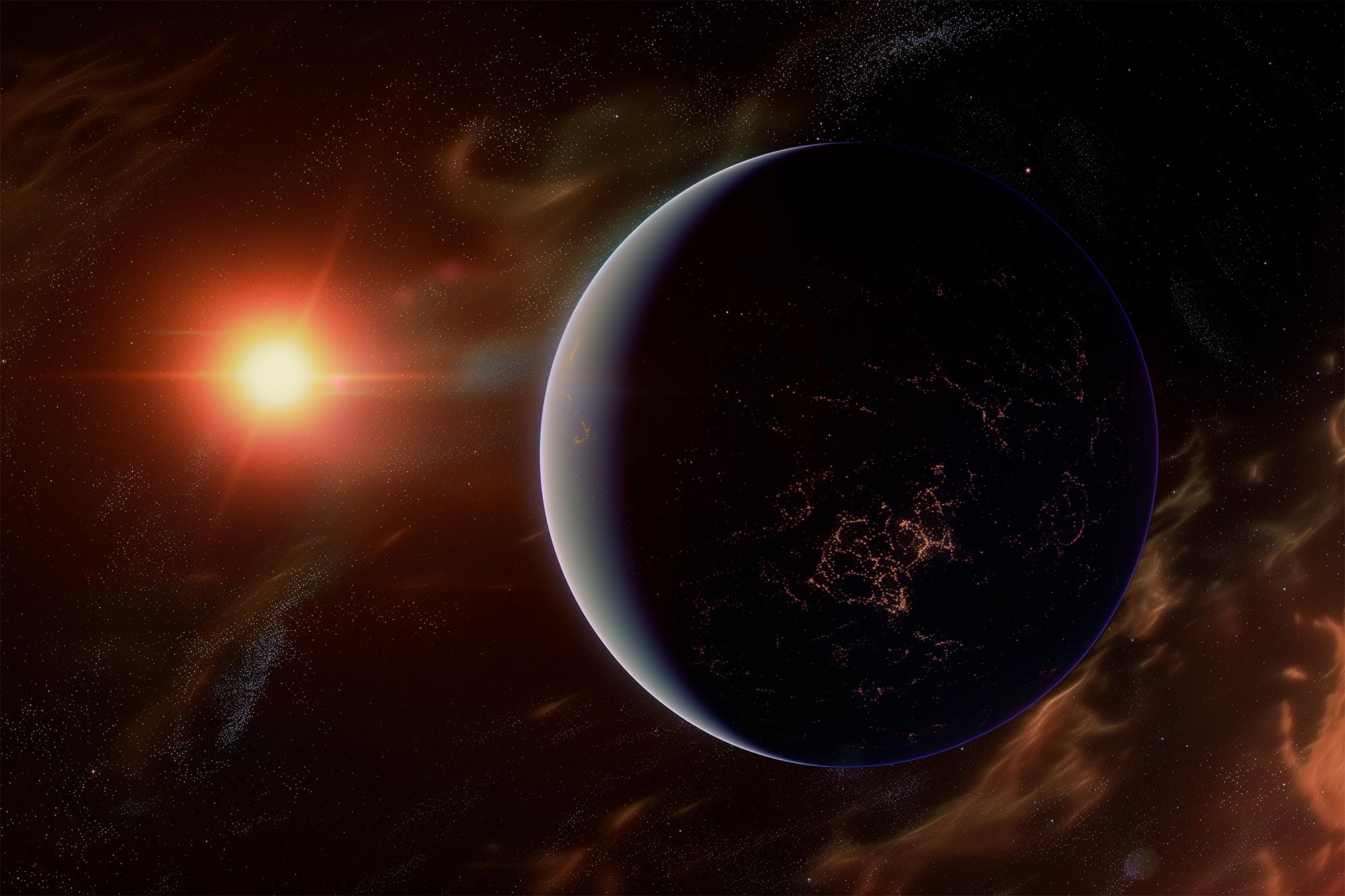
A newly discovered super-Earth, HD 20794 d, lies in a nearby planetary system and orbits within its star’s habitable zone. Its unusual elliptical orbit could impact its potential for life, making it a fascinating subject for future research.
Three decades after the first exoplanet was identified, scientists have detected more than 7,000 such planets in our galaxy—yet billions more remain undiscovered. While the initial focus was on detection, researchers are now shifting their attention to studying exoplanets’ characteristics to assess their potential for hosting life.
This latest discovery, HD 20794 d, stands out due to its highly elliptical orbit, which causes it to move in and out of its star’s habitable zone. Such an orbit presents a unique opportunity to study how planetary conditions fluctuate and whether life-sustaining environments can emerge under these dynamic conditions.
The discovery is the result of 20 years of observations using some of the world’s most advanced telescopes. The findings have been published in Astronomy & Astrophysics, marking an important step forward in understanding planetary habitability.
The Search for Life Beyond Earth
“Are we alone in the Universe?” For thousands of years, the question of whether we are alone in the universe remained purely philosophical. Only recently has modern science begun to offer concrete hypotheses and evidence to address it. Progress has been steady but slow, with each new discovery — whether theoretical or observational — expanding the boundaries of our understanding.
A major breakthrough came in 1995 when astronomers Michel Mayor and Didier Queloz discovered the first planet orbiting a star beyond our Sun. Their pioneering work, conducted at the University of Geneva (UNIGE), earned them the 2019 Nobel Prize in Physics.
Its luminosity and proximity make HD 20794 d an ideal candidate for future telescopes for observing the atmosphere of exoplanets.
Nearly thirty years later, the field has advanced significantly. Astronomers have now identified more than 7,000 exoplanets, and the prevailing scientific view suggests that nearly every star in our galaxy hosts its own planetary system. The focus has now shifted to studying planets that are easier to characterize or that possess features relevant to habitability. One such planet is HD 20794 d, a newly detected super-Earth, discovered by a team that includes researchers from UNIGE’s Astronomy Department.
This video shows the habitable zone around the star HD 20794 (in green) and the trajectory of the three planets in the system. Credit: Gabriel Pérez Díaz, SMM (IAC)
A Promising Super-Earth Nearby
This promising planet is a super-Earth, a telluric planet larger than the Earth. It is part of a planetary system containing two other planets. It orbits a G-type star, like the Sun, at a distance of just 19.7 light-years, which is, on the scale of the Universe, in the very close neighborhood of the Earth. This “closeness” makes it easier to study, as its light signals are more visible and stronger.
“HD 20794, around which HD 20794 d orbits, is not an ordinary star,” explains Xavier Dumusque, Senior Lecturer and researcher in the Department of Astronomy at the UNIGE and co-author of the study. “Its luminosity and proximity makes it an ideal candidate for future telescopes whose mission will be to observe the atmospheres of exoplanets directly.”
The interest in planet HD 20794 d lies in its position in the habitable zone of its star, the zone that delimits the place where liquid water can exist, one of the conditions necessary for the development of life as we know it. This zone depends on several factors, mainly the stellar properties. For stars such as the Sun or HD 20794, it can extend from 0.7 to 1.5 astronomical units (AU), encompassing not only the orbit of the Earth but also that of Mars in the case of the Sun. The exoplanet HD 20794 d takes 647 days to orbit its star, around forty days less than Mars.
An Unusual Elliptical Orbit
Instead of following a relatively circular orbit, like the Earth or Mars, HD 20794 d follows an elliptical trajectory with large changes in the distance to its star during its revolution. The planet thus oscillates between the inner edge of its star HZ (0.75 AU) and outside of it (2 AU) along its orbit. This configuration is of particular interest to astronomers because it allows them to adjust theoretical models and test their understanding of the notion of a planet’s habitability. If there is water on HD 20794 d, it would pass from the state of ice to the liquid state, conducive to the appearance of life, during the planet’s revolution around the star.
Detecting this super-Earth was not easy and the process was iterative. The team analyzed more than twenty years of data from state-of-the-art instruments such as ESPRESSO and HARPS. For the latter, the scientists were able to rely on YARARA, a data reduction algorithm recently developed at the UNIGE. For years, planetary signals had been obscured by noise, making it difficult to discern whether planets actually existed. “We analyzed the data for years, carefully eliminating sources of contamination,” explains Michael Cretignier, a post-doctoral researcher at Oxford University, co-author of the study and developer of YARARA during his PhD at UNIGE.
A New Frontier in the Search for Life
The discovery of HD 20794 d provides scientists with an interesting laboratory for modeling and testing new hypotheses in their search for life in the Universe. The proximity of this planetary system to its bright star also makes it a prime target for next-generation instruments such as the ANDES spectrograph for ESO’s Extremely Large Telescope (ELT). Knowing whether this planet harbors life will still require a number of scientific milestones and a transdisciplinary approach. The conditions for its habitability are already being studied by the new Centre for Life in the Universe (CVU) at the UNIGE’s Faculty of Science.
Explore Further:
Reference: “Revisiting the multi-planetary system of the nearby star HD 20794 – Confirmation of a low-mass planet in the habitable zone of a nearby G-dwarf” by N. Nari, X. Dumusque, N. C. Hara, A. Suárez Mascareño, M. Cretignier, J. I. González Hernández, A. K. Stefanov, V. M. Passegger, R. Rebolo, F. Pepe, N. C. Santos, S. Cristiani, J. P. Faria, P. Figueira, A. Sozzetti, M. R. Zapatero Osorio, V. Adibekyan, Y. Alibert, C. Allende Prieto, F. Bouchy, S. Benatti, A. Castro-González, V. D’Odorico, M. Damasso, J. B. Delisle, P. Di Marcantonio, D. Ehrenreich, R. Génova-Santos, M. J. Hobson, B. Lavie, J. Lillo-Box, G. Lo Curto, C. Lovis, C. J. A. P. Martins, A. Mehner, G. Micela, P. Molaro, C. Mordasini, N. Nunes, E. Palle, S.P. Quanz, D. Ségransan, A. M. Silva, S. G. Sousa, S. Udry, N. Unger and J. Venturini, 28 January 2025, Astronomy & Astrophysics.
DOI: 10.1051/0004-6361/202451769
Never miss a breakthrough: Join the SciTechDaily newsletter.
Follow us on Google and Google News.